• BellyFlush is a natural digestive health supplement designed to support a cleaner gut, reduced bloating, and smoother digestion. It works by helping flush out built-up waste and toxins that can cause discomfort, gas, and a heavy feeling in the belly. Made with gentle, plant-based ingredients, BellyFlush promotes regular bowel movements without harsh laxatives or cramping. Many users report feeling lighter, more energized, and more comfortable with consistent use. By supporting a balanced gut microbiome and better nutrient absorption, BellyFlush helps improve overall digestive wellness. Manufactured in FDA-registered, GMP-certified facilities, BellyFlush offers a safe, natural solution for anyone seeking better digestion, less bloating, and long-term gut health support. https://belly--flush.com
    BellyFlush is a natural digestive health supplement designed to support a cleaner gut, reduced bloating, and smoother digestion. It works by helping flush out built-up waste and toxins that can cause discomfort, gas, and a heavy feeling in the belly. Made with gentle, plant-based ingredients, BellyFlush promotes regular bowel movements without harsh laxatives or cramping. Many users report feeling lighter, more energized, and more comfortable with consistent use. By supporting a balanced gut microbiome and better nutrient absorption, BellyFlush helps improve overall digestive wellness. Manufactured in FDA-registered, GMP-certified facilities, BellyFlush offers a safe, natural solution for anyone seeking better digestion, less bloating, and long-term gut health support. https://belly--flush.com
    BellyFlush™ Official Website | Gentle Colon Cleanse
    BellyFlush™ is an effective colon cleanse that helps clear waste, ease gas, and support healthy digestion using gentle, natural ingredients your gut will love.
    0 Σχόλια 0 Μοιράστηκε 263 Views
  • Looking for a London City Airport to Heathrow Transfer?

    Need a fast, reliable, and stress-free way to travel from London City Airport to Heathrow? Want to avoid the hassle of public transport, heavy luggage, or last-minute delays? Britway Airport Transfer offers a smooth, comfortable, and professional transfer service that makes your journey simple and convenient.

    Why struggle with trains, buses, or multiple connections when you can enjoy a direct door-to-door transfer ? Looking for a ride that’s on time, comfortable, and tailored to your schedule ? Wouldn’t it be great to relax in a clean, modern vehicle while an experienced driver navigates traffic for you?

    Worried about flight delays or hidden charges? With Britway, your transfer comes with real-time flight monitoring, transparent pricing , and professional, licensed drivers , so you can travel stress-free. Traveling alone, with family, or for business ? We offer a range of vehicles to suit your luggage and comfort needs.

    So, why not make your London City Airport to Heathrow transfer seamless and enjoyable? Ready to book your ride and travel with peace of mind today ?

    Email: bookings@britwayairporttransfer.co.uk
    Phone: +44-203 627 2111
    Website: https://britwayairporttransfer.co.uk/

    #LondonCityToHeathrow, #AirportTransferLondon, #HeathrowTaxi, #LondonCityAirportTaxi, #PrivateAirportTransfer, #LuxuryAirportTransfer, #ReliableAirportTaxi, #UKAirportTransfer, #StressFreeTravel, #BritwayAirportTransfer, #DoorToDoorTaxi, #ExecutiveAirportTaxi

    Looking for a London City Airport to Heathrow Transfer? 🚖✈️ Need a fast, reliable, and stress-free way to travel from London City Airport to Heathrow? Want to avoid the hassle of public transport, heavy luggage, or last-minute delays? Britway Airport Transfer offers a smooth, comfortable, and professional transfer service that makes your journey simple and convenient. Why struggle with trains, buses, or multiple connections when you can enjoy a direct door-to-door transfer 🚘? Looking for a ride that’s on time, comfortable, and tailored to your schedule ⏱️? Wouldn’t it be great to relax in a clean, modern vehicle while an experienced driver navigates traffic for you? Worried about flight delays or hidden charges? With Britway, your transfer comes with real-time flight monitoring, transparent pricing 💷, and professional, licensed drivers 👔, so you can travel stress-free. Traveling alone, with family, or for business 👨‍👩‍👧‍👦💼? We offer a range of vehicles to suit your luggage and comfort needs. So, why not make your London City Airport to Heathrow transfer seamless and enjoyable? Ready to book your ride and travel with peace of mind today 🌟? 📧 Email: bookings@britwayairporttransfer.co.uk 📞 Phone: +44-203 627 2111 🌐 Website: https://britwayairporttransfer.co.uk/ #LondonCityToHeathrow, #AirportTransferLondon, #HeathrowTaxi, #LondonCityAirportTaxi, #PrivateAirportTransfer, #LuxuryAirportTransfer, #ReliableAirportTaxi, #UKAirportTransfer, #StressFreeTravel, #BritwayAirportTransfer, #DoorToDoorTaxi, #ExecutiveAirportTaxi
    0 Σχόλια 0 Μοιράστηκε 782 Views
  • Buy Forklifts + Training Package: Save 30%
    #forklift #training #Singapore #storage #racking #Sime #UMW

    By opting for a certified forklift training package with a new equipment purchase deal, businesses are not just buying a machine—they are investing in a complete, operational solution.

    When you pursue the best forklift Singapore bundle with mandatory training included in 2026, you are purchasing predictability.

    For businesses evaluating a heavy-duty storage racking bundled with forklift purchase and training, ensuring the forklift has the appropriate lift height and capacity is paramount.

    Find out More >> https://linkly.link/2TapY
    Buy Forklifts + Training Package: Save 30% #forklift #training #Singapore #storage #racking #Sime #UMW By opting for a certified forklift training package with a new equipment purchase deal, businesses are not just buying a machine—they are investing in a complete, operational solution. When you pursue the best forklift Singapore bundle with mandatory training included in 2026, you are purchasing predictability. For businesses evaluating a heavy-duty storage racking bundled with forklift purchase and training, ensuring the forklift has the appropriate lift height and capacity is paramount. Find out More >> https://linkly.link/2TapY
    LINKLY.LINK
    『Buy Forklifts + Training Package: Save 30%』
    Maximize Your Warehouse Investment: The Smart Bundle StrategyFor warehouse and …
    0 Σχόλια 0 Μοιράστηκε 922 Views
  • Is One Day Really Enough to Explore Agra from Delhi?

    Wondering if one day is enough to visit Agra from Delhi? It’s possible, but thoughtful planning makes all the difference.

    • Start early: Leave Delhi before dawn to maximise your time and avoid heavy traffic.


    • Prioritise key sights: Focus on must-see locations like the Taj Mahal and the Agra Fort so your day feels full but not rushed.


    • Use efficient transport: Hiring a comfortable vehicle helps you move quickly and relax between stops.


    • Keep the schedule tight: Have your route and timings locked so you don’t waste time deciding on the go.


    • Plan your return: Aim for a late-afternoon or early-evening start back to Delhi to avoid night driving stress.


    With proper planning, a timely departure and comfortable travel arrangements, you can enjoy the entire Agra experience in a single day without feeling rushed Innovacrysta for outstation trip from Delhi to Agra.

    Read more- https://indiatourtaxi.wixsite.com/taxiservicesdelhi/post/is-1-day-enough-for-agra

    #delhitagra #1daytrip #samewaytrip #roadtripindia #grouptravel #familytravel #daytour #travelguide #quickjourney #comfortabletravel
    Is One Day Really Enough to Explore Agra from Delhi? Wondering if one day is enough to visit Agra from Delhi? It’s possible, but thoughtful planning makes all the difference. • Start early: Leave Delhi before dawn to maximise your time and avoid heavy traffic. • Prioritise key sights: Focus on must-see locations like the Taj Mahal and the Agra Fort so your day feels full but not rushed. • Use efficient transport: Hiring a comfortable vehicle helps you move quickly and relax between stops. • Keep the schedule tight: Have your route and timings locked so you don’t waste time deciding on the go. • Plan your return: Aim for a late-afternoon or early-evening start back to Delhi to avoid night driving stress. With proper planning, a timely departure and comfortable travel arrangements, you can enjoy the entire Agra experience in a single day without feeling rushed Innovacrysta for outstation trip from Delhi to Agra. Read more- https://indiatourtaxi.wixsite.com/taxiservicesdelhi/post/is-1-day-enough-for-agra #delhitagra #1daytrip #samewaytrip #roadtripindia #grouptravel #familytravel #daytour #travelguide #quickjourney #comfortabletravel
    INDIATOURTAXI.WIXSITE.COM
    Is 1 Day Enough for Agra?
    Imagine waking up in Delhi and watching the sun set behind the Taj Mahal — all in one day. Sounds ambitious? Maybe. But is it possible? Absolutely. A one day trip to Agra from Delhi is not just doable, but in fact is one of the most exciting short escapes you can take from the capital city. Thanks to the Yamuna Expressway, the Delhi to Agra distance is now just 245 km and the journey takes roughly 3 to 3.5 hours by car. So even if you’re a local or a traveller short on time, this route makes it
    0 Σχόλια 0 Μοιράστηκε 3431 Views
  • When is Khardung La Pass open?

    The Khardung La Pass is normally open throughout the year, but can be closed during the times of harsh winters. The months of May to October are considered the safest and most scenic conditions for bike tours. Summers from May to June are the best time to ride with mild temperatures as well as clear roads, making it perfect for adventure and photography.

    Monsoon times from July to August may bring occasional landslides, so bikers should exercise caution, but the pass remains mostly accessible.

    Autumn, from September to October is ideal for fewer crowds with crisp air and golden landscapes. By the time of November to January, there can be heavy snowfall and icy roads, because of which the pass can be closed. For any rider, May to October is the best time to visit Khardung La Pass.

    A Khardung La bike tour is more than a journey it’s an achievement, an adventure, and a memory that lasts a lifetime. You will experience climbs of unimaginable steepness, snow-covered landscapes and culture with every aspect of the ride unique to other two wheeled experiences.

    https://www.brahmandtour.com/blog_detail/60/complete-guide-to-khardung-la-for-bike-tours

    #khardungla #passesinladakh #khardunglapass #brahmandtour #motorcycletourinindia #motorbiketours #explorewithbrahmand #khardunglabiketour
    When is Khardung La Pass open? The Khardung La Pass is normally open throughout the year, but can be closed during the times of harsh winters. The months of May to October are considered the safest and most scenic conditions for bike tours. Summers from May to June are the best time to ride with mild temperatures as well as clear roads, making it perfect for adventure and photography. Monsoon times from July to August may bring occasional landslides, so bikers should exercise caution, but the pass remains mostly accessible. Autumn, from September to October is ideal for fewer crowds with crisp air and golden landscapes. By the time of November to January, there can be heavy snowfall and icy roads, because of which the pass can be closed. For any rider, May to October is the best time to visit Khardung La Pass. A Khardung La bike tour is more than a journey it’s an achievement, an adventure, and a memory that lasts a lifetime. You will experience climbs of unimaginable steepness, snow-covered landscapes and culture with every aspect of the ride unique to other two wheeled experiences. https://www.brahmandtour.com/blog_detail/60/complete-guide-to-khardung-la-for-bike-tours #khardungla #passesinladakh #khardunglapass #brahmandtour #motorcycletourinindia #motorbiketours #explorewithbrahmand #khardunglabiketour
    WWW.BRAHMANDTOUR.COM
    Complete Guide to Khardung La for Bike Tours
    Explore the ultimate bike trip to Khardung La. Discover routes, permits, altitude tips, and best time to visit for an unforgettable Ladakh motorcycle adventure
    0 Σχόλια 0 Μοιράστηκε 3041 Views
  • Can Rexroth pumps be used in mobile machinery?
    Absolutely. Rexroth hydraulic pumps are widely used in mobile machinery such as excavators, loaders, cranes, and agricultural equipment. Their robust design, high efficiency, and responsive control make them ideal for machines that operate under continuous load and varying conditions. Features like variable displacement and load-sensing technology ensure precise hydraulic performance while reducing fuel consumption and wear. Simply put, Rexroth pumps provide reliable power and long-term durability, making them a trusted choice for mobile applications.
    Rexroth pumps are used in countless industries. Some of the most common applications include:
    •Construction machines– Loaders, cranes, excavators, pumps, and drilling machines rely totally on piston pumps for lifting and heavy movement.
    • Industrial Machinery – Injection molding, metal forming, and presses often depend on Rexroth pumps for better hydraulic force and performance.
    • Marine and Offshore Systems - this category includes ship steering systems, winches and offshore oil drilling rigs where reliability is critical.
    • Energy and Renewable Power – this power is used in and is seen in wind turbines, hydroelectric systems, and oil and gas systems.
    • Agricultural Machinery – hydraulic pumps are used in tractors, harvesters, and other agricultural equipment because of their reliability.
    Their adaptability makes them a preferred choice in both mobile hydraulics machines that move and stationary hydraulics (industrial setups). For any kind of maintenance, repair or OEM parts replacement, visit Reliable Rexroth hydraulic pump service
    visit- https://excellenthydraulic.wixsite.com/excellenthydraulic/post/rexroth-hydraulic-pumps-features-and-applications
    #rexrothhydraulicpump #hydraulicpumprepair #rexrothpumpservice
    #pumpmaintenance #rexrothpumprepair #excellenthydraulicworks #hydraulicpumrepair
    Can Rexroth pumps be used in mobile machinery? Absolutely. Rexroth hydraulic pumps are widely used in mobile machinery such as excavators, loaders, cranes, and agricultural equipment. Their robust design, high efficiency, and responsive control make them ideal for machines that operate under continuous load and varying conditions. Features like variable displacement and load-sensing technology ensure precise hydraulic performance while reducing fuel consumption and wear. Simply put, Rexroth pumps provide reliable power and long-term durability, making them a trusted choice for mobile applications. Rexroth pumps are used in countless industries. Some of the most common applications include: •Construction machines– Loaders, cranes, excavators, pumps, and drilling machines rely totally on piston pumps for lifting and heavy movement. • Industrial Machinery – Injection molding, metal forming, and presses often depend on Rexroth pumps for better hydraulic force and performance. • Marine and Offshore Systems - this category includes ship steering systems, winches and offshore oil drilling rigs where reliability is critical. • Energy and Renewable Power – this power is used in and is seen in wind turbines, hydroelectric systems, and oil and gas systems. • Agricultural Machinery – hydraulic pumps are used in tractors, harvesters, and other agricultural equipment because of their reliability. Their adaptability makes them a preferred choice in both mobile hydraulics machines that move and stationary hydraulics (industrial setups). For any kind of maintenance, repair or OEM parts replacement, visit Reliable Rexroth hydraulic pump service visit- https://excellenthydraulic.wixsite.com/excellenthydraulic/post/rexroth-hydraulic-pumps-features-and-applications #rexrothhydraulicpump #hydraulicpumprepair #rexrothpumpservice #pumpmaintenance #rexrothpumprepair #excellenthydraulicworks #hydraulicpumrepair
    0 Σχόλια 0 Μοιράστηκε 6990 Views
  • What is the Role of Hydraulic Pumps in Excavators, Loaders, and Bulldozers?


    Hydraulic pumps are central to the operation of heavy machinery such as excavators, loaders, and bulldozers. They generally serve as a primary power source that transforms mechanical energy into hydraulic pressure to move several components of machinery.

    Excavators use hydraulic pumps to control the boom, arm, and bucket during digging, lifting, and rotating, allowing for seamless and efficient operation. Loaders depend on hydraulic pumps for lifting and tilting the bucket, while also controlling steering which enables efficient material movement. Finally, bulldozers primarily utilize hydraulic pumps that allow the blade to lift, tilt, and push large.

    If the hydraulic pump is not working, there will be no power, no speed, or no accuracy with the excavator, loader, or bulldozer. Your machine will need a routine maintenance schedule or repairs to make sure that hydraulic pump is working normally. The hydraulic pump can be seen very easily as the heart of every excavator, loader, and bulldozer and a basic functional and performance component for machines that work on a job site.

    visit- https://www.123articleonline.com/articles/1489736/role-of-hydraulic-pumps-in-excavators-loaders-and-bulldozers

    #hydraulicpumprepair #constructionequipment #hydraulicmaintenance #industrialmaintenance #heavymachinery #pumpprepairservices #hydraulicsystems #constructionmachinery #preventivemaintenance #hydraulicservice #equipmentrepair #machinerymaintenance
    What is the Role of Hydraulic Pumps in Excavators, Loaders, and Bulldozers? Hydraulic pumps are central to the operation of heavy machinery such as excavators, loaders, and bulldozers. They generally serve as a primary power source that transforms mechanical energy into hydraulic pressure to move several components of machinery. Excavators use hydraulic pumps to control the boom, arm, and bucket during digging, lifting, and rotating, allowing for seamless and efficient operation. Loaders depend on hydraulic pumps for lifting and tilting the bucket, while also controlling steering which enables efficient material movement. Finally, bulldozers primarily utilize hydraulic pumps that allow the blade to lift, tilt, and push large. If the hydraulic pump is not working, there will be no power, no speed, or no accuracy with the excavator, loader, or bulldozer. Your machine will need a routine maintenance schedule or repairs to make sure that hydraulic pump is working normally. The hydraulic pump can be seen very easily as the heart of every excavator, loader, and bulldozer and a basic functional and performance component for machines that work on a job site. visit- https://www.123articleonline.com/articles/1489736/role-of-hydraulic-pumps-in-excavators-loaders-and-bulldozers #hydraulicpumprepair #constructionequipment #hydraulicmaintenance #industrialmaintenance #heavymachinery #pumpprepairservices #hydraulicsystems #constructionmachinery #preventivemaintenance #hydraulicservice #equipmentrepair #machinerymaintenance
    0 Σχόλια 0 Μοιράστηκε 6877 Views
  • Top 7 Common Excavator Hydraulic Pump Problems and How to Fix Them

    Excavators are built for heavy-duty work, and at the heart of their performance lies the hydraulic pump. When this pump starts to fail, even a minor issue can slow down operations or cause complete machine downtime. Operators who understand the usual problems can often spot trouble early and avoid expensive repairs.

    Here are seven common issues you’ll come across:

    1. Low Pressure – Usually linked to leakage inside the pump or seals that have worn out.

    2. Overheating – A filter that is dirty or the incorrect type of oil are often reasons the pump is running hotter than normal.

    3. Strange Noises – Air bubbles, cavitation, or parts that have come out of alignment can cause whining, rattling, or vibrations.

    4. Sluggish Response – When the machine feels sluggish, it may be due to low oil or a blocked hydraulic line.

    5. Oil Leaks – Typically, a crack in a hose, a weak fitting, or bad seal, account for leaking oil.

    6. Worn Parts – Running on old oil or contaminated oil can cause the wear on pump parts to happen faster.

    7. Sudden Failure – If the machine is neglected for too long, it could totally fail and simply stop working.

    CHECK IT OUT- https://excellenthydraulic.wixsite.com/excellenthydraulic/post/what-are-the-common-problems-in-excavator-hydraulic-pump

    Regular servicing, clean oil, and timely inspections are the best way to ensure that an excavator hydraulic pump is taken care of and works properly.

    #excavatorhydraulicpump #hydraulicpumprepair #excavatorrepair #heavyequipmentrepair #constructionequipment #excellenthydraulicworks

    Top 7 Common Excavator Hydraulic Pump Problems and How to Fix Them Excavators are built for heavy-duty work, and at the heart of their performance lies the hydraulic pump. When this pump starts to fail, even a minor issue can slow down operations or cause complete machine downtime. Operators who understand the usual problems can often spot trouble early and avoid expensive repairs. Here are seven common issues you’ll come across: 1. Low Pressure – Usually linked to leakage inside the pump or seals that have worn out. 2. Overheating – A filter that is dirty or the incorrect type of oil are often reasons the pump is running hotter than normal. 3. Strange Noises – Air bubbles, cavitation, or parts that have come out of alignment can cause whining, rattling, or vibrations. 4. Sluggish Response – When the machine feels sluggish, it may be due to low oil or a blocked hydraulic line. 5. Oil Leaks – Typically, a crack in a hose, a weak fitting, or bad seal, account for leaking oil. 6. Worn Parts – Running on old oil or contaminated oil can cause the wear on pump parts to happen faster. 7. Sudden Failure – If the machine is neglected for too long, it could totally fail and simply stop working. CHECK IT OUT- https://excellenthydraulic.wixsite.com/excellenthydraulic/post/what-are-the-common-problems-in-excavator-hydraulic-pump Regular servicing, clean oil, and timely inspections are the best way to ensure that an excavator hydraulic pump is taken care of and works properly. #excavatorhydraulicpump #hydraulicpumprepair #excavatorrepair #heavyequipmentrepair #constructionequipment #excellenthydraulicworks
    0 Σχόλια 0 Μοιράστηκε 7619 Views
  • Why is My Hydraulic Pump Not Building Pressure?

    When a hydraulic pump fails to build pressure, it can stop heavy equipment and machines from working properly. This issue often appears in construction, industrial, and farm machinery and usually needs quick attention.

    Here’s a detailed checklist of the things you should check before hydraulic pump repair when it is not creating pressure:

    1. Hydraulic oil level and fluid condition
    2. Air trapped in the system (cavitation or aeration)
    3. Worn or damaged seals, pistons, or gears
    4. Blocked filters or restricted lines
    5. Incorrectly set or stuck relief valve

    Ignoring these signs can lead to costly downtime. If the problem continues after basic checks, getting the pump repaired by an expert is the safest option.

    We provide professional hydraulic pump repair in Delhi NCR, including Danfoss, Rexroth, and Sauer pumps. Our team ensures complete troubleshooting, rebuilding, and testing for reliable performance.

    check it out- https://protocol.ooo/en/articles/things-to-check-when-a-hydraulic-pump-is-not-creating-pressure

    #hydraulicpumprepair #hydraulicmotorrepair #hydraulicpumpmaintenance #oemhydraulicparts #hydraulicpumptechnician #excellenthydraulicworks #hydraulicrepairnearby #hydraulicpumpcare
    Why is My Hydraulic Pump Not Building Pressure? When a hydraulic pump fails to build pressure, it can stop heavy equipment and machines from working properly. This issue often appears in construction, industrial, and farm machinery and usually needs quick attention. Here’s a detailed checklist of the things you should check before hydraulic pump repair when it is not creating pressure: 1. Hydraulic oil level and fluid condition 2. Air trapped in the system (cavitation or aeration) 3. Worn or damaged seals, pistons, or gears 4. Blocked filters or restricted lines 5. Incorrectly set or stuck relief valve Ignoring these signs can lead to costly downtime. If the problem continues after basic checks, getting the pump repaired by an expert is the safest option. We provide professional hydraulic pump repair in Delhi NCR, including Danfoss, Rexroth, and Sauer pumps. Our team ensures complete troubleshooting, rebuilding, and testing for reliable performance. check it out- https://protocol.ooo/en/articles/things-to-check-when-a-hydraulic-pump-is-not-creating-pressure #hydraulicpumprepair #hydraulicmotorrepair #hydraulicpumpmaintenance #oemhydraulicparts #hydraulicpumptechnician #excellenthydraulicworks #hydraulicrepairnearby #hydraulicpumpcare
    PROTOCOL.OOO
    Things to Check When a Hydraulic Pump is not Creating Pressure? - PROTOCOL
    Anyone who has spent time around hydraulic machines knows the feeling when you hit the switch, everything seems norm...
    0 Σχόλια 0 Μοιράστηκε 8570 Views
  • What are the issues that occur in Hydraulic Cylinders & Pump?

    Hydraulic machines do the heavy lifting in almost every industry- construction sites, farms, and even factories. At the centre of it all are two parts: the pump and the cylinder. If either one fails, the whole system starts giving trouble. You will notice slow movement, higher fuel use, and downtime that no operator wants.

    Most problems do not occur instantly, they give early signs. If you catch them in time, you can save money and avoid a complete breakdown.

    1. Oil Leakage
    2. Contaminated Hydraulic Fluid
    3. Overheating
    4. Seal & Bearing Wear
    5. Air in the System (Aeration/Cavitation)
    6. Misalignment / Overloading
    7. Improper Maintenance

    In short: leakage, contamination, overheating, air entrapment, wear & misalignment are the biggest common problems in hydraulic cylinders and pumps.

    Here, find troubleshooting guides for hydraulic cylinder pump and why they happen, and what operators can do before calling for a major repair.

    check it out- https://excellenthydraulicwork.weebly.com/blog/troubleshooting-hydraulic-cylinders-pumps

    #constructioncylinderrepair #hydrauliccylinder #cylindermaintenance #heavyequipment #hydraulicrepair #cylinderservice #hydraulicmaintenance #excellenthydraulicworks #hydraulicpumprepair

    What are the issues that occur in Hydraulic Cylinders & Pump? Hydraulic machines do the heavy lifting in almost every industry- construction sites, farms, and even factories. At the centre of it all are two parts: the pump and the cylinder. If either one fails, the whole system starts giving trouble. You will notice slow movement, higher fuel use, and downtime that no operator wants. Most problems do not occur instantly, they give early signs. If you catch them in time, you can save money and avoid a complete breakdown. 1. Oil Leakage 2. Contaminated Hydraulic Fluid 3. Overheating 4. Seal & Bearing Wear 5. Air in the System (Aeration/Cavitation) 6. Misalignment / Overloading 7. Improper Maintenance In short: leakage, contamination, overheating, air entrapment, wear & misalignment are the biggest common problems in hydraulic cylinders and pumps. Here, find troubleshooting guides for hydraulic cylinder pump and why they happen, and what operators can do before calling for a major repair. check it out- https://excellenthydraulicwork.weebly.com/blog/troubleshooting-hydraulic-cylinders-pumps #constructioncylinderrepair #hydrauliccylinder #cylindermaintenance #heavyequipment #hydraulicrepair #cylinderservice #hydraulicmaintenance #excellenthydraulicworks #hydraulicpumprepair
    0 Σχόλια 0 Μοιράστηκε 5635 Views
  • What Are the Key Features of Rexroth Hydraulic Pumps?

    Hydraulic systems drive many of the most essential machines in the world today, from construction equipment and factory presses to marine systems and energy plants. The hydraulic pump, which receives mechanical input and converts it to pressurised fluid flow, is a key component in these systems.


    Among the leading names in hydraulic technology, Bosch Rexroth has built a reputation for manufacturing pumps that combine reliability, efficiency, and precision.


    This blog describes key features, major benefits of Rexroth hydraulic pumps and where they are commonly used.
    Well-known for their engineering quality, innovative design and good performance.

    Some of their features, which they include are discussed below:

    1. High Pressure Performance – Many piston pumps can safely run at over 300 bar, well-suited for heavy service.

    2. Efficient Design – Extended internal geometry reduced both leakage and energy loss, thus improving operational costs.

    3. Options for Variable Displacement - More sophisticated control systems can optimize pumps to only provide the necessary flow to increase energy efficiency.

    4. Durability - Made from quality materials and constructed to precise specifications, ensuring use in extreme conditions for an extended period of time.

    5. Modularity - There are flexible options in designs that allow the pumps to be fitted to design issues in order to meet specifications for the system.

    6. Advanced Controls - Mechanical or electronic controls to be compatible with basic designs or high-tech designs for these types of pumps.


    check it out- https://excellenthydraulic.wixsite.com/excellenthydraulic/post/rexroth-hydraulic-pumps-features-and-applications

    #rexrothhydraulicpump #hydraulicpumprepair #rexrothpumpservice
    #pumpmaintenance #rexrothpumprepair #excellenthydraulicworks #hydraulicpumrepair
    What Are the Key Features of Rexroth Hydraulic Pumps? Hydraulic systems drive many of the most essential machines in the world today, from construction equipment and factory presses to marine systems and energy plants. The hydraulic pump, which receives mechanical input and converts it to pressurised fluid flow, is a key component in these systems. Among the leading names in hydraulic technology, Bosch Rexroth has built a reputation for manufacturing pumps that combine reliability, efficiency, and precision. This blog describes key features, major benefits of Rexroth hydraulic pumps and where they are commonly used. Well-known for their engineering quality, innovative design and good performance. Some of their features, which they include are discussed below: 1. High Pressure Performance – Many piston pumps can safely run at over 300 bar, well-suited for heavy service. 2. Efficient Design – Extended internal geometry reduced both leakage and energy loss, thus improving operational costs. 3. Options for Variable Displacement - More sophisticated control systems can optimize pumps to only provide the necessary flow to increase energy efficiency. 4. Durability - Made from quality materials and constructed to precise specifications, ensuring use in extreme conditions for an extended period of time. 5. Modularity - There are flexible options in designs that allow the pumps to be fitted to design issues in order to meet specifications for the system. 6. Advanced Controls - Mechanical or electronic controls to be compatible with basic designs or high-tech designs for these types of pumps. check it out- https://excellenthydraulic.wixsite.com/excellenthydraulic/post/rexroth-hydraulic-pumps-features-and-applications #rexrothhydraulicpump #hydraulicpumprepair #rexrothpumpservice #pumpmaintenance #rexrothpumprepair #excellenthydraulicworks #hydraulicpumrepair
    0 Σχόλια 0 Μοιράστηκε 7535 Views
  • How do I choose the right Rexroth pump for my application?

    A piston pump is a device that pushes hydraulic oil at high pressure into your system. That pressure is what makes a big excavator arm lift tons of weight like it’s nothing. Unlike gear or vane pumps, which are fine for lighter jobs, Rexroth piston pumps are built for heavy applications.

    Rexroth (part of Bosch Rexroth) makes these pumps with tight tolerances and quality materials. The result? Pumps that run hard, stay efficient, and don’t give up easily. There are various models you can choose from- A4CSG series, A4VG, A2FO, A7VK etc.

    Now, here’s where Rexroth piston pumps stand apart:
    1. Maximum Efficiency, Minimum Loss
    2. Reliability in Harsh Conditions
    3. Long-Term Savings
    4. Easy Maintenance & Quick Repairs

    Looking for a Rexroth Hydraulic Pump and want to select the right one? Read this blog for an in-depth guide, expert maintenance tips, and the right solutions for your hydraulic needs. We specialise in restoring pumps to peak performance using genuine spares and precision repair techniques.

    check it out - https://hydraulicpumprepairing.wordpress.com/2025/09/18/unlocking-fluid-power-efficiency-with-rexroth-piston-pumps/

    #rexrothhydraulicpump #hydraulicpumprepair #rexrothpumpservice
    #pumpmaintenance #rexrothpumprepair #excellenthydraulicworks #hydraulicpumrepair
    How do I choose the right Rexroth pump for my application? A piston pump is a device that pushes hydraulic oil at high pressure into your system. That pressure is what makes a big excavator arm lift tons of weight like it’s nothing. Unlike gear or vane pumps, which are fine for lighter jobs, Rexroth piston pumps are built for heavy applications. Rexroth (part of Bosch Rexroth) makes these pumps with tight tolerances and quality materials. The result? Pumps that run hard, stay efficient, and don’t give up easily. There are various models you can choose from- A4CSG series, A4VG, A2FO, A7VK etc. Now, here’s where Rexroth piston pumps stand apart: 1. Maximum Efficiency, Minimum Loss 2. Reliability in Harsh Conditions 3. Long-Term Savings 4. Easy Maintenance & Quick Repairs Looking for a Rexroth Hydraulic Pump and want to select the right one? Read this blog for an in-depth guide, expert maintenance tips, and the right solutions for your hydraulic needs. We specialise in restoring pumps to peak performance using genuine spares and precision repair techniques. check it out - https://hydraulicpumprepairing.wordpress.com/2025/09/18/unlocking-fluid-power-efficiency-with-rexroth-piston-pumps/ #rexrothhydraulicpump #hydraulicpumprepair #rexrothpumpservice #pumpmaintenance #rexrothpumprepair #excellenthydraulicworks #hydraulicpumrepair
    0 Σχόλια 0 Μοιράστηκε 6213 Views
  • How Do Excavators Rely on Hydraulic Cylinders?

    Excavators are the backbone of the construction industry, relying very heavily on hydraulic cylinders for generating the machinery force needed for moving large loads and performing heavy tasks. Excavators come in many types of hydraulic cylinders applications such as single-acting, double-acting, telescopic and differential.

    When pressure is applied to a liquid in a confined space, it equally transmits in all directions and exerts an equal pressure to slide the piston within the cylinder.

    The piston moves and results in extending or retracting the cylinder’s rod, which performs various functions such as lifting, pushing, or pulling rods.

    There are several factors that affect the performance of hydraulic cylinders in excavators.

    · Contaminated hydraulic fluid- Decreases the lifespan of the cylinder and leads to slow performance

    · Due Service form many times- Improper maintenance leads to bad performance

    · Leakage issue- Occurs due to wear and tear or increased pressure in the system

    Check it out for more information- https://hydraulicpumprepairing.wordpress.com/2025/09/16/importance-of-hydraulic-pumps-in-construction-equipment/

    #excellenthydraulicworks #hydraulicpumpmaintenance #hydraulicpumprepair #hydraulicpumpservice


    How Do Excavators Rely on Hydraulic Cylinders? Excavators are the backbone of the construction industry, relying very heavily on hydraulic cylinders for generating the machinery force needed for moving large loads and performing heavy tasks. Excavators come in many types of hydraulic cylinders applications such as single-acting, double-acting, telescopic and differential. When pressure is applied to a liquid in a confined space, it equally transmits in all directions and exerts an equal pressure to slide the piston within the cylinder. The piston moves and results in extending or retracting the cylinder’s rod, which performs various functions such as lifting, pushing, or pulling rods. There are several factors that affect the performance of hydraulic cylinders in excavators. · Contaminated hydraulic fluid- Decreases the lifespan of the cylinder and leads to slow performance · Due Service form many times- Improper maintenance leads to bad performance · Leakage issue- Occurs due to wear and tear or increased pressure in the system Check it out for more information- https://hydraulicpumprepairing.wordpress.com/2025/09/16/importance-of-hydraulic-pumps-in-construction-equipment/ #excellenthydraulicworks #hydraulicpumpmaintenance #hydraulicpumprepair #hydraulicpumpservice
    0 Σχόλια 0 Μοιράστηκε 6424 Views
  • What Is The Cost To Repair A Hydraulic Cylinder?


    Most repair costs are associated with changing seals, rods, or bearings, machining or polishing worn-out parts, etc. If the barrel of the cylinder is damaged and needs to be completely rebuilt, the costs could be higher. Labour costs can also vary in total based on whether it is heavy equipment, where dismantling and reassembling take several hours.

    How Can You Lower Repair Costs?

    Perform Regular Maintenance: Inspect the seals, rods, and connections periodically to catch any issues early on.

    Use Quality Hydraulic Oil: Clean hydraulic oil will help eliminate the chance of internal damage.

    Get Issues Fixed Quickly: Minor spills/leaks may not be costly at first, but they can turn into major breakdowns if not taken care of at the right time.

    Contact trusted service providers: For emergency or regular maintenance, contact skilled trade technicians who will ensure with right Hydraulic Cylinder Repair and do not need to come back in a few months for a repeat failure.

    VISIT- https://www.hydraulicpumprepair.in/hydraulic-component.html

    If the goal is to improve the cost of long-term repairs and extend the life of your hydraulic cylinder, it is worth investing in a preventive maintenance program.


    #hydrauliccylinderrepair #cylinderrepaircost #heavyequipmentrepair #hydraulicmaintenance
    #hydraulicpumprepair #excellenthydraulicworks

    What Is The Cost To Repair A Hydraulic Cylinder? Most repair costs are associated with changing seals, rods, or bearings, machining or polishing worn-out parts, etc. If the barrel of the cylinder is damaged and needs to be completely rebuilt, the costs could be higher. Labour costs can also vary in total based on whether it is heavy equipment, where dismantling and reassembling take several hours. How Can You Lower Repair Costs? Perform Regular Maintenance: Inspect the seals, rods, and connections periodically to catch any issues early on. Use Quality Hydraulic Oil: Clean hydraulic oil will help eliminate the chance of internal damage. Get Issues Fixed Quickly: Minor spills/leaks may not be costly at first, but they can turn into major breakdowns if not taken care of at the right time. Contact trusted service providers: For emergency or regular maintenance, contact skilled trade technicians who will ensure with right Hydraulic Cylinder Repair and do not need to come back in a few months for a repeat failure. VISIT- https://www.hydraulicpumprepair.in/hydraulic-component.html If the goal is to improve the cost of long-term repairs and extend the life of your hydraulic cylinder, it is worth investing in a preventive maintenance program. #hydrauliccylinderrepair #cylinderrepaircost #heavyequipmentrepair #hydraulicmaintenance #hydraulicpumprepair #excellenthydraulicworks
    0 Σχόλια 0 Μοιράστηκε 6790 Views
  • Benefits Of Low Code Test Automation

    In today’s fast-paced digital world, businesses need a smarter way to deliver quality software at speed. This is where the Benefits Of Low Code Test Automation from Webomates transform the game. Webomates’ AI-driven low-code/no-code test automation platform enables organizations to design and execute tests without heavy coding knowledge. Teams can quickly create, modify, and maintain automated test cases using a simple drag-and-drop interface.

    Learn More: https://www.webomates.com/blog/automation-testing/10-benefits-of-switching-to-low-code-no-code-test-automation/

    #LowCodeTestAutomation #BenefitsOfLowCodeTesting #AutomationTesting #AIDrivenTesting #TestAutomationTools # ContinuousTesting #SoftwareQuality #DigitalTransformation #AgileTesting #NoCodeAutomation #TestAutomationStrategy
    Benefits Of Low Code Test Automation In today’s fast-paced digital world, businesses need a smarter way to deliver quality software at speed. This is where the Benefits Of Low Code Test Automation from Webomates transform the game. Webomates’ AI-driven low-code/no-code test automation platform enables organizations to design and execute tests without heavy coding knowledge. Teams can quickly create, modify, and maintain automated test cases using a simple drag-and-drop interface. Learn More: https://www.webomates.com/blog/automation-testing/10-benefits-of-switching-to-low-code-no-code-test-automation/ #LowCodeTestAutomation #BenefitsOfLowCodeTesting #AutomationTesting #AIDrivenTesting #TestAutomationTools # ContinuousTesting #SoftwareQuality #DigitalTransformation #AgileTesting #NoCodeAutomation #TestAutomationStrategy
    WWW.WEBOMATES.COM
    10 Benefits of switching to Low Code/No Code Test Automation
    Explore benefits of Low Code/No Code for Test Automation. It helps you release products faster, work better together, and be more productive.
    0 Σχόλια 0 Μοιράστηκε 9087 Views
  • https://www.databridgemarketresearch.com/reports/global-heavy-duty-bags-and-sacks-market
    https://www.databridgemarketresearch.com/reports/global-heavy-duty-bags-and-sacks-market
    Heavy Duty Bags and Sacks Market – Global Market – Industry Trends and Forecast to 2029 | Data Bridge Market Research
    The Heavy Duty Bags and Sacks market was valued at USD 17.00 Billion in 2021 and is expected to reach USD 26.37 Billion by 2029, growing at a CAGR of 5.5% (2022-2029). Get insights on trends, segmentation, and key players with Data Bridge Market Research Reports.
    0 Σχόλια 0 Μοιράστηκε 809 Views
  • Benefits Of Low Code Test Automation

    In today’s fast-paced digital world, businesses need a smarter way to deliver quality software at speed. This is where the Benefits Of Low Code Test Automation from Webomates transform the game. Webomates’ AI-driven low-code/no-code test automation platform enables organizations to design and execute tests without heavy coding knowledge. Teams can quickly create, modify, and maintain automated test cases using a simple drag-and-drop interface.

    Learn More: https://www.webomates.com/blog/automation-testing/10-benefits-of-switching-to-low-code-no-code-test-automation/

    #LowCodeTestAutomation #BenefitsOfLowCodeTesting #AutomationTesting #AIDrivenTesting #TestAutomationTools #ContinuousTesting #SoftwareQuality #DigitalTransformation #AgileTesting #NoCodeAutomation #TestAutomationStrategy
    Benefits Of Low Code Test Automation In today’s fast-paced digital world, businesses need a smarter way to deliver quality software at speed. This is where the Benefits Of Low Code Test Automation from Webomates transform the game. Webomates’ AI-driven low-code/no-code test automation platform enables organizations to design and execute tests without heavy coding knowledge. Teams can quickly create, modify, and maintain automated test cases using a simple drag-and-drop interface. Learn More: https://www.webomates.com/blog/automation-testing/10-benefits-of-switching-to-low-code-no-code-test-automation/ #LowCodeTestAutomation #BenefitsOfLowCodeTesting #AutomationTesting #AIDrivenTesting #TestAutomationTools #ContinuousTesting #SoftwareQuality #DigitalTransformation #AgileTesting #NoCodeAutomation #TestAutomationStrategy
    0 Σχόλια 0 Μοιράστηκε 9715 Views
  • Why You Should Rent a Tempo Traveller in Delhi?

    Traveling in Delhi with family or friends is always exciting, but moving in separate cars can be tiring and confusing. A Tempo Traveller makes the trip easier because everyone can sit together, talk, and enjoy the journey without any stress. It gives more space, comfort, and fun for every traveler.

    Whether you are planning a city tour, a family function, or a trip to nearby places, a Tempo Traveller is the perfect choice. With big seats, good leg space, and air conditioning, it makes the ride very comfortable. You do not need to worry about parking or driving in heavy traffic because a driver will take care of everything.

    If you want a simple, safe, and happy travel experience, choosing a Tempo Traveller on Rent is the best idea. It not only saves time but also brings your group closer, making the journey more memorable. So next time you plan a trip in Delhi, make it stress-free with a Tempo Traveller.

    https://www.tempotravellerrentindelhi.com

    #tempotraveller #tempotravellerindelhi #delhitravel #roadtripdelhi #grouptravel #familytrip #hiretempotraveller #tempotravellerbooking
    Why You Should Rent a Tempo Traveller in Delhi? Traveling in Delhi with family or friends is always exciting, but moving in separate cars can be tiring and confusing. A Tempo Traveller makes the trip easier because everyone can sit together, talk, and enjoy the journey without any stress. It gives more space, comfort, and fun for every traveler. Whether you are planning a city tour, a family function, or a trip to nearby places, a Tempo Traveller is the perfect choice. With big seats, good leg space, and air conditioning, it makes the ride very comfortable. You do not need to worry about parking or driving in heavy traffic because a driver will take care of everything. If you want a simple, safe, and happy travel experience, choosing a Tempo Traveller on Rent is the best idea. It not only saves time but also brings your group closer, making the journey more memorable. So next time you plan a trip in Delhi, make it stress-free with a Tempo Traveller. https://www.tempotravellerrentindelhi.com #tempotraveller #tempotravellerindelhi #delhitravel #roadtripdelhi #grouptravel #familytrip #hiretempotraveller #tempotravellerbooking
    0 Σχόλια 0 Μοιράστηκε 6748 Views
  • HEAVY EMBROIDERED Gulbhahar Jutti
    HEAVY EMBROIDERED Gulbhahar Jutti
    0 Σχόλια 0 Μοιράστηκε 438 Views
  • Hasen-Home Floor Drain Cover China offers practical and stylish drainage covers designed to enhance any bathroom or kitchen space. Made with premium materials, these covers resist rust and wear, ensuring optimal function for years. Their versatile designs fit various floor types, providing an efficient barrier against unwanted debris.
    √Smooth surface for easy cleaning
    √Strong construction for heavy use
    √Fits standard drainage sizes

    #showerdrainagechina #ShowerDrainKitChina
    Hasen-Home Floor Drain Cover China offers practical and stylish drainage covers designed to enhance any bathroom or kitchen space. Made with premium materials, these covers resist rust and wear, ensuring optimal function for years. Their versatile designs fit various floor types, providing an efficient barrier against unwanted debris. √Smooth surface for easy cleaning √Strong construction for heavy use √Fits standard drainage sizes #showerdrainagechina #ShowerDrainKitChina
    How Can a Shower Drain Cover Factory Improve Your Bathroom Drainage?- Zhejiang Haixin Kitchen & Bath Technology Co., Ltd
    What is a Shower Drain Cover? A shower drain cover is an essential part of any shower system. It is designed to cover the drain opening, allowing water to flow ...
    0 Σχόλια 0 Μοιράστηκε 5463 Views
  • Smart Construction Sites: The Role of Next-Gen Heavy Vehicles 2031

    Get Full Report: https://www.businessmarketinsights.com/reports/heavy-construction-vehicles-market

    The heavy construction vehicles market size is expected to reach US$ 76.3 billion by 2031 from US$ 51.3 billion in 2024. The market is estimated to record a CAGR of 6.0% from 2025 to 2031.

    Get a sample PDF of the report – https://www.businessmarketinsights.com/sample/BMIPUB00031691?utm_source=Blog&utm_medium=10640

    Executive Summary and Global Market Analysis:
    The heavy construction vehicles market, encompassing equipment like dump trucks, concrete mixers, pavers, and trenchers, is experiencing robust global growth, driven by rapid urbanization, infrastructure development, and technological advancements. Valued at billions annually, the market is projected to expand steadily through 2030, fueled by rising demand for modern infrastructure in both developed and emerging economies. Key global drivers include government-led infrastructure investments, such as China's Belt and Road Initiative and India's smart city projects, alongside the adoption of sustainable technologies like electric and hydrogen-powered vehicles. Automation and smart systems, including AI-driven cranes and telematics-enabled trucks, are enhancing efficiency, further propelling market growth.

    #HeavyConstructionVehicles #ConstructionEquipment #HeavyMachinery #InfrastructureDevelopment #FleetManagement #SmartConstruction #EquipmentInnovation #ElectricMachinery #AutonomousVehicles #ConstructionIndustry #Excavators #Bulldozers #RoadBuilding #SustainableConstruction #ConstructionFleet #GlobalInfrastructure #MarketForecast #EquipmentRental #Telematics #2031Outlook
    Smart Construction Sites: The Role of Next-Gen Heavy Vehicles 2031 Get Full Report: https://www.businessmarketinsights.com/reports/heavy-construction-vehicles-market The heavy construction vehicles market size is expected to reach US$ 76.3 billion by 2031 from US$ 51.3 billion in 2024. The market is estimated to record a CAGR of 6.0% from 2025 to 2031. Get a sample PDF of the report – https://www.businessmarketinsights.com/sample/BMIPUB00031691?utm_source=Blog&utm_medium=10640 Executive Summary and Global Market Analysis: The heavy construction vehicles market, encompassing equipment like dump trucks, concrete mixers, pavers, and trenchers, is experiencing robust global growth, driven by rapid urbanization, infrastructure development, and technological advancements. Valued at billions annually, the market is projected to expand steadily through 2030, fueled by rising demand for modern infrastructure in both developed and emerging economies. Key global drivers include government-led infrastructure investments, such as China's Belt and Road Initiative and India's smart city projects, alongside the adoption of sustainable technologies like electric and hydrogen-powered vehicles. Automation and smart systems, including AI-driven cranes and telematics-enabled trucks, are enhancing efficiency, further propelling market growth. #HeavyConstructionVehicles #ConstructionEquipment #HeavyMachinery #InfrastructureDevelopment #FleetManagement #SmartConstruction #EquipmentInnovation #ElectricMachinery #AutonomousVehicles #ConstructionIndustry #Excavators #Bulldozers #RoadBuilding #SustainableConstruction #ConstructionFleet #GlobalInfrastructure #MarketForecast #EquipmentRental #Telematics #2031Outlook
    WWW.BUSINESSMARKETINSIGHTS.COM
    Heavy Construction Vehicle Market Outlook (2021-2031) by Vehicle Type, Fuel Type, End-user
    Heavy Construction Vehicle Market was valued at US$ 51.3 Billion in 2024 and is projected to reach US$ 76.3 Billion by 2031 with a CAGR of 6.0% from 2025 to 2031 segmented into Vehicle Type, Fuel Type, End-user.
    0 Σχόλια 0 Μοιράστηκε 21494 Views
  • https://uktarps.co.uk/product-category/heavy-duty-tarpaulins/
    https://uktarps.co.uk/product-category/heavy-duty-tarpaulins/
    UKTARPS.CO.UK
    Heavy Duty Tarpaulins | Heavy Duty Waterproof Tarpaulins
    Our Heavy Duty Tarpaulins are a superior type of cover designed to stand Against tough weather conditions. Our Heavy Duty Tarpaulins are Fully Waterproof and Durable.
    0 Σχόλια 0 Μοιράστηκε 1395 Views
  • https://buytarpaulinsuk.co.uk/category/pvc-tarpaulin/heavy-weight-tarpaulins/
    https://buytarpaulinsuk.co.uk/category/pvc-tarpaulin/heavy-weight-tarpaulins/
    BUYTARPAULINSUK.CO.UK
    Heavy Duty Tarpaulins | Waterproof Heavy Weight Tarps | Buy Tarpaulins
    Buy Heavy Duty Waterproof Tarpaulins, Buy Tarpaulins UK also supply Heavy Weight Tarpaulin perfect for Construction Sites .Visit us Now For More.
    0 Σχόλια 0 Μοιράστηκε 1058 Views
  • Company Profiles and SWOT Analysis: Heavy Construction Vehicles Market Leaders (2025–2031)

    Get a sample PDF of the report –https://www.businessmarketinsights.com/sample/BMIPUB00031691?utm_source=Blog&utm_medium=10640

    The heavy construction vehicles market size is expected to reach US$ 76.3 billion by 2031 from US$ 51.3 billion in 2024. The market is estimated to record a CAGR of 6.0% from 2025 to 2031.

    Executive Summary and Global Market Outlook:

    The heavy construction vehicles market—which includes equipment such as dump trucks, concrete mixers, pavers, and trenchers—is experiencing significant global market growth. This expansion is driven by accelerating urbanization, large-scale infrastructure projects, and rapid technological innovation. Valued in the billions annually, the market is projected to grow steadily through 2030, underpinned by rising demand for modern, efficient infrastructure across both developed and developing regions.

    Get Full Report: https://www.businessmarketinsights.com/reports/heavy-construction-vehicles-market
    Company Profiles and SWOT Analysis: Heavy Construction Vehicles Market Leaders (2025–2031) Get a sample PDF of the report –https://www.businessmarketinsights.com/sample/BMIPUB00031691?utm_source=Blog&utm_medium=10640 The heavy construction vehicles market size is expected to reach US$ 76.3 billion by 2031 from US$ 51.3 billion in 2024. The market is estimated to record a CAGR of 6.0% from 2025 to 2031. Executive Summary and Global Market Outlook: The heavy construction vehicles market—which includes equipment such as dump trucks, concrete mixers, pavers, and trenchers—is experiencing significant global market growth. This expansion is driven by accelerating urbanization, large-scale infrastructure projects, and rapid technological innovation. Valued in the billions annually, the market is projected to grow steadily through 2030, underpinned by rising demand for modern, efficient infrastructure across both developed and developing regions. Get Full Report: https://www.businessmarketinsights.com/reports/heavy-construction-vehicles-market
    0 Σχόλια 0 Μοιράστηκε 7489 Views
  • boxes and cartons
    Looking for the best carton box supplier in Singapore? Look no further! In this article, we will introduce you to the top carton box suppliers in Singapore who offer high-quality products and excellent customer service. Whether you need carton boxes for moving, storage, or shipping, these suppliers have got you covered.

    Our featured suppliers pride themselves on providing durable and reliable carton boxes that can withstand heavy loads and protect your items during transit.
    Read More : https://intepacs.com/carton-box/
    boxes and cartons Looking for the best carton box supplier in Singapore? Look no further! In this article, we will introduce you to the top carton box suppliers in Singapore who offer high-quality products and excellent customer service. Whether you need carton boxes for moving, storage, or shipping, these suppliers have got you covered. Our featured suppliers pride themselves on providing durable and reliable carton boxes that can withstand heavy loads and protect your items during transit. Read More : https://intepacs.com/carton-box/
    INTEPACS.COM
    Carton Box Singapore | Cheap & Affordable Moving Boxes
    Leading Supplier and Manufacturer of Carton Boxes in Singapore. All Sizes & Types Available. Low Minimum Order Quantity from only 50 Pieces. Call Us Today
    0 Σχόλια 0 Μοιράστηκε 5039 Views
  • To the 104 who have gave all :

    We gather with a heavy heart and deep gratitude to honor each and every one of you. Your names forever etched on the Nightstalker Memorial wall signify the sacrifices you made, the lives you led, and the profound impact you had on our nation and its defenders.

    You were warriors, brave and unrelenting , who embodied the spirit of the Nightstalkers. Your commitment to duty and unwavering dedication to protecting our freedoms are a testament to your character and courage. Each name represents a life that was lived with purpose, a life that touched others, and a life that will never be forgotten.

    We remember the names on this sacred wall, not as mere inscriptions, but as a powerful reminder of the tremendous sacrifice made by you and your families. We are forever indebted to you for your selflessness, your service, and the ultimate price you paid.

    As we stand before this memorial, we pledge to honor your memory and carry your legacy forward. We will ensure that your stories are told, your bravery celebrated, and your names spoken with reverence and gratitude. Your sacrifice will forever be etched in our hearts, inspiring us to live with the same dedication, courage, and honor that you exemplified.

    Thank you,, for your unwavering service, unyielding bravery, and the extraordinary sacrifices you made. Your names will forever be engraved in our hearts and in the annals of history.
    NSDQ NSDF
    To the 104 who have gave all : We gather with a heavy heart and deep gratitude to honor each and every one of you. Your names forever etched on the Nightstalker Memorial wall signify the sacrifices you made, the lives you led, and the profound impact you had on our nation and its defenders. You were warriors, brave and unrelenting , who embodied the spirit of the Nightstalkers. Your commitment to duty and unwavering dedication to protecting our freedoms are a testament to your character and courage. Each name represents a life that was lived with purpose, a life that touched others, and a life that will never be forgotten. We remember the names on this sacred wall, not as mere inscriptions, but as a powerful reminder of the tremendous sacrifice made by you and your families. We are forever indebted to you for your selflessness, your service, and the ultimate price you paid. As we stand before this memorial, we pledge to honor your memory and carry your legacy forward. We will ensure that your stories are told, your bravery celebrated, and your names spoken with reverence and gratitude. Your sacrifice will forever be etched in our hearts, inspiring us to live with the same dedication, courage, and honor that you exemplified. Thank you,, for your unwavering service, unyielding bravery, and the extraordinary sacrifices you made. Your names will forever be engraved in our hearts and in the annals of history. NSDQ NSDF
    Salute
    1
    0 Σχόλια 0 Μοιράστηκε 47574 Views 1
  • To our beloved Fallen soldiers…

    Today, we gather with heavy hearts, yet filled with immense gratitude, as we pay tribute to your extraordinary valor and unwavering commitment to our nation. You are not mere names etched on granite walls; you are forever engraved in the depths of our souls, where your memory will eternally reside.

    Your sacrifice embodies the true essence of bravery and selflessness. You embraced the call to duty, leaving behind your families, dreams, and aspirations to protect the liberties we hold dear. With every breath you took, you exemplified the noblest qualities of humanity, reminding us of the profound love you held for our country.

    Though you may have departed this earthly realm, your spirit remains alive within us. We carry your legacy in our hearts, ensuring that your stories are not forgotten. We will recount the tales of your courage, the moments of your sacrifice, and the lives you touched along the way. Your names will echo through generations, as a testament to your unwavering dedication and the profound impact you have left upon us all.

    We will tell the tales & speak the names until we have no breaths left.

    NSDQ NSDF 
    To our beloved Fallen soldiers… Today, we gather with heavy hearts, yet filled with immense gratitude, as we pay tribute to your extraordinary valor and unwavering commitment to our nation. You are not mere names etched on granite walls; you are forever engraved in the depths of our souls, where your memory will eternally reside. Your sacrifice embodies the true essence of bravery and selflessness. You embraced the call to duty, leaving behind your families, dreams, and aspirations to protect the liberties we hold dear. With every breath you took, you exemplified the noblest qualities of humanity, reminding us of the profound love you held for our country. Though you may have departed this earthly realm, your spirit remains alive within us. We carry your legacy in our hearts, ensuring that your stories are not forgotten. We will recount the tales of your courage, the moments of your sacrifice, and the lives you touched along the way. Your names will echo through generations, as a testament to your unwavering dedication and the profound impact you have left upon us all. We will tell the tales & speak the names until we have no breaths left. NSDQ NSDF 
    0 Σχόλια 0 Μοιράστηκε 32330 Views
  • The Giant Killer
    ·
    God Bless this Hero!

    Private Cleto Rodriguez brazenly attacked an enemy fortress to save his platoon during the Battle of Manila, heroics for which he received the nation’s highest military honor the Medal of Honor:

    On February 9, 1945, 21-year-old US Army Private Cleto L. Rodriguez rushed across smoking rubble and into withering Japanese gunfire on the island of Luzon in the Philippines.

    For nearly a week, he and his fellow soldiers from Company B, 2nd Battalion, 148th Infantry Regiment of the 37th Infantry Division battled to liberate the capital city from a determined enemy.

    The American advance had pushed the Japanese back to the Paco District’s once-elegant railway station, situated on the broad Plaza Dilao.

    Three companies of die-hard Japanese marines were busily fortifying the building.

    Nearly invisible entrenched fighting positions dotted the area.

    Sandbag-lined pillboxes and bunkers protected well-armed and equipped defenders.

    Rodriguez’s platoon launched a frontal assault against the station across the wide expanse, but enemy fire pinned them down 100 yards from the building.

    Rodriguez developed a plan to save his platoon with Private First Class John N. Reese, Jr., a fellow 21-year-old automatic rifleman and full-blooded Cherokee from Pryor, Oklahoma.

    Living up to the words on their regimental patch, “WE’LL DO IT,” the two grabbed as many grenades and magazines for their Browning Automatic Rifles as they could carry and ran through enemy fire toward the train station.

    Even in urban combat where dangers multiply, Rodriguez was not panicked.

    “I have never known fear,” he later claimed.

    At a young age he had become acquainted with hardship.

    Born in San Marcos, Texas in 1923, he lost his parents at only nine years old.

    Selling newspapers to support his family, he often slept in the San Antonio Express’s building so he could wake up early enough to deliver the papers before school.

    Rodriguez dropped out before graduating and joined a gang, leading to an aggressiveness that served him well after volunteering for the Army in March 1943 and joining the “Buckeye Division.”

    Up against 300 enemy troops, the two Americans fired and maneuvered as a disciplined team.

    Clearing hostile positions as they went, the pair of BAR men patiently pushed to within 20 yards of the station’s main entrance.

    Without regard for his safety, Private Rodriguez destroyed a 20mm gun and machine gun from close range.

    After two-and-a-half hours, the two were out of grenades and had nearly burned through all their ammunition.

    With the help of Reese’s suppressive fire, Rodriguez made it back safely to friendly lines.

    The Oklahoman, however, fell to a sniper’s bullet while reloading.

    Both soldiers displayed exceptional bravery, resulting in 82 enemy troops killed.

    With the platoon from Company B no longer caught in a deadly position, the American advance continued.

    Rodriguez once again took the initiative only two days later, single-handedly killing six enemy soldiers and destroying a 20mm gun.

    President Harry S. Truman presented newly promoted Technical Sergeant Rodriguez with the Congressional Medal of Honor, the first Mexican American in the Pacific theater of operations to receive the nation’s highest military award.

    One of the most decorated soldiers in the PTO, Rodriguez also received the Silver Star, Bronze Star, Purple Heart, and numerous other awards.

    For his bravery on February 9, Private Reese received the Medal of Honor posthumously.

    After the war, Technical Sergeant Rodriguez returned to San Antonio to a hero’s welcome.

    He left the Army in December 1945 and worked for the Veterans Administration, where he began a lifelong commitment to help fellow Hispanic Americans receive continuing education and skills training.

    In 1952, Rodriguez rejoined the service, initially with the US Air Force before transferring to the Army, retiring in 1970 as a master sergeant.

    On December 7, 1990, Rodriguez died at 67 years old.

    He is buried at Fort Sam Houston National Cemetery in San Antonio, the final resting place of eleven other Medal of Honor recipients, six of whom are fellow WWII veterans.

    MEDAL OF HONOR CITATION:
    “The President of the United States of America, in the name of Congress, takes pleasure in presenting the Medal of Honor to Technical Sergeant Cleto L. Rodriguez, United States Army, for conspicuous gallantry and intrepidity in action above and beyond the call of duty on 9 February 1945, while serving with Company B, 148th Infantry Regiment, 37th Infantry Division.

    Technical Sergeant Rodriguez was an automatic rifleman when his unit attacked the strongly defended Paco Railroad Station during the battle for Manila, Philippine Islands.

    While making a frontal assault across an open field, his platoon was halted 100 yards from the station by intense enemy fire.

    On his own initiative, he left the platoon, accompanied by a comrade, and continued forward to a house 60 yards from the objective.

    Although under constant enemy observation, the two men remained in this position for an hour, firing at targets of opportunity, killing more than 35 hostile soldiers and wounding many more.

    Moving closer to the station and discovering a group of Japanese replacements attempting to reach pillboxes, they opened heavy fire, killed more than 40 and stopped all subsequent attempts to man the emplacements.

    Enemy fire became more intense as they advanced to within 20 yards of the station.

    Then, covered by his companion, Private Rodriguez boldly moved up to the building and threw five grenades through a doorway killing 7 Japanese, destroying a 20-mm gun and wrecking a heavy machinegun.

    With their ammunition running low, the two men started to return to the American lines, alternately providing covering fire for each other's withdrawal.

    During this movement, Private Rodriguez' companion was killed.

    In 2 1/2 hours of fierce fighting the intrepid team killed more than 82 Japanese, completely disorganized their defense, and paved the way for the subsequent overwhelming defeat of the enemy at this strongpoint.

    Two days later, Private Rodriguez again enabled his comrades to advance when he single-handedly killed six Japanese and destroyed a well-placed 20-mm gun by his outstanding skill with his weapons, gallant determination to destroy the enemy, and heroic courage in the face of tremendous odds, Private Rodriguez, on two occasions, materially aided the advance of our troops in Manila.”

    Photo of President Harry S. Truman presents Cleto Rodriguez with the Medal of Honor on the White House Lawn on October 12, 1945. Signal Corps photograph.

    The Giant Killer book & page honors these war heroes the book details the incredible life of the smallest soldier, Green Beret Captain Richard Flaherty along with the harrowing stories from the men of the 101st Airborne in Vietnam.

    The Giant Killer FB page honors these incredible war heroes making sure their stories of valor and sacrifice are never forgotten.

    God Bless our Vets!
    The Giant Killer · God Bless this Hero! Private Cleto Rodriguez brazenly attacked an enemy fortress to save his platoon during the Battle of Manila, heroics for which he received the nation’s highest military honor the Medal of Honor: On February 9, 1945, 21-year-old US Army Private Cleto L. Rodriguez rushed across smoking rubble and into withering Japanese gunfire on the island of Luzon in the Philippines. For nearly a week, he and his fellow soldiers from Company B, 2nd Battalion, 148th Infantry Regiment of the 37th Infantry Division battled to liberate the capital city from a determined enemy. The American advance had pushed the Japanese back to the Paco District’s once-elegant railway station, situated on the broad Plaza Dilao. Three companies of die-hard Japanese marines were busily fortifying the building. Nearly invisible entrenched fighting positions dotted the area. Sandbag-lined pillboxes and bunkers protected well-armed and equipped defenders. Rodriguez’s platoon launched a frontal assault against the station across the wide expanse, but enemy fire pinned them down 100 yards from the building. Rodriguez developed a plan to save his platoon with Private First Class John N. Reese, Jr., a fellow 21-year-old automatic rifleman and full-blooded Cherokee from Pryor, Oklahoma. Living up to the words on their regimental patch, “WE’LL DO IT,” the two grabbed as many grenades and magazines for their Browning Automatic Rifles as they could carry and ran through enemy fire toward the train station. Even in urban combat where dangers multiply, Rodriguez was not panicked. “I have never known fear,” he later claimed. At a young age he had become acquainted with hardship. Born in San Marcos, Texas in 1923, he lost his parents at only nine years old. Selling newspapers to support his family, he often slept in the San Antonio Express’s building so he could wake up early enough to deliver the papers before school. Rodriguez dropped out before graduating and joined a gang, leading to an aggressiveness that served him well after volunteering for the Army in March 1943 and joining the “Buckeye Division.” Up against 300 enemy troops, the two Americans fired and maneuvered as a disciplined team. Clearing hostile positions as they went, the pair of BAR men patiently pushed to within 20 yards of the station’s main entrance. Without regard for his safety, Private Rodriguez destroyed a 20mm gun and machine gun from close range. After two-and-a-half hours, the two were out of grenades and had nearly burned through all their ammunition. With the help of Reese’s suppressive fire, Rodriguez made it back safely to friendly lines. The Oklahoman, however, fell to a sniper’s bullet while reloading. Both soldiers displayed exceptional bravery, resulting in 82 enemy troops killed. With the platoon from Company B no longer caught in a deadly position, the American advance continued. Rodriguez once again took the initiative only two days later, single-handedly killing six enemy soldiers and destroying a 20mm gun. President Harry S. Truman presented newly promoted Technical Sergeant Rodriguez with the Congressional Medal of Honor, the first Mexican American in the Pacific theater of operations to receive the nation’s highest military award. One of the most decorated soldiers in the PTO, Rodriguez also received the Silver Star, Bronze Star, Purple Heart, and numerous other awards. For his bravery on February 9, Private Reese received the Medal of Honor posthumously. After the war, Technical Sergeant Rodriguez returned to San Antonio to a hero’s welcome. He left the Army in December 1945 and worked for the Veterans Administration, where he began a lifelong commitment to help fellow Hispanic Americans receive continuing education and skills training. In 1952, Rodriguez rejoined the service, initially with the US Air Force before transferring to the Army, retiring in 1970 as a master sergeant. On December 7, 1990, Rodriguez died at 67 years old. He is buried at Fort Sam Houston National Cemetery in San Antonio, the final resting place of eleven other Medal of Honor recipients, six of whom are fellow WWII veterans. MEDAL OF HONOR CITATION: “The President of the United States of America, in the name of Congress, takes pleasure in presenting the Medal of Honor to Technical Sergeant Cleto L. Rodriguez, United States Army, for conspicuous gallantry and intrepidity in action above and beyond the call of duty on 9 February 1945, while serving with Company B, 148th Infantry Regiment, 37th Infantry Division. Technical Sergeant Rodriguez was an automatic rifleman when his unit attacked the strongly defended Paco Railroad Station during the battle for Manila, Philippine Islands. While making a frontal assault across an open field, his platoon was halted 100 yards from the station by intense enemy fire. On his own initiative, he left the platoon, accompanied by a comrade, and continued forward to a house 60 yards from the objective. Although under constant enemy observation, the two men remained in this position for an hour, firing at targets of opportunity, killing more than 35 hostile soldiers and wounding many more. Moving closer to the station and discovering a group of Japanese replacements attempting to reach pillboxes, they opened heavy fire, killed more than 40 and stopped all subsequent attempts to man the emplacements. Enemy fire became more intense as they advanced to within 20 yards of the station. Then, covered by his companion, Private Rodriguez boldly moved up to the building and threw five grenades through a doorway killing 7 Japanese, destroying a 20-mm gun and wrecking a heavy machinegun. With their ammunition running low, the two men started to return to the American lines, alternately providing covering fire for each other's withdrawal. During this movement, Private Rodriguez' companion was killed. In 2 1/2 hours of fierce fighting the intrepid team killed more than 82 Japanese, completely disorganized their defense, and paved the way for the subsequent overwhelming defeat of the enemy at this strongpoint. Two days later, Private Rodriguez again enabled his comrades to advance when he single-handedly killed six Japanese and destroyed a well-placed 20-mm gun by his outstanding skill with his weapons, gallant determination to destroy the enemy, and heroic courage in the face of tremendous odds, Private Rodriguez, on two occasions, materially aided the advance of our troops in Manila.” Photo of President Harry S. Truman presents Cleto Rodriguez with the Medal of Honor on the White House Lawn on October 12, 1945. Signal Corps photograph. The Giant Killer book & page honors these war heroes the book details the incredible life of the smallest soldier, Green Beret Captain Richard Flaherty along with the harrowing stories from the men of the 101st Airborne in Vietnam. The Giant Killer FB page honors these incredible war heroes making sure their stories of valor and sacrifice are never forgotten. God Bless our Vets!
    Like
    1
    0 Σχόλια 0 Μοιράστηκε 100113 Views
  • via: USAF Special Warfare Recruiting
    ·
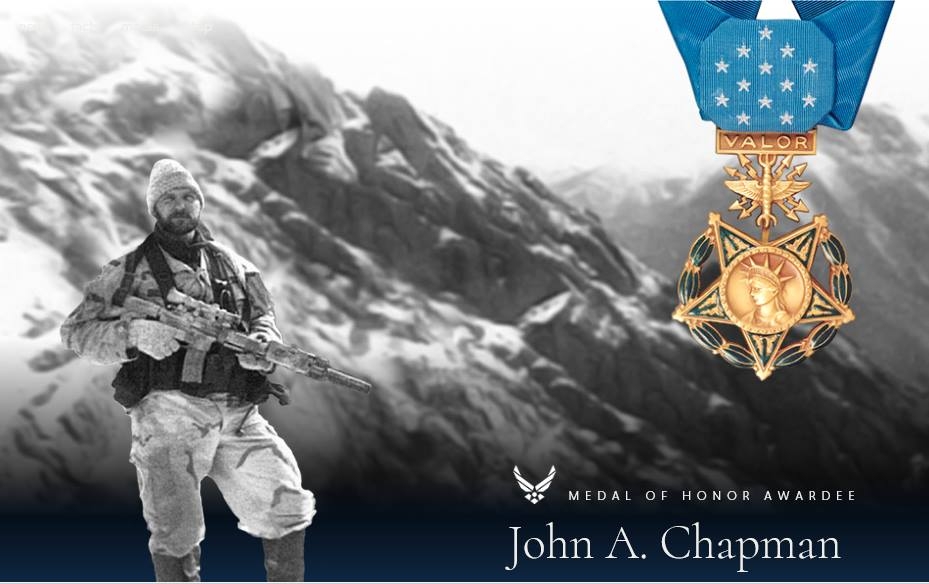
    This Sunday’s Hero Story…

    The President of the United States of America takes pride in presenting the Medal of Honor (Posthumously) to (then) Technical Sergeant John A. Chapman, United States Air Force, for conspicuous gallantry and intrepidity at the risk of life above and beyond the call of duty.

    Technical Sergeant Chapman distinguished himself by extraordinary heroism as an Air Force Special Tactics Combat Controller of the 24th Special Tactics Squadron, attached to a Navy Sea, Air, and Land (SEAL) Team conducting reconnaissance operations in Takur Ghar, Afghanistan, on 4 March 2002.

    During insertion, the team’s helicopter was ambushed causing a teammate to fall into an entrenched group of enemy combatants below.

    Sergeant Chapman and the team voluntarily reinserted onto the snow-capped mountain, into the heart of a known enemy stronghold to rescue one of their own.

    Without regard for his own safety, Sergeant Chapman immediately engaged, moving in the direction of the closest enemy position despite coming under heavy fire from multiple directions.

    He fearlessly charged an enemy bunker, up a steep incline in thigh-deep snow and into hostile fire, directly engaging the enemy.

    Upon reaching the bunker, Sergeant Chapman assaulted and cleared the position, killing all enemy occupants.

    With complete disregard for his own life, Sergeant Chapman deliberately moved from cover only 12 meters from the enemy, and exposed himself once again to attack a second bunker, from which an emplaced machine gun was firing on his team.

    During this assault from an exposed position directly in the line of intense fire, Sergeant Chapman was struck and injured by enemy fire.

    Despite severe, mortal wounds, he continued to fight relentlessly, sustaining a violent engagement with multiple enemy personnel before making the ultimate sacrifice.

    By his heroic actions and extraordinary valor, sacrificing his life for the lives of his teammates, Technical Sergeant Chapman upheld the highest traditions of military service and reflected great credit upon himself and the United States Air Force.

    #medalofhonor #moh #neverforgotten #honor #courage #bravery #airforce #cct #combatcontroller #firstthere

    Air Force Special Operations Command
    Air Force Special Tactics
    via: USAF Special Warfare Recruiting · This Sunday’s Hero Story… The President of the United States of America takes pride in presenting the Medal of Honor (Posthumously) to (then) Technical Sergeant John A. Chapman, United States Air Force, for conspicuous gallantry and intrepidity at the risk of life above and beyond the call of duty. Technical Sergeant Chapman distinguished himself by extraordinary heroism as an Air Force Special Tactics Combat Controller of the 24th Special Tactics Squadron, attached to a Navy Sea, Air, and Land (SEAL) Team conducting reconnaissance operations in Takur Ghar, Afghanistan, on 4 March 2002. During insertion, the team’s helicopter was ambushed causing a teammate to fall into an entrenched group of enemy combatants below. Sergeant Chapman and the team voluntarily reinserted onto the snow-capped mountain, into the heart of a known enemy stronghold to rescue one of their own. Without regard for his own safety, Sergeant Chapman immediately engaged, moving in the direction of the closest enemy position despite coming under heavy fire from multiple directions. He fearlessly charged an enemy bunker, up a steep incline in thigh-deep snow and into hostile fire, directly engaging the enemy. Upon reaching the bunker, Sergeant Chapman assaulted and cleared the position, killing all enemy occupants. With complete disregard for his own life, Sergeant Chapman deliberately moved from cover only 12 meters from the enemy, and exposed himself once again to attack a second bunker, from which an emplaced machine gun was firing on his team. During this assault from an exposed position directly in the line of intense fire, Sergeant Chapman was struck and injured by enemy fire. Despite severe, mortal wounds, he continued to fight relentlessly, sustaining a violent engagement with multiple enemy personnel before making the ultimate sacrifice. By his heroic actions and extraordinary valor, sacrificing his life for the lives of his teammates, Technical Sergeant Chapman upheld the highest traditions of military service and reflected great credit upon himself and the United States Air Force. #medalofhonor #moh #neverforgotten #honor #courage #bravery #airforce #cct #combatcontroller #firstthere Air Force Special Operations Command Air Force Special Tactics
    Like
    1
    0 Σχόλια 0 Μοιράστηκε 95274 Views

  • via: Medal of Honor Valor Trail
    5h ·
    #OnThisDay

    In early March 2002, coalition forces launched Operation Anaconda to encircle remaining Taliban forces in Paktia province, Afghanistan. On March 3, a seven-man team of Navy SEALs and one Air Force combat controller John Chapman left by Chinook helicopter for a reconnaissance mission on the Takur Ghar mountain. Reaching the deployment ridge on the morning of March 4, the team, led by Senior Chief Britt Slabinski, came under heavy fire. Petty Officer First Class Neil Roberts fell from the helicopter, which was soon forced to crash-land three miles away.

    Quickly, the team decided to return for Roberts, unaware he had been killed. Immediately coming under attack after re-engaging, Chapman and Slabinski charged up an incline in deep snow to successfully clear an enemy bunker. Soon after, a machine gun in a nearby strongpoint opened fire on the team. Chapman assaulted this bunker, exposed himself to the automatic fire, and was wounded in his efforts. Despite his injuries, Chapman kept fighting until mortally injured. For his bravery and ultimate sacrifice, Chapman was posthumously decorated with the Medal of Honor.

    With his team suffering casualties, Slabinski moved them to a stronger position and ordered nearby close air support. Enemy mortar attacks commenced at daybreak, forcing the group further down the mountain. Across rough terrain, Slabinski carried a seriously wounded comrade while directing airstrikes. For 14 hours, he helped stabilize casualties and battled off enemy attacks. Despite suffering killed and wounded men, a quick-reaction force of Army Rangers and Air Force troops moved up to Slabinski’s team. Together, they fought against Taliban assaults until 8:15 p.m. when all personnel, including the seven men killed, were extracted by helicopter.

    For his leadership and courage throughout the battle, Slabinski received the Navy Cross, which was upgraded to the Medal of Honor in 2018.
    Photo: "The Battle of Takur Ghar" by Keith Rocco, National Guard Heritage Painting
    via: Medal of Honor Valor Trail 5h · #OnThisDay In early March 2002, coalition forces launched Operation Anaconda to encircle remaining Taliban forces in Paktia province, Afghanistan. On March 3, a seven-man team of Navy SEALs and one Air Force combat controller John Chapman left by Chinook helicopter for a reconnaissance mission on the Takur Ghar mountain. Reaching the deployment ridge on the morning of March 4, the team, led by Senior Chief Britt Slabinski, came under heavy fire. Petty Officer First Class Neil Roberts fell from the helicopter, which was soon forced to crash-land three miles away. Quickly, the team decided to return for Roberts, unaware he had been killed. Immediately coming under attack after re-engaging, Chapman and Slabinski charged up an incline in deep snow to successfully clear an enemy bunker. Soon after, a machine gun in a nearby strongpoint opened fire on the team. Chapman assaulted this bunker, exposed himself to the automatic fire, and was wounded in his efforts. Despite his injuries, Chapman kept fighting until mortally injured. For his bravery and ultimate sacrifice, Chapman was posthumously decorated with the Medal of Honor. With his team suffering casualties, Slabinski moved them to a stronger position and ordered nearby close air support. Enemy mortar attacks commenced at daybreak, forcing the group further down the mountain. Across rough terrain, Slabinski carried a seriously wounded comrade while directing airstrikes. For 14 hours, he helped stabilize casualties and battled off enemy attacks. Despite suffering killed and wounded men, a quick-reaction force of Army Rangers and Air Force troops moved up to Slabinski’s team. Together, they fought against Taliban assaults until 8:15 p.m. when all personnel, including the seven men killed, were extracted by helicopter. For his leadership and courage throughout the battle, Slabinski received the Navy Cross, which was upgraded to the Medal of Honor in 2018. Photo: "The Battle of Takur Ghar" by Keith Rocco, National Guard Heritage Painting
    0 Σχόλια 0 Μοιράστηκε 62976 Views

  • via: USAF Special Warfare Recruiting
    ·
    This Sunday’s Hero Story…

    The President of the United States of America takes pride in presenting the Medal of Honor (Posthumously) to (then) Technical Sergeant John A. Chapman, United States Air Force, for conspicuous gallantry and intrepidity at the risk of life above and beyond the call of duty. Technical Sergeant Chapman distinguished himself by extraordinary heroism as an Air Force Special Tactics Combat Controller of the 24th Special Tactics Squadron, attached to a Navy Sea, Air, and Land (SEAL) Team conducting reconnaissance operations in Takur Ghar, Afghanistan, on 4 March 2002. During insertion, the team’s helicopter was ambushed causing a teammate to fall into an entrenched group of enemy combatants below. Sergeant Chapman and the team voluntarily reinserted onto the snow-capped mountain, into the heart of a known enemy stronghold to rescue one of their own. Without regard for his own safety, Sergeant Chapman immediately engaged, moving in the direction of the closest enemy position despite coming under heavy fire from multiple directions. He fearlessly charged an enemy bunker, up a steep incline in thigh-deep snow and into hostile fire, directly engaging the enemy. Upon reaching the bunker, Sergeant Chapman assaulted and cleared the position, killing all enemy occupants. With complete disregard for his own life, Sergeant Chapman deliberately moved from cover only 12 meters from the enemy, and exposed himself once again to attack a second bunker, from which an emplaced machine gun was firing on his team. During this assault from an exposed position directly in the line of intense fire, Sergeant Chapman was struck and injured by enemy fire. Despite severe, mortal wounds, he continued to fight relentlessly, sustaining a violent engagement with multiple enemy personnel before making the ultimate sacrifice. By his heroic actions and extraordinary valor, sacrificing his life for the lives of his teammates, Technical Sergeant Chapman upheld the highest traditions of military service and reflected great credit upon himself and the United States Air Force.

    #medalofhonor #moh #neverforgotten #honor #courage #bravery #airforce #cct #combatcontroller #firstthere

    Air Force Special Operations Command
    Air Force Special Tactics
    via: USAF Special Warfare Recruiting · This Sunday’s Hero Story… The President of the United States of America takes pride in presenting the Medal of Honor (Posthumously) to (then) Technical Sergeant John A. Chapman, United States Air Force, for conspicuous gallantry and intrepidity at the risk of life above and beyond the call of duty. Technical Sergeant Chapman distinguished himself by extraordinary heroism as an Air Force Special Tactics Combat Controller of the 24th Special Tactics Squadron, attached to a Navy Sea, Air, and Land (SEAL) Team conducting reconnaissance operations in Takur Ghar, Afghanistan, on 4 March 2002. During insertion, the team’s helicopter was ambushed causing a teammate to fall into an entrenched group of enemy combatants below. Sergeant Chapman and the team voluntarily reinserted onto the snow-capped mountain, into the heart of a known enemy stronghold to rescue one of their own. Without regard for his own safety, Sergeant Chapman immediately engaged, moving in the direction of the closest enemy position despite coming under heavy fire from multiple directions. He fearlessly charged an enemy bunker, up a steep incline in thigh-deep snow and into hostile fire, directly engaging the enemy. Upon reaching the bunker, Sergeant Chapman assaulted and cleared the position, killing all enemy occupants. With complete disregard for his own life, Sergeant Chapman deliberately moved from cover only 12 meters from the enemy, and exposed himself once again to attack a second bunker, from which an emplaced machine gun was firing on his team. During this assault from an exposed position directly in the line of intense fire, Sergeant Chapman was struck and injured by enemy fire. Despite severe, mortal wounds, he continued to fight relentlessly, sustaining a violent engagement with multiple enemy personnel before making the ultimate sacrifice. By his heroic actions and extraordinary valor, sacrificing his life for the lives of his teammates, Technical Sergeant Chapman upheld the highest traditions of military service and reflected great credit upon himself and the United States Air Force. #medalofhonor #moh #neverforgotten #honor #courage #bravery #airforce #cct #combatcontroller #firstthere Air Force Special Operations Command Air Force Special Tactics
    Like
    Salute
    2
    0 Σχόλια 0 Μοιράστηκε 95041 Views
  • - AFSOC Combat Controller TSgt.John Chapman's family receives his Medal of Honor posthumously today -

    This is the FIRST Medal of Honor for a Special Tactics Airman -- & the 1st Airman since the Vietnam War.

    SUMMARY OF ACTION: BATTLE AT TAKUR GHAR

    Sergeant Chapman enlisted in the Air Force on Sept. 27, 1985, as an information systems operator, but felt called to be part of Air Force special operations. In 1989, he cross-trained to become an Air Force combat controller.

    According to friends and family, Sergeant Chapman had a tendency to make the difficult look effortless, and consistently sought new challenges. Dating back to his high school days, he made the varsity soccer squad as a freshman. Also an avid muscle-car enthusiast, he rebuilt and maintained an old Pontiac GTO.

    Combat control would prove to be another instance of “making it look easy.”

    Combat control training is more than two years long and amongst the most rigorous in the U.S. military. Only about one in ten Airmen who start the program graduate.

    From months of rigorous physical fitness training to multiple joint schools – including military SCUBA, Army static-line and freefall, air traffic control, and combat control schools – Sergeant Chapman is remembered as someone who could do anything put in front of him.

    “One remembers two types of students – the sharp ones and the really dull ones – and Chapman was in the sharp category,” said Ron Childress, a former Combat Control School instructor. Combat Control School is one of the most difficult points of a combat controller’s training program, from completing arduous tasks without sleeping for days, to running miles with weighted rucksacks and a gas mask.

    “During one of his first days at Combat Control School, I noticed a slight smirk on his face like [the training] was too simple for him…and it was,” said Childress.

    Following Combat Control School, Sergeant Chapman served with the 1721st Combat Control Squadron at Pope Air Force Base, North Carolina, where he met his wife, Valerie, in 1992. They had two daughters, who were the center of Sergeant Chapman’s world even when he was away from home – which was common in the combat control career field.

    “He would come home from a long trip and immediately have on his father hat – feeding, bathing, reading and getting his girls ready for bed,” said Chief Master Sgt. Michael West, who served with Sergeant Chapman through Combat Control School, a three-year tour in Okinawa, Japan, and at Pope Air Force Base. “They were his life and he was proud of them…to the Air Force he was a great hero…what I saw was a great father.”

    The Battle of Takur Ghar

    In conjunction with Operation Anaconda in March 2002, small reconnaissance teams were tasked to establish observation posts in strategic locations in Afghanistan, and when able, direct U.S. air power to destroy enemy targets. The mountain of Takur Ghar was an ideal spot for such an observation post, with excellent visibility to key locations. For Sergeant Chapman and his joint special operations teammates, the mission on the night of March 3 was to establish a reconnaissance position on Takur Ghar and report al Qaeda movement in the Sahi-Kowt area.

    “This was very high profile, no-fail job, and we picked John,” said retired Air Force Col. Ken Rodriguez, Sergeant Chapman’s commander at the time. “In a very high-caliber career field, with the highest quality of men – even then – John stood out as our guy.”

    During the initial insertion onto Afghanistan’s Takur Ghar mountaintop on March 4, the MH-47 “Chinook” helicopter carrying Sergeant Chapman and the joint special operations reconnaissance team was ambushed. A rocket propelled grenade struck the helicopter and bullets ripped through the fuselage. The blast ripped through the left side of the Chinook, throwing Navy Petty Officer 1st Class Neil Roberts off the ramp of the helicopter onto the enemy-infested mountaintop below.

    The severely damaged aircraft was unable to return for Petty Officer Roberts, and performed a controlled crash landing a few miles from the mountaintop. Thus began the chain of events that led to unparalleled acts of valor by numerous joint special operations forces, the deaths of seven U.S. servicemen and now, 16 years later, posthumous award of the Medal of Honor to Sergeant Chapman.

    Alone, against the elements and separated from his team with enemy personnel closing in, Petty Officer Roberts was in desperate need of support. The remaining joint special operations team members, fully aware of his precarious situation, immediately began planning a daring rescue attempt that included returning to the top of Takur Ghar where they had just taken heavy enemy fire.

    As the team returned to Petty Officer Roberts’ last-known position, now on a second MH-47, the entrenched enemy forces immediately engaged the approaching helicopter with heavy fire. Miraculously, the helicopter, although heavily damaged, was able to successfully offload the remaining special operations team members and return to base. Sergeant Chapman, upon exiting the helicopter, immediately charged uphill through the snow toward enemy positions while under heavy fire from three directions.

    Once on the ground, the team assessed the situation and moved quickly to the high ground. The most prominent cover and concealment on the hilltop were a large rock and tree. As they approached the tree, Sergeant Chapman received fire from two enemy personnel in a fortified position. He returned fire, charged the enemy position and took out the enemy combatants within.

    Almost immediately, the team began taking machine gun fire from another fortified enemy position only 12 meters away. Sergeant Chapman deliberately moved into the open to engage the new enemy position. As he heroically engaged the enemy, he was struck by a burst of gunfire and became critically injured.

    Sergeant Chapman regained his faculties and continued to fight relentlessly despite his severe wounds. He sustained a violent engagement with multiple enemy fighters, for over an hour through the arrival of the quick reaction force, before paying the ultimate sacrifice. In performance of these remarkably heroic actions, Sergeant Chapman is credited with saving the lives of his teammates.

    The upgrade to MOH

    “John was always selfless – it didn’t just emerge on Takur Ghar – he had always been selfless and highly competent, and thank God for all those qualities,” said Col. Rodriguez. “He could have hunkered down in the bunker and waited for the (Quick Reaction Force) and (Combat Search and Rescue) team to come in, but he assessed the situation and selflessly gave his life for them.”

    Sergeant Chapman was originally awarded the Air Force Cross for his actions; however, following a review of Air Force Cross and Silver Star recipients directed by then-Secretary of Defense Ash Carter, the Secretary of the Air Force recommended Sergeant Chapman’s Air Force Cross be upgraded to the Medal of Honor.

    In accordance with Air Force policy whereby Medal of Honor recipients are automatically promoted one grade on the first day of the month following the award, Sergeant Chapman will be posthumously promoted to the rank of master sergeant on Sept. 1, 2018.

    Although Sergeant Chapman will be awarded the Medal of Honor, family and friends have expressed his humility and how he would react today, if he were here.

    “If John were to find out he received the Medal of Honor, he would be very humbled and honored,” said Chief Master Sergeant West. “He was just doing his job, and that’s what he would say at this moment.”

    His widow, Valerie Nessel, has always known her husband was capable of such greatness, but asserts that John wouldn’t be anxious to be in the spotlight.

    “[John] would want to recognize the other men that lost their lives,” said Valerie. “Even though he did something he was awarded the Medal of Honor for, he would not want the other guys to be forgotten – that they were part of the team together.”

    “I think he would say that his Medal of Honor was not just for him, but for all of the guys who were lost,” she added.

    In total, seven service members lost their lives during the Battle of Takur Ghar:

    Petty Officer 1st Class Neil Roberts – U.S. Navy SEAL
    Technical Sergeant John Chapman – U.S. Air Force combat control
    Senior Airman Jason Cunningham – U.S. Air Force pararescue
    Corporal Matthew Commons – U.S. Army Ranger
    Sergeant Bradley Crose – U.S. Army Ranger
    Specialist Marc Anderson – U.S. Army Ranger
    Sergeant Philip Svitak – U.S. Army 160th Special Operations Aviation Regiment

    “John would have, so I’ll say it for him. Every American who set foot on that mountaintop acted with great courage and selflessness, and deserve all of our praise and admiration for the sacrifices they made,” said Col. Rodriguez.
    - AFSOC Combat Controller TSgt.John Chapman's family receives his Medal of Honor posthumously today - This is the FIRST Medal of Honor for a Special Tactics Airman -- & the 1st Airman since the Vietnam War. SUMMARY OF ACTION: BATTLE AT TAKUR GHAR Sergeant Chapman enlisted in the Air Force on Sept. 27, 1985, as an information systems operator, but felt called to be part of Air Force special operations. In 1989, he cross-trained to become an Air Force combat controller. According to friends and family, Sergeant Chapman had a tendency to make the difficult look effortless, and consistently sought new challenges. Dating back to his high school days, he made the varsity soccer squad as a freshman. Also an avid muscle-car enthusiast, he rebuilt and maintained an old Pontiac GTO. Combat control would prove to be another instance of “making it look easy.” Combat control training is more than two years long and amongst the most rigorous in the U.S. military. Only about one in ten Airmen who start the program graduate. From months of rigorous physical fitness training to multiple joint schools – including military SCUBA, Army static-line and freefall, air traffic control, and combat control schools – Sergeant Chapman is remembered as someone who could do anything put in front of him. “One remembers two types of students – the sharp ones and the really dull ones – and Chapman was in the sharp category,” said Ron Childress, a former Combat Control School instructor. Combat Control School is one of the most difficult points of a combat controller’s training program, from completing arduous tasks without sleeping for days, to running miles with weighted rucksacks and a gas mask. “During one of his first days at Combat Control School, I noticed a slight smirk on his face like [the training] was too simple for him…and it was,” said Childress. Following Combat Control School, Sergeant Chapman served with the 1721st Combat Control Squadron at Pope Air Force Base, North Carolina, where he met his wife, Valerie, in 1992. They had two daughters, who were the center of Sergeant Chapman’s world even when he was away from home – which was common in the combat control career field. “He would come home from a long trip and immediately have on his father hat – feeding, bathing, reading and getting his girls ready for bed,” said Chief Master Sgt. Michael West, who served with Sergeant Chapman through Combat Control School, a three-year tour in Okinawa, Japan, and at Pope Air Force Base. “They were his life and he was proud of them…to the Air Force he was a great hero…what I saw was a great father.” The Battle of Takur Ghar In conjunction with Operation Anaconda in March 2002, small reconnaissance teams were tasked to establish observation posts in strategic locations in Afghanistan, and when able, direct U.S. air power to destroy enemy targets. The mountain of Takur Ghar was an ideal spot for such an observation post, with excellent visibility to key locations. For Sergeant Chapman and his joint special operations teammates, the mission on the night of March 3 was to establish a reconnaissance position on Takur Ghar and report al Qaeda movement in the Sahi-Kowt area. “This was very high profile, no-fail job, and we picked John,” said retired Air Force Col. Ken Rodriguez, Sergeant Chapman’s commander at the time. “In a very high-caliber career field, with the highest quality of men – even then – John stood out as our guy.” During the initial insertion onto Afghanistan’s Takur Ghar mountaintop on March 4, the MH-47 “Chinook” helicopter carrying Sergeant Chapman and the joint special operations reconnaissance team was ambushed. A rocket propelled grenade struck the helicopter and bullets ripped through the fuselage. The blast ripped through the left side of the Chinook, throwing Navy Petty Officer 1st Class Neil Roberts off the ramp of the helicopter onto the enemy-infested mountaintop below. The severely damaged aircraft was unable to return for Petty Officer Roberts, and performed a controlled crash landing a few miles from the mountaintop. Thus began the chain of events that led to unparalleled acts of valor by numerous joint special operations forces, the deaths of seven U.S. servicemen and now, 16 years later, posthumous award of the Medal of Honor to Sergeant Chapman. Alone, against the elements and separated from his team with enemy personnel closing in, Petty Officer Roberts was in desperate need of support. The remaining joint special operations team members, fully aware of his precarious situation, immediately began planning a daring rescue attempt that included returning to the top of Takur Ghar where they had just taken heavy enemy fire. As the team returned to Petty Officer Roberts’ last-known position, now on a second MH-47, the entrenched enemy forces immediately engaged the approaching helicopter with heavy fire. Miraculously, the helicopter, although heavily damaged, was able to successfully offload the remaining special operations team members and return to base. Sergeant Chapman, upon exiting the helicopter, immediately charged uphill through the snow toward enemy positions while under heavy fire from three directions. Once on the ground, the team assessed the situation and moved quickly to the high ground. The most prominent cover and concealment on the hilltop were a large rock and tree. As they approached the tree, Sergeant Chapman received fire from two enemy personnel in a fortified position. He returned fire, charged the enemy position and took out the enemy combatants within. Almost immediately, the team began taking machine gun fire from another fortified enemy position only 12 meters away. Sergeant Chapman deliberately moved into the open to engage the new enemy position. As he heroically engaged the enemy, he was struck by a burst of gunfire and became critically injured. Sergeant Chapman regained his faculties and continued to fight relentlessly despite his severe wounds. He sustained a violent engagement with multiple enemy fighters, for over an hour through the arrival of the quick reaction force, before paying the ultimate sacrifice. In performance of these remarkably heroic actions, Sergeant Chapman is credited with saving the lives of his teammates. The upgrade to MOH “John was always selfless – it didn’t just emerge on Takur Ghar – he had always been selfless and highly competent, and thank God for all those qualities,” said Col. Rodriguez. “He could have hunkered down in the bunker and waited for the (Quick Reaction Force) and (Combat Search and Rescue) team to come in, but he assessed the situation and selflessly gave his life for them.” Sergeant Chapman was originally awarded the Air Force Cross for his actions; however, following a review of Air Force Cross and Silver Star recipients directed by then-Secretary of Defense Ash Carter, the Secretary of the Air Force recommended Sergeant Chapman’s Air Force Cross be upgraded to the Medal of Honor. In accordance with Air Force policy whereby Medal of Honor recipients are automatically promoted one grade on the first day of the month following the award, Sergeant Chapman will be posthumously promoted to the rank of master sergeant on Sept. 1, 2018. Although Sergeant Chapman will be awarded the Medal of Honor, family and friends have expressed his humility and how he would react today, if he were here. “If John were to find out he received the Medal of Honor, he would be very humbled and honored,” said Chief Master Sergeant West. “He was just doing his job, and that’s what he would say at this moment.” His widow, Valerie Nessel, has always known her husband was capable of such greatness, but asserts that John wouldn’t be anxious to be in the spotlight. “[John] would want to recognize the other men that lost their lives,” said Valerie. “Even though he did something he was awarded the Medal of Honor for, he would not want the other guys to be forgotten – that they were part of the team together.” “I think he would say that his Medal of Honor was not just for him, but for all of the guys who were lost,” she added. In total, seven service members lost their lives during the Battle of Takur Ghar: Petty Officer 1st Class Neil Roberts – U.S. Navy SEAL Technical Sergeant John Chapman – U.S. Air Force combat control Senior Airman Jason Cunningham – U.S. Air Force pararescue Corporal Matthew Commons – U.S. Army Ranger Sergeant Bradley Crose – U.S. Army Ranger Specialist Marc Anderson – U.S. Army Ranger Sergeant Philip Svitak – U.S. Army 160th Special Operations Aviation Regiment “John would have, so I’ll say it for him. Every American who set foot on that mountaintop acted with great courage and selflessness, and deserve all of our praise and admiration for the sacrifices they made,” said Col. Rodriguez.
    Salute
    1
    0 Σχόλια 0 Μοιράστηκε 118540 Views
  • via: The Giant Killer
    ·
    Pictured are the eight U.S. Marines of the suicide mission "Doom Patrol" to recover the body of a dead Marine, Charlie Company, 7th Marine in Quảng Nam Province, 1968.

    In February 1968, eight Marines volunteered for a suicide mission. After 32 US casualties were incurred during the first 30 hours of Operation Pursuit. The operation was initiated in mid-February 1968 by the 1st Marine Division to search for enemy rocket caches in the mountains west of Da Nang.

    Operation Pursuit began at 11 a.m. on Feb. 14 as Charlie Company crossed the western end of Hill 10 while Delta Company departed from Hill 41, about 2 miles to the southeast. Accompanying them were 1st Division combat correspondent Sgt. Robert Bayer and photographer Cpl. R.J. Del Vecchio.

    The two companies linked up on the approach to Hills 270 and 310. The dense jungle growth at the base of Hill 270 channeled the Marines into a single-file column during the slow, exhausting climb that forced the men to hack out a trail with machetes. By 6:30 p.m., Delta Company had secured Objective 1, the saddle between Hills 270 and 310. Charlie Company had secured Objective 2, the top of Hill 270.

    Pfc. Michael J. Kelly, a member of the point squad who had been with the company for only two months, was hit by an enemy bullet that struck a grenade on his cartridge belt. The detonation killed Kelly, severing a leg in the process.

    Lt. Col. Bill Davis ordered Charlie and Delta companies of the 1st Battalion, 7th Marine Regiment, to get off Hills 270 and 310 and return to their base camps in the flatlands to the east.

    A little later the morning of Feb. 16, the acting commander of Charlie Company, 1st Lt. Dana F. MacCormack, whose men were descending from Hill 270, radioed Davis: “Here come the NVA, Colonel! I’ve got one more KIA that the last helo did not have room for. We are having a hell of a time carrying this body, and the bones are cutting up the body bag.”

    Davis, on Hill 310 with the battalion command group, told MacCormack to get Charlie Company off the mountain immediately to avoid any more casualties. And that meant leaving the body behind.

    Thousands of North Vietnamese Army troops had trekked down the Ho Chi Minh Trail in eastern Laos and moved through South Vietnam’s A Shau Valley before making their way to high ground, including Hills 270 and 310, overlooking an area known as Happy Valley and the Marine positions to the east.

    In early afternoon, out of food and water and low on ammunition, the weary, battle-shocked Marines of Charlie Company arrived at Hill 10 and were met by the actual company commander, Capt. Karl Ripplemeyer, who had been on leave and just returned. Delta Company, meanwhile, had reached its base camp on Hill 41.

    Davis radioed the regimental commander, Col. Ross R. Miner, and told him that the Marines were back at the command posts, but added that a dead Marine had to be left behind. A few hours later, Miner told Davis that a B-52 bombing mission was scheduled to strike Hills 270 and 310 and ordered him to send a team to recover Kelly’s body before the bombing started. Davis, however, did not want to risk any more lives in those mountains before the bombing runs were completed and argued against an immediate recovery mission, but Miner wouldn’t rescind his order.

    Davis discussed Miner’s order with Ripplemeyer, as well as the battalion operations officer and the officer who coordinated air support for the battalion. Davis decided to use Charlie Company volunteers for the recovery since they knew the location of Kelly’s body.

    “It was 100% a suicide mission,” Whittier, the 2nd Platoon lieutenant, would write to his wife on Feb. 17. “This is a point I can’t too heavily emphasize.”

    “Suicide mission” was an unintentionally appropriate term, given Charlie Company’s longstanding nickname: “Suicide Charley.” The unit had earned its nickname during the October 1942 Japanese assault on Guadalcanal, when 1st Battalion was led by Lt. Col. Lewis B. “Chesty” Puller, who later became the Corps’ most decorated Marine and finished his career as a lieutenant general. During that battle, Charlie Company held its line against a far larger Japanese force despite suffering heavy losses. The day after the fight, a white flag of parachute cloth with a picture of a skull and crossbones rose over the company’s position. Emblazoned on the flag was “Suicide Charley.”

    The patrol to recover Kelly’s body had only a few hours to prepare for its departure. A runner was sent to Charlie Company seeking the volunteers, including an experienced squad leader. John D. McCreless, then a 20-year-old sergeant, recalled: “When the decision came down to use a squad of volunteers, I got crazy and raised my hand and said I’d lead it.”

    Lance Cpl. Stephen B. McCashin responded similarly: “When I heard they were asking for volunteers, I said anyone who would go back into those mountains again would have to be crazy. I thought it was a suicide mission, but since I’m on my second tour here, I must be crazy, so I decided to go.”

    Pfc. Joseph A. Hamrick signed up because, he said, “I was the only one of the volunteers who knew exactly where the body was, so even though I had only been in the ‘Nam’ for a month and had never walked point, I figured I could go right to it.”

    The other Marines on the eight-man patrol were Pfc. Thomas M. Adamson, Lance Cpl. Tyree Albert Chamberlain, Pfc. Alfred P. Granados, Cpl. Billy R. Ranes and Pfc. Pedro A. Rodriguez. Someone—no one can remember exactly who—dubbed the volunteers the “Doom Patrol.”

    Granados, the radio operator, remembers their preparations. “Our equipment was light for a short recon patrol—no helmets, flak jackets or cartridge belts, and all but one of the men of the Doom Patrol asked to trade their M16s for the more reliable M14, and permission was granted,” he said. “We were to make no enemy contact, travel by stealth in the dark, get the body and return. If we ran into a superior enemy force, we were to abort, split up and get back any way we could.”

    Before the men departed, a senior staff sergeant told McCreless: “None of you will probably return alive, but to increase your chances, if things get hairy you can just bring back the leg.” The eight Marines weren’t totally on their own for the mission. The battalion air officer had arranged for continuous air support for the patrol.

    At 2 a.m. on Feb. 17, McCreless’ squad left Hill 10. A little more than an hour later, near the abandoned village of Phuoc Ninh —military maps distinguished villages with the same name by numbering them—the Marines spotted NVA soldiers moving toward their position. Chamberlain opened fire and killed one of them, but the patrol was now compromised. McCreless faced a difficult decision: abort the mission or stay the course. He spoke to the battalion command center and was told to proceed. No one wanted an empty casket sent to Kelly’s family, and the men on the mission knew the odds when they volunteered.

    On the move again toward the base of Hill 270, the Marines observed another enemy patrol, and McCreless stopped for an hour near another abandoned village, Phuoc Ninh, a precautionary pause in the dark to make sure there was no other NVA activity in the area before continuing their journey.

    By sunrise, around 5 a.m., the patrol had cleared the open rice paddy areas and started into the dense jungle on the side of the mountain—with a long march still ahead, which meant they would have to conduct their “stealth” mission in broad daylight. Three hours later, the men were in a flat area above the bomb crater where Kelly’s body lay, covered with a poncho. There they waited while pilots in O1-Bird Dog propeller-driven planes called in airstrikes.

    One of the pilots radioed McCreless to tell him that napalm drops by F-4 Phantom II fighter-bombers would land just forward of the bomb crater. He instructed the patrol members to take cover, take three deep breaths, exhale and hold their next breath. The napalm struck about a 100 yards in front of the patrol.
    Granados still remembers the intense heat and dust being sucked past his face into the inferno. The shock waves from the blast seemed to raise him off the ground.

    After the napalm flames diminished, Granados saw NVA soldiers emerging from bunkers and spider holes.
    McCreless, worried that the enemy troops were about to move against his seriously outnumbered men, yelled: “Get the leg, and let’s get the hell out!”

    Moments later, Ranes and Adamson dashed to the crater. They grabbed the severed leg and quickly strapped it to a backpack that Chamberlain carried. The eight Marines then ran back down the trail, amid the still-smoldering napalm and the enemy fire tearing into trees and brush around them. A final strafing run by F-4 Phantoms silenced the firing.

    After reaching the flatlands, the patrol came upon Charlie Company’s 1st Platoon, sent to assist the squad if any of the men had been wounded or killed. The platoon escorted McCreless’ squad to base camp, and by 2 p.m. all the Marines were back on Hill 10.

    Amid great rejoicing, Davis summoned the men to his quarters and handed them cigars and cold beer to celebrate their incredible accomplishment. (He wasn’t aware at that time that the full body had not been recovered.) As recounted in his autobiography Tet Marine, Davis told the Doom Patrol that he had been a fan of Suicide Charley since the Chosin Reservoir battle during the Korean War. “I’ve been proud of them during all these years, because they did great things at the Reservoir,” he said. “But never did they do anything greater than YOU did, as volunteers, last night and today.”

    McCreless said: “The only reason I can think of why we were able to pull it off is that the NVA just couldn’t believe that we were stupid enough to go in there and do what we did. They must have thought we were bait for some kind of trap.”

    After the celebration, Davis typed a letter to the commander of the 7th Marine Regiment:

    “Dear Colonel Miner, I’ve never been prouder to be a Marine than at this moment! This magnificent squad [from Suicide Charley] went on what appeared to be a suicide mission. I wish you could have heard this young Marine [Pfc. Joseph Hamrick] describe why he volunteered. He just couldn’t imagine that an empty casket would go to a Marine’s parents. He knew they had to do the job, and while he was scared all the way out, and all the way back, he knew that they just had to succeed. I’ve just lived through an experience that I’ll always hold dear to me. Semper Fi.”

    Within 10 hours of the patrol’s return, the B-52s from Andersen Air Force Base on Guam devastated the high ground on Hills 270 and 310. But the NVA would return to Hill 310, and many more Marines were wounded or killed there the following month during Operation Worth and in August during Operation Mameluke Thrust.

    On March 8, Whittier and McCreless were wounded. Later that day, at the Navy hospital in Da Nang, Whittier died from his wounds. A few days later, McCreless was medevaced to Japan for additional surgery. During fighting on May 30, Doom Patrol volunteer Rodriguez was killed.

    Men from E Company, 2nd Battalion, 7th Marines, found Kelly’s body on March 25 during Operation Worth. A medevac helicopter picked up the remains and took them to the mortuary in Da Nang. A funeral with a casket containing Kelly’s leg was held in his hometown of Findlay, Ohio, in March 1968. A second funeral, with the rest of his remains, was held in April 1968.

    Story by Jack Wells
    — Jack Wells served in Vietnam during 1968-69 as an artillery forward observer with Alpha and Bravo companies, 1st Battalion, 7th Marine Regiment, 1st Marine Division, and later as executive officer of H Battery, 3rd Battalion, 11th Marine Regiment, 1st Marine Division.

    SALUTE!
    via: The Giant Killer · Pictured are the eight U.S. Marines of the suicide mission "Doom Patrol" to recover the body of a dead Marine, Charlie Company, 7th Marine in Quảng Nam Province, 1968. In February 1968, eight Marines volunteered for a suicide mission. After 32 US casualties were incurred during the first 30 hours of Operation Pursuit. The operation was initiated in mid-February 1968 by the 1st Marine Division to search for enemy rocket caches in the mountains west of Da Nang. Operation Pursuit began at 11 a.m. on Feb. 14 as Charlie Company crossed the western end of Hill 10 while Delta Company departed from Hill 41, about 2 miles to the southeast. Accompanying them were 1st Division combat correspondent Sgt. Robert Bayer and photographer Cpl. R.J. Del Vecchio. The two companies linked up on the approach to Hills 270 and 310. The dense jungle growth at the base of Hill 270 channeled the Marines into a single-file column during the slow, exhausting climb that forced the men to hack out a trail with machetes. By 6:30 p.m., Delta Company had secured Objective 1, the saddle between Hills 270 and 310. Charlie Company had secured Objective 2, the top of Hill 270. Pfc. Michael J. Kelly, a member of the point squad who had been with the company for only two months, was hit by an enemy bullet that struck a grenade on his cartridge belt. The detonation killed Kelly, severing a leg in the process. Lt. Col. Bill Davis ordered Charlie and Delta companies of the 1st Battalion, 7th Marine Regiment, to get off Hills 270 and 310 and return to their base camps in the flatlands to the east. A little later the morning of Feb. 16, the acting commander of Charlie Company, 1st Lt. Dana F. MacCormack, whose men were descending from Hill 270, radioed Davis: “Here come the NVA, Colonel! I’ve got one more KIA that the last helo did not have room for. We are having a hell of a time carrying this body, and the bones are cutting up the body bag.” Davis, on Hill 310 with the battalion command group, told MacCormack to get Charlie Company off the mountain immediately to avoid any more casualties. And that meant leaving the body behind. Thousands of North Vietnamese Army troops had trekked down the Ho Chi Minh Trail in eastern Laos and moved through South Vietnam’s A Shau Valley before making their way to high ground, including Hills 270 and 310, overlooking an area known as Happy Valley and the Marine positions to the east. In early afternoon, out of food and water and low on ammunition, the weary, battle-shocked Marines of Charlie Company arrived at Hill 10 and were met by the actual company commander, Capt. Karl Ripplemeyer, who had been on leave and just returned. Delta Company, meanwhile, had reached its base camp on Hill 41. Davis radioed the regimental commander, Col. Ross R. Miner, and told him that the Marines were back at the command posts, but added that a dead Marine had to be left behind. A few hours later, Miner told Davis that a B-52 bombing mission was scheduled to strike Hills 270 and 310 and ordered him to send a team to recover Kelly’s body before the bombing started. Davis, however, did not want to risk any more lives in those mountains before the bombing runs were completed and argued against an immediate recovery mission, but Miner wouldn’t rescind his order. Davis discussed Miner’s order with Ripplemeyer, as well as the battalion operations officer and the officer who coordinated air support for the battalion. Davis decided to use Charlie Company volunteers for the recovery since they knew the location of Kelly’s body. “It was 100% a suicide mission,” Whittier, the 2nd Platoon lieutenant, would write to his wife on Feb. 17. “This is a point I can’t too heavily emphasize.” “Suicide mission” was an unintentionally appropriate term, given Charlie Company’s longstanding nickname: “Suicide Charley.” The unit had earned its nickname during the October 1942 Japanese assault on Guadalcanal, when 1st Battalion was led by Lt. Col. Lewis B. “Chesty” Puller, who later became the Corps’ most decorated Marine and finished his career as a lieutenant general. During that battle, Charlie Company held its line against a far larger Japanese force despite suffering heavy losses. The day after the fight, a white flag of parachute cloth with a picture of a skull and crossbones rose over the company’s position. Emblazoned on the flag was “Suicide Charley.” The patrol to recover Kelly’s body had only a few hours to prepare for its departure. A runner was sent to Charlie Company seeking the volunteers, including an experienced squad leader. John D. McCreless, then a 20-year-old sergeant, recalled: “When the decision came down to use a squad of volunteers, I got crazy and raised my hand and said I’d lead it.” Lance Cpl. Stephen B. McCashin responded similarly: “When I heard they were asking for volunteers, I said anyone who would go back into those mountains again would have to be crazy. I thought it was a suicide mission, but since I’m on my second tour here, I must be crazy, so I decided to go.” Pfc. Joseph A. Hamrick signed up because, he said, “I was the only one of the volunteers who knew exactly where the body was, so even though I had only been in the ‘Nam’ for a month and had never walked point, I figured I could go right to it.” The other Marines on the eight-man patrol were Pfc. Thomas M. Adamson, Lance Cpl. Tyree Albert Chamberlain, Pfc. Alfred P. Granados, Cpl. Billy R. Ranes and Pfc. Pedro A. Rodriguez. Someone—no one can remember exactly who—dubbed the volunteers the “Doom Patrol.” Granados, the radio operator, remembers their preparations. “Our equipment was light for a short recon patrol—no helmets, flak jackets or cartridge belts, and all but one of the men of the Doom Patrol asked to trade their M16s for the more reliable M14, and permission was granted,” he said. “We were to make no enemy contact, travel by stealth in the dark, get the body and return. If we ran into a superior enemy force, we were to abort, split up and get back any way we could.” Before the men departed, a senior staff sergeant told McCreless: “None of you will probably return alive, but to increase your chances, if things get hairy you can just bring back the leg.” The eight Marines weren’t totally on their own for the mission. The battalion air officer had arranged for continuous air support for the patrol. At 2 a.m. on Feb. 17, McCreless’ squad left Hill 10. A little more than an hour later, near the abandoned village of Phuoc Ninh —military maps distinguished villages with the same name by numbering them—the Marines spotted NVA soldiers moving toward their position. Chamberlain opened fire and killed one of them, but the patrol was now compromised. McCreless faced a difficult decision: abort the mission or stay the course. He spoke to the battalion command center and was told to proceed. No one wanted an empty casket sent to Kelly’s family, and the men on the mission knew the odds when they volunteered. On the move again toward the base of Hill 270, the Marines observed another enemy patrol, and McCreless stopped for an hour near another abandoned village, Phuoc Ninh, a precautionary pause in the dark to make sure there was no other NVA activity in the area before continuing their journey. By sunrise, around 5 a.m., the patrol had cleared the open rice paddy areas and started into the dense jungle on the side of the mountain—with a long march still ahead, which meant they would have to conduct their “stealth” mission in broad daylight. Three hours later, the men were in a flat area above the bomb crater where Kelly’s body lay, covered with a poncho. There they waited while pilots in O1-Bird Dog propeller-driven planes called in airstrikes. One of the pilots radioed McCreless to tell him that napalm drops by F-4 Phantom II fighter-bombers would land just forward of the bomb crater. He instructed the patrol members to take cover, take three deep breaths, exhale and hold their next breath. The napalm struck about a 100 yards in front of the patrol. Granados still remembers the intense heat and dust being sucked past his face into the inferno. The shock waves from the blast seemed to raise him off the ground. After the napalm flames diminished, Granados saw NVA soldiers emerging from bunkers and spider holes. McCreless, worried that the enemy troops were about to move against his seriously outnumbered men, yelled: “Get the leg, and let’s get the hell out!” Moments later, Ranes and Adamson dashed to the crater. They grabbed the severed leg and quickly strapped it to a backpack that Chamberlain carried. The eight Marines then ran back down the trail, amid the still-smoldering napalm and the enemy fire tearing into trees and brush around them. A final strafing run by F-4 Phantoms silenced the firing. After reaching the flatlands, the patrol came upon Charlie Company’s 1st Platoon, sent to assist the squad if any of the men had been wounded or killed. The platoon escorted McCreless’ squad to base camp, and by 2 p.m. all the Marines were back on Hill 10. Amid great rejoicing, Davis summoned the men to his quarters and handed them cigars and cold beer to celebrate their incredible accomplishment. (He wasn’t aware at that time that the full body had not been recovered.) As recounted in his autobiography Tet Marine, Davis told the Doom Patrol that he had been a fan of Suicide Charley since the Chosin Reservoir battle during the Korean War. “I’ve been proud of them during all these years, because they did great things at the Reservoir,” he said. “But never did they do anything greater than YOU did, as volunteers, last night and today.” McCreless said: “The only reason I can think of why we were able to pull it off is that the NVA just couldn’t believe that we were stupid enough to go in there and do what we did. They must have thought we were bait for some kind of trap.” After the celebration, Davis typed a letter to the commander of the 7th Marine Regiment: “Dear Colonel Miner, I’ve never been prouder to be a Marine than at this moment! This magnificent squad [from Suicide Charley] went on what appeared to be a suicide mission. I wish you could have heard this young Marine [Pfc. Joseph Hamrick] describe why he volunteered. He just couldn’t imagine that an empty casket would go to a Marine’s parents. He knew they had to do the job, and while he was scared all the way out, and all the way back, he knew that they just had to succeed. I’ve just lived through an experience that I’ll always hold dear to me. Semper Fi.” Within 10 hours of the patrol’s return, the B-52s from Andersen Air Force Base on Guam devastated the high ground on Hills 270 and 310. But the NVA would return to Hill 310, and many more Marines were wounded or killed there the following month during Operation Worth and in August during Operation Mameluke Thrust. On March 8, Whittier and McCreless were wounded. Later that day, at the Navy hospital in Da Nang, Whittier died from his wounds. A few days later, McCreless was medevaced to Japan for additional surgery. During fighting on May 30, Doom Patrol volunteer Rodriguez was killed. Men from E Company, 2nd Battalion, 7th Marines, found Kelly’s body on March 25 during Operation Worth. A medevac helicopter picked up the remains and took them to the mortuary in Da Nang. A funeral with a casket containing Kelly’s leg was held in his hometown of Findlay, Ohio, in March 1968. A second funeral, with the rest of his remains, was held in April 1968. Story by Jack Wells — Jack Wells served in Vietnam during 1968-69 as an artillery forward observer with Alpha and Bravo companies, 1st Battalion, 7th Marine Regiment, 1st Marine Division, and later as executive officer of H Battery, 3rd Battalion, 11th Marine Regiment, 1st Marine Division. SALUTE!
    Salute
    1
    0 Σχόλια 0 Μοιράστηκε 72075 Views
  • USAF Special Warfare Recruiting
    ·
    Todays Hero Story:

    The President of the United States of America takes pleasure in presenting the Silver Star to Master Sergeant Timothy A. Stamey, United States Air Force, for conspicuous gallantry and intrepidity in action while serving with the 18th Air Support Operations Group in Afghanistan, from 8 November 2001 to 5 January 2002.

    During this period, Sergeant Stamey served as Operational Detachment Alpha Tactical Air Control Party Sergeant in support of Operation Enduring Freedom. While assisting host nation forces, he courageously operated in enemy territory in advance of the forward line of troops, frequently negotiating minefields under continuous fire and threat of attack, with no immediate support.

    Sergeant Stamey provided positive terminal attack control on over eighty sorties of fighters and bombers destroying over seventy-five tanks, mobile anti-aircraft systems, and vehicles, four ammo-dumps, numerous command and control facilities and bunkers, inflicting 2,139 enemy casualties. As a result, Northern Alliance forces were able to push forward cities of Taloqan, Khanabad and Konduz.

    From 13 to 15 November 2001, enemy forces initiated a counter-attack. Accordingly, the team received continuous small arms, direct heavy weapons and indirect and direct tank fire. Sergeant Stamey called in strikes against the attackers until they withdrew.

    On 23 November 2001, as allied forces were preparing for a final attack toward Khanabad and Konduz, Sergeant Stamey and the team members received sniper and heavy machine gun fire from enemy positions on three sides. He contacted a B-52, declared an emergency situation, and briefed the pilot.

    Sergeant Stamey then assisted in suppressing the enemy with small arms fire. With his team running low on ammunition, he passed his remaining ammunition out to the team members. Without regard for his personal safety and under intense fire, Sergeant Stamey crawled to their ammunition storage point, returned to resupply the team, and then resumed accurate sniper fire while awaiting additional close air support. When the aircraft arrived, he resumed terminal attack control and destroyed the advancing enemy.

    Sergeant Stamey's efforts directly contributed to the team's mission success. By his gallantry and devotion to duty, Sergeant Stamey has reflected great credit upon himself and the United States Air Force.

    #silverstar #honor #courage #bravery #airforce #specialwarfare #tacp #jtac #thestrongshallstand
    TACP Association | TACP Foundation
    USAF Special Warfare Recruiting · Todays Hero Story: The President of the United States of America takes pleasure in presenting the Silver Star to Master Sergeant Timothy A. Stamey, United States Air Force, for conspicuous gallantry and intrepidity in action while serving with the 18th Air Support Operations Group in Afghanistan, from 8 November 2001 to 5 January 2002. During this period, Sergeant Stamey served as Operational Detachment Alpha Tactical Air Control Party Sergeant in support of Operation Enduring Freedom. While assisting host nation forces, he courageously operated in enemy territory in advance of the forward line of troops, frequently negotiating minefields under continuous fire and threat of attack, with no immediate support. Sergeant Stamey provided positive terminal attack control on over eighty sorties of fighters and bombers destroying over seventy-five tanks, mobile anti-aircraft systems, and vehicles, four ammo-dumps, numerous command and control facilities and bunkers, inflicting 2,139 enemy casualties. As a result, Northern Alliance forces were able to push forward cities of Taloqan, Khanabad and Konduz. From 13 to 15 November 2001, enemy forces initiated a counter-attack. Accordingly, the team received continuous small arms, direct heavy weapons and indirect and direct tank fire. Sergeant Stamey called in strikes against the attackers until they withdrew. On 23 November 2001, as allied forces were preparing for a final attack toward Khanabad and Konduz, Sergeant Stamey and the team members received sniper and heavy machine gun fire from enemy positions on three sides. He contacted a B-52, declared an emergency situation, and briefed the pilot. Sergeant Stamey then assisted in suppressing the enemy with small arms fire. With his team running low on ammunition, he passed his remaining ammunition out to the team members. Without regard for his personal safety and under intense fire, Sergeant Stamey crawled to their ammunition storage point, returned to resupply the team, and then resumed accurate sniper fire while awaiting additional close air support. When the aircraft arrived, he resumed terminal attack control and destroyed the advancing enemy. Sergeant Stamey's efforts directly contributed to the team's mission success. By his gallantry and devotion to duty, Sergeant Stamey has reflected great credit upon himself and the United States Air Force. #silverstar #honor #courage #bravery #airforce #specialwarfare #tacp #jtac #thestrongshallstand TACP Association | TACP Foundation
    Salute
    Like
    4
    1 Σχόλια 0 Μοιράστηκε 68279 Views
  • via: History in Color
    ·
    The result of the Ordnance Department body armor test that demonstrated the effect of pistol, rifle, and machine-gun fire on heavy body armor. Photograph taken at Fort de la Peigney in Langres, France, in c. 1918.

    Credit: timcolorization on Instagram
    historycolored.com
    #history #ww1 #historycolored
    via: History in Color · The result of the Ordnance Department body armor test that demonstrated the effect of pistol, rifle, and machine-gun fire on heavy body armor. Photograph taken at Fort de la Peigney in Langres, France, in c. 1918. Credit: timcolorization on Instagram historycolored.com #history #ww1 #historycolored
    Salute
    1
    0 Σχόλια 0 Μοιράστηκε 24219 Views
  • Today in History:

    - On today’s date 169 years ago, Tuesday, January 23, 1855, noted American gunsmith, firearms designer, & founder of the Browning Arms Company John Moses Browning (1855-1926) was born at Ogden City in Utah Territory.

    Browning is famous for developing many varieties of military & civilian firearms, cartridges, & firearms mechanisms, many of which are still in use around the world. He is probably the most important figure in the development of modern automatic & semi-automatic firearms & he is credited with 128 firearms patents.

    Among John Browning’s most successful designs are the Model ‘94 Winchester lever-action rifle, the Colt .45 M1911 semi-automatic pistol, the Browning 9mm P-35 Hi-Power semi-automatic pistol, the Browning M2 .50 caliber machine gun, the Browning Automatic Rifle, & the Browning Auto-5 semi-automatic shotgun.

    The undated studio photograph depicts John M. Browning with one of his namesake Browning M1917 water-cooled heavy machine guns.
    Today in History: - On today’s date 169 years ago, Tuesday, January 23, 1855, noted American gunsmith, firearms designer, & founder of the Browning Arms Company John Moses Browning (1855-1926) was born at Ogden City in Utah Territory. Browning is famous for developing many varieties of military & civilian firearms, cartridges, & firearms mechanisms, many of which are still in use around the world. He is probably the most important figure in the development of modern automatic & semi-automatic firearms & he is credited with 128 firearms patents. Among John Browning’s most successful designs are the Model ‘94 Winchester lever-action rifle, the Colt .45 M1911 semi-automatic pistol, the Browning 9mm P-35 Hi-Power semi-automatic pistol, the Browning M2 .50 caliber machine gun, the Browning Automatic Rifle, & the Browning Auto-5 semi-automatic shotgun. The undated studio photograph depicts John M. Browning with one of his namesake Browning M1917 water-cooled heavy machine guns.
    Love
    1
    0 Σχόλια 0 Μοιράστηκε 26634 Views
  • The Giant Killer:

    Vietnam – The Men With Green Faces
    Shortly after being established in January 1962, SEAL Team ONE deployed CPO Robert Sullivan and CPO Charles Raymond to take initial surveys and make preparations for training indigenous South Vietnamese in the tactics, techniques, and procedures of maritime commandos.

    During this same period, the U.S. Government agreed to increase aid to South Vietnam in the fight against Viet Cong rebels. The agreement included paying for a larger Vietnamese army as well as for more U.S. advisors in the field. The Viet Cong (properly the Viet Nam Cong San or Vietnamese Communists), was the term applied to about 10,000 troops that had been left in hideouts in South Vietnam after the Geneva Conference of 1954 ended the French Indochina War (1946–1954).

    The Viet Cong, or VC, as they were commonly known, first tried subversive tactics to overthrow the South Vietnamese regime and later resorted to open warfare. They were subsequently reinforced by huge numbers of North Vietnamese troops infiltrating south.

    Platoons from SEAL Team ONE and SEAL Team TWO were assigned to a specific operating area in Vietnam, and for the most part operated autonomously. Each SEAL platoon had a mobile support team (MST) boat element assigned. The MSTs were small groups of men specially trained to support SEAL operations. MSTs operated a variety of boats that included the light, medium, and heavy SEAL support craft (LSSC, MSSC, and HSSC, respectively).

    By mid-1968 the SEAL Teams were fielding 12-man platoons, each comprising two squads of six men each, and most missions Vietnam were squad-sized operations. Generally four or five platoons at any given time were deployed to South Vietnam. SEAL platoons were never assigned permanently to Vietnam, but were sent on temporary duty assignments; generally for period of about six months time. Many of the men made several tours.

    While the majority of SEAL operations were conducted after inserting from boats, it was in Vietnam that SEALs first began developing hit-and-run air-assault tactics using Army and Navy helicopters. Operations involved helicopters in “slick” or passenger configurations, but were also lightly armed with door guns.
    SEAL platoons carried out day and night ambushes (but much preferred night operations), hit-and-run raids, reconnaissance patrols, and special intelligence collection operations. Calling them the “men with green faces” because of the face camouflage they used, the VC feared SEALs and often put bounties on their heads.

    involvement in Vietnam, the relatively small group of SEALs accounted for 600 confirmed VC killed and 300 more almost certainly killed. Numerous others were captured or detained. No statistical tally can be placed on the effects of the intelligence gathered by SEALs, but there is no question that they made a contribution to the war out of all proportion to their numbers. In the psychological war, too, they were extraordinary; going some way towards evening up the unspoken balance of terror and gaining a reputation as fearsome and extraordinary warriors.

    The last SEAL platoon departed Vietnam on 7 December 1971. The last SEAL advisors left Vietnam in March 1973. Between 1965 and 1972 there were 46 SEALs killed in Vietnam. They are forever remembered on the Navy SEAL Memorial at the Museum.

    Note: Three U.S. Navy SEALs were recipients of the Medal of Honor during Vietnam. They were: Lieutenant Bob Kerrey, Lieutenant Tom Norris, and EM2 Mike Thornton. Mike Thornton was awarded the Medal of Honor for the rescue and exfiltration of Lieutenant Norris under withering fire on the night of 31 October 1972. There is no other recorded instance where two Medal of Honor recipients are known to have been involved in the same combat operation.

    Story by Navy SEAL museum
    The Giant Killer: Vietnam – The Men With Green Faces Shortly after being established in January 1962, SEAL Team ONE deployed CPO Robert Sullivan and CPO Charles Raymond to take initial surveys and make preparations for training indigenous South Vietnamese in the tactics, techniques, and procedures of maritime commandos. During this same period, the U.S. Government agreed to increase aid to South Vietnam in the fight against Viet Cong rebels. The agreement included paying for a larger Vietnamese army as well as for more U.S. advisors in the field. The Viet Cong (properly the Viet Nam Cong San or Vietnamese Communists), was the term applied to about 10,000 troops that had been left in hideouts in South Vietnam after the Geneva Conference of 1954 ended the French Indochina War (1946–1954). The Viet Cong, or VC, as they were commonly known, first tried subversive tactics to overthrow the South Vietnamese regime and later resorted to open warfare. They were subsequently reinforced by huge numbers of North Vietnamese troops infiltrating south. Platoons from SEAL Team ONE and SEAL Team TWO were assigned to a specific operating area in Vietnam, and for the most part operated autonomously. Each SEAL platoon had a mobile support team (MST) boat element assigned. The MSTs were small groups of men specially trained to support SEAL operations. MSTs operated a variety of boats that included the light, medium, and heavy SEAL support craft (LSSC, MSSC, and HSSC, respectively). By mid-1968 the SEAL Teams were fielding 12-man platoons, each comprising two squads of six men each, and most missions Vietnam were squad-sized operations. Generally four or five platoons at any given time were deployed to South Vietnam. SEAL platoons were never assigned permanently to Vietnam, but were sent on temporary duty assignments; generally for period of about six months time. Many of the men made several tours. While the majority of SEAL operations were conducted after inserting from boats, it was in Vietnam that SEALs first began developing hit-and-run air-assault tactics using Army and Navy helicopters. Operations involved helicopters in “slick” or passenger configurations, but were also lightly armed with door guns. SEAL platoons carried out day and night ambushes (but much preferred night operations), hit-and-run raids, reconnaissance patrols, and special intelligence collection operations. Calling them the “men with green faces” because of the face camouflage they used, the VC feared SEALs and often put bounties on their heads. involvement in Vietnam, the relatively small group of SEALs accounted for 600 confirmed VC killed and 300 more almost certainly killed. Numerous others were captured or detained. No statistical tally can be placed on the effects of the intelligence gathered by SEALs, but there is no question that they made a contribution to the war out of all proportion to their numbers. In the psychological war, too, they were extraordinary; going some way towards evening up the unspoken balance of terror and gaining a reputation as fearsome and extraordinary warriors. The last SEAL platoon departed Vietnam on 7 December 1971. The last SEAL advisors left Vietnam in March 1973. Between 1965 and 1972 there were 46 SEALs killed in Vietnam. They are forever remembered on the Navy SEAL Memorial at the Museum. Note: Three U.S. Navy SEALs were recipients of the Medal of Honor during Vietnam. They were: Lieutenant Bob Kerrey, Lieutenant Tom Norris, and EM2 Mike Thornton. Mike Thornton was awarded the Medal of Honor for the rescue and exfiltration of Lieutenant Norris under withering fire on the night of 31 October 1972. There is no other recorded instance where two Medal of Honor recipients are known to have been involved in the same combat operation. Story by Navy SEAL museum
    Salute
    2
    0 Σχόλια 0 Μοιράστηκε 38379 Views
  • 🇺🇲 WWII uncovered: 11th Airborne Division's Rod Serling, Hollywood's "Angry Young Man"

    Before he became the well-known creator of "The Twilight Zone," Rod Serling was a young, 5'4" paratrooper in the 511th Parachute Infantry Regiment, 11th Airborne Division. As one of "The Angels", Rod did not meet the height requirements for the parachutes, but talked his way into the regiment anyway.

    While the division was on New Guinea, Jack Benny came by to perform for the Angels and Rod was able to write and perform in a small skit that was broadcast on Armed Forces Radio. It was a sign of things to come for Serling.

    During the Angels' campaign on Leyte in late 1944, T-4 Serling and the Suicide Squad kept busy eliminating enemy bunkers and defensive positions. While high in the island's mountains, the regiment could only be resupplied by air and one day Rod watched in horror as a heavy crate landed squarely on his good friend PVT Melvin Levy's shoulders, killing him instantly. Rod marked Melvin’s grave with a Star of David in honor of his friend’s Jewish heritage. It was the first of the war's many difficult experiences that affected, perhaps even haunted, Rod, in addition to a wound to his knee that plagued him for the rest of his life.

    During the Angels' campaign to liberate Luzon, Rod and the Demolitions team kept busy with the dangerous job of blasting countless grass-covered pillboxes and blockhouses, many of which were heavily defended. On one occasion, Rod found himself staring down the barrel of a Japanese rifle. Luckily one of his buddies was quicker and shot the enemy soldier.

    In one Manila neighborhood, Rod and the other Angels were enjoying an impromptu celebration by the newly-liberated Filipinos when the Japanese began shelling the area. Noticing a wounded Filipino woman out in the open, Rod rushed into the fire to carry her to safety, an action to earned him the Bronze Star.

    After the war, Rod turned to writing to "face his demons" and went on to become one of televisions most well-known, and award-winning, screenwriters, playwrights, television producers, and narrators. He also was a passionate teacher at Antioch College (Ohio) and Ithaca College (New York).
    Known to smoke three packs of cigarettes a day, Rod died on June 28, 1975. May we all remember these words spoken before his death: "for civilization to survive, the human race has to remain civilized".

    For more information on Rod's experiences in World War II, please visit 511pir.com or 11th Airborne Division Association - "Angels"
    #ww2uncovered #honorourveterans #ww2 #WorldWarII #worldwar2 #worldwartwo #paratrooper #paratroopers #airborne #greatestgeneration #ww2veteran #WWII #WWIIveteran #AATW #twilightzone #Airborne #rodserling #LestWeForget

    Original description and photo submitted by Jeremy Holm ©️ author of "When Angels Fall: From Toccoa to Tokyo: The 511th Parachute Infantry Regiment in World War II MacArthur’s Secret Weapon & Heroes of Los Baños"
    🇺🇲 WWII uncovered: 11th Airborne Division's Rod Serling, Hollywood's "Angry Young Man" Before he became the well-known creator of "The Twilight Zone," Rod Serling was a young, 5'4" paratrooper in the 511th Parachute Infantry Regiment, 11th Airborne Division. As one of "The Angels", Rod did not meet the height requirements for the parachutes, but talked his way into the regiment anyway. While the division was on New Guinea, Jack Benny came by to perform for the Angels and Rod was able to write and perform in a small skit that was broadcast on Armed Forces Radio. It was a sign of things to come for Serling. During the Angels' campaign on Leyte in late 1944, T-4 Serling and the Suicide Squad kept busy eliminating enemy bunkers and defensive positions. While high in the island's mountains, the regiment could only be resupplied by air and one day Rod watched in horror as a heavy crate landed squarely on his good friend PVT Melvin Levy's shoulders, killing him instantly. Rod marked Melvin’s grave with a Star of David in honor of his friend’s Jewish heritage. It was the first of the war's many difficult experiences that affected, perhaps even haunted, Rod, in addition to a wound to his knee that plagued him for the rest of his life. During the Angels' campaign to liberate Luzon, Rod and the Demolitions team kept busy with the dangerous job of blasting countless grass-covered pillboxes and blockhouses, many of which were heavily defended. On one occasion, Rod found himself staring down the barrel of a Japanese rifle. Luckily one of his buddies was quicker and shot the enemy soldier. In one Manila neighborhood, Rod and the other Angels were enjoying an impromptu celebration by the newly-liberated Filipinos when the Japanese began shelling the area. Noticing a wounded Filipino woman out in the open, Rod rushed into the fire to carry her to safety, an action to earned him the Bronze Star. After the war, Rod turned to writing to "face his demons" and went on to become one of televisions most well-known, and award-winning, screenwriters, playwrights, television producers, and narrators. He also was a passionate teacher at Antioch College (Ohio) and Ithaca College (New York). Known to smoke three packs of cigarettes a day, Rod died on June 28, 1975. May we all remember these words spoken before his death: "for civilization to survive, the human race has to remain civilized". 🪂For more information on Rod's experiences in World War II, please visit 511pir.com or 11th Airborne Division Association - "Angels" #ww2uncovered #honorourveterans #ww2 #WorldWarII #worldwar2 #worldwartwo #paratrooper #paratroopers #airborne #greatestgeneration #ww2veteran #WWII #WWIIveteran #AATW #twilightzone #Airborne #rodserling #LestWeForget Original description and photo submitted by Jeremy Holm ©️ author of "When Angels Fall: From Toccoa to Tokyo: The 511th Parachute Infantry Regiment in World War II MacArthur’s Secret Weapon & Heroes of Los Baños"
    Salute
    1
    0 Σχόλια 0 Μοιράστηκε 79425 Views
  • So long as they continued to work and breed, their other activities were without importance. Left to themselves, like cattle turned loose upon the plains of Argentina, they had reverted to a style of life that appeared to be natural to them, a sort of ancestral pattern. Heavy physical work, the care of home and children, petty quarrels with neighbors, films, football, beer and above all, gambling filled up the horizon of their minds. To keep them in control was not difficult.
    ~ George Orwell, 1984

    (Art: Photograph by Francisco Ontañón)
    So long as they continued to work and breed, their other activities were without importance. Left to themselves, like cattle turned loose upon the plains of Argentina, they had reverted to a style of life that appeared to be natural to them, a sort of ancestral pattern. Heavy physical work, the care of home and children, petty quarrels with neighbors, films, football, beer and above all, gambling filled up the horizon of their minds. To keep them in control was not difficult. ~ George Orwell, 1984 (Art: Photograph by Francisco Ontañón)
    Like
    1
    0 Σχόλια 0 Μοιράστηκε 7968 Views
  • Awesome read; if it doesn't bring a tear to your eye, you're not human; I am so proud to have been in an organization that instilled the values described in LTC Lofaro's speech below:

    Dining-in speech at U.S. Military Academy
    by LTC Guy Lofaro:

    "Let me say before beginning that it has been my pleasure to attend several dinings-in here at West Point and hence I have some basis for comparison. You people have done a fine job and you ought to congratulate yourselves. In fact, why don't we take this time to have the persons who were responsible for this event stand so we can acknowledge them publicly.

    I guess I am honored with these invitations because there exists this rumor that I can tell a story. Cadets who I have had in class sometimes approach me beforehand and request that, during my speech, I tell some of the stories I've told them in class. For the longest time I have resisted this. I simply didn't think this the right forum for story-telling, so I tried instead, with varying degrees of success, to use this time to impart some higher lesson - some thought that would perhaps stay with one or two of you a little longer than the 10 or 15 minutes I will be standing here. I tried this again last week at another dining in and I bombed. Big time. Of course, the cadets didn't say that. They said all the polite things- "Thank you, sir, for those inspiring words" - "You've provided us much food for thought" - "We all certainly learned something from you tonight, sir." And I'm thinking - yeah - you learned something all right. You learned never to invite that SOB to be a dining in speaker again.

    So in the interim I've spent quite a bit of time thinking about what I would say to you to night. What can I say that will stay with you? And as I reflected on this I turned it on myself - what stays with me? What makes a mark on me? What do I remember, and why? How have I learned the higher lessons I so desperately want to impart to you? Well - I've learned those higher lessons through experience. And as I thought further, I realized that there's only one way to relate experience -that is to tell some stories. So I'm going to try something new here this evening. I'm going to give you your stories and attempt to relate what I've learned by living them. I'm going to let you crawl inside my eye-sockets and see some of the things I've seen these past 18 years.

    Imagine you are a brand new second lieutenant on a peacekeeping mission in the Sinai Peninsula. You are less than a year out of West Point, and only a few weeks out of the basic course. You are standing at a strict position of attention in front of your battalion commander, a man you will come to realize was one of the finest soldiers with whom you've ever served, and you are being questioned about a mistake - a big mistake - that you've made. You see, your platoon lost some live ammo. Oh sure, it was eventually found, but for a few hours you had the entire battalion scrambling. Your battalion commander is not yelling at you though, he's not demeaning you, he's simply taking this opportunity to ensure you learn from the experience. And you do- you learn that people make mistakes, that those mistakes do not usually result in the end of the world, and that such occasions are valuable opportunities to impart some higher lessons. Then, out of the corner of your eye, you see your platoon sergeant emerge from behind a building. He's an old soldier - a fine soldier though - whose knees have seen a few too many airborne operations. He sees you and the colonel - and he takes off at a run. You see him approaching from behind the colonel and the next thing you see is the back of your platoon sergeant's head. He is now standing between you and your battalion commander - the two are eyeball to eyeball. Your platoon sergeant says, a touch of indignance in his voice "Leave my lieutenant alone, sir. He didn't lose the ammo, I did. I was the one who miscounted. You want someone's ass, you take mine."

    And you learn another lesson - you learn about loyalty.

    It's a few months later and you are one of two soldiers left on a hot PZ on some Caribbean island. There's been another foul up - not yours this time, but you're going to pay for it. It's you and your RTO, a nineteen-year-old surfer from Florida who can quote Shakespeare because his Mom was a high school literature teacher and who joined the army because his Dad was a WWII Ranger. The last UH-60 has taken off on an air assault and someone is supposed to come back and get you guys. But the fire is getting heavy, and you're not sure anything can get down there without getting shot up. You're taking fire from some heavily forested hills. At least two machineguns, maybe three, maybe more, and quite a few AKs, but you can't make out anything else. You and your RTO are in a hole, hunkered down as the bad guys are peppering your hole with small arms fire. Your RTO is trying to get some help - another bird to come get you, some artillery, some attack helicopters - anything. But there are other firefights happening elsewhere on this island involving much larger numbers.

    So as the cosmos unfold at; that particular moment, in that particular place, you and that RTO are well down the order of merit list. You feel a tug at your pants leg. Ketch, that's what you call him, Ketch tells you he got a "wait, out" when he asked for help. The radio is jammed with calls for fire and requests for support from other parts of the island. "What we gonna do, sir?' he asks. And all of a sudden, you're learning another lesson. You're learning about the weightiness of command, because it's not just you in that hole, it's this kid you've spent every day with for the last five months. This kid you've come to love like a kid brother. There is only one way out and that's through the bad guys. You see, you are on a peninsula that rises about 100 feet from the sea. The inland side is where the bad guys are. You figure you are safe in this hole, so long as they don't bring in any indirect fire stuff, but if they come down off those hills, onto the peninsula, then you're going to have to fight it out. And that's what you tell your RTO. We either get help or, if the bad guys come for us, we fight. He looks at you. You don't know how long. And he says only four words. Two sentences. "Roger, sir. Let's rock." Appropriate coming from a surfer. Then he slithers back down to the bottom of the hole. Staying on the radio, your lifeline, trying to get some help. You are peering over the edge of the hole, careful not to make too big a target. You're thinking about your wife and that little month-old baby you left a few days ago. It was two o'clock in the morning when you got the call. "Pack your gear and get in here." You kissed them both and told them to watch the news. Hell, you didn't know where here you were going or why, but you were told to go, and you went.

    Then all of a sudden it gets real loud, and things are flying all around and then there's a shadow that passes over you. You look up and find yourself staring at the bottom of a Blackhawk, about 15 feet over the deck, flying fast and low, and as it passes over your hole you see the door gunner dealing death and destruction on the bad guys in those hills. It sets down about 25 meters from your hole, as close as it can get. You look up and see the crew chief kneeling inside, waving frantically to you, the door gunner still dealing with it, trying to keep the bad guys' heads down, who have now switched their fire to the bird, a much bigger, and better, target. You look at Ketch and then you're off - and you run 25 meters faster than 25 meters have ever been run since humans began to walk upright. And you dive through the open doors onto the floor of the Blackhawk. There are no seats in the bird since this is combat and we don't use them in the real deal. And you are hugging your RTO, face-to-face, like a lover, and shouting at him "You OKAY? You OKAY? You OKAY?" but he doesn't tell you he's OKAY since he's yelling the same thing at you -- "You OKAY? You OKAY? You OKAY?" And then the pilot pulls pitch and executes a violent and steep ascent out of there and had you not been holding on to the d-rings in the floor and the crew chief not been holding your legs you might have fallen out. Then you're over the water, you're safe, and the bird levels out, and you roll over to your back and close your eyes - and you think you fall asleep. But then you feel a hand on your blouse, and you open your eyes and see the crew chief kneeling over you with a head set in his hand. He wants you to put it on so you do. And the first thing you hear is "I-Beamer, buddy boy. I Beamer." You were in I-4 while a cadet, and that was your rallying cry. And you look up to where the pilots sit and you see a head sticking out from behind one of the seats. He's looking at you and it's his voice you hear, but you can't make out who it is because his visor is down. Then he lifts it, and you see the face of a man who was 2 years ahead of you in your company. He tells you that he knew you were there and he wasn't going to leave an I-Beamer like that. And you learn about courage, and camaraderie. And friendship that never dies.

    It's a few years later and you've already had your company command. You're in grad school, studying at Michigan. You get a phone call one night, one of the sergeants from your company. He tells you Harvey Moore is dead, killed in a training accident when his Blackhawk flew into the ground. Harvey Moore. Two time winner of the Best Ranger Competition. Great soldier. Got drunk one night after his wife left him and took his son. You see, staff sergeants don't make as much money as lawyers, so she left with the lawyer. He got stinking drunk, though it didn't take much since he didn't drink at all before this, and got into his car. Then had an accident. Then got a DUI. He was an E-6 promotable when this happened, and the SOP was a general-officer article 15 and a reduction one grade, which would really be two for him because he was on the promotion list. But Harvey Moore is a good soldier, and it's time to go to bat for a guy who, if your company command was any sort of a success, played a significant part in making it so. And you go with your battalion commander to see the CG, and you stand at attention in front of the CG's desk for 20 minutes convincing him that Harvey Moore deserves a break. You win. Harvey Moore never drinks again. He makes E-7. And when you change command, he grabs your arm, with tears in his eyes, and thanks you for all you've done. Then the phone call. And you learn about grief.

    And then you're a major and you're back in the 82d - your home. And one day some SOB having a bad week decides it's time to take it out on the world and he shoots up a PT formation. Takes out 20 guys. You're one of them. 5.56 tracer round right to the gut. Range about 10 meters. And you're dead for a little while, but it's not your time yet - there are still too many lessons to learn. And you wake up after 5 surgeries and 45 days in a coma. And you look down at your body and you don't recognize it - it has become a receptacle for hospital tubing and electronic monitoring devices. You have a tracheotomy, so there's a huge tube going down your throat and you can't talk, but that thing is making sure you breathe. And there's a tube in your nose that goes down into your stomach - that's how you eat. And there are four IVs - one in each arm and two in the veins in the top of your feet. There is a tube through your right clavicle - that's where they inject the high-powered antibiotics that turns your hair white and makes you see things. But disease is the enemy now and it's gotta be done. And there are three tubes emerging from three separate holes in your stomach. They are there to drain the liquids from your stomach cavity. It drains into some bags hanging on the right;side of your bed. And they've shaved your chest and attached countless electrodes to monitor your heartbeat, blood pressure, and anything else they can measure. They have these things stuck all over your head as well, and on your wrists and ankles. And your family gathers around, and they are like rocks, and they pull you through. But there's also a guy, dressed in BDUs, with a maroon beret in his and, who stands quietly in the corner. Never says anything. Just smiles. And looks at you. He's there every day. Not every hour of every day, but he comes every day.

    Sometimes he's there when you wake up. Sometimes he's there when you go to sleep. He comes during his lunch break. He stays an hour, or two, or three. And just stands in the corner. And smiles. No one told him to be there. But he made it his place of duty. His guard post. You see, it's your sergeant major, and his ranger buddy is down, and a ranger never leaves a fallen comrade. And you learn, through this man, the value of a creed.
    (Note from Guy): if you've never read the Ranger Creed, Google it. The men of the Ranger Regiment live this creed every day. It is probably more powerful than wedding vows, and once you've lived by it, it's part of your life forever)

    And every four hours two huge male nurses come in and gently roll you on your side. The bullet exited through your left buttock and made a hole the size of a softball. The bandages need to be changed. Take the soiled wads out and put clean ones in. And a second lieutenant comes in. She seems to be there all the time. She's the one changing the bandages. And it hurts like hell, but she, too, is smiling, and talking to you, and she's gentle. And you know you've seen her before, but you can't talk - you still have that tube in your throat. But she knows. And she tells you that you taught her Military Art History, that now it's her turn to take care of you, that she's in charge of you and the team of nurses assigned to you, and she won't let you down. And you learn about compassion.

    And then it's months later and you're still recovering. Most of the tubes are gone but it's time for another round of major surgeries. And you go into one of the last, this one about 9 hours long. And they put you back together. And you wake up in the ICU one more time. Only one IV this time. And when you open your eyes, there's a huge figure standing over your bed. BDUs. Green beret in his hand. Bigger than God. And he's smiling. "It's about damn time you woke up you lazy bastard" he says. And you know it's your friend and former commander and you've got to come back with something quick - something good. He's the deputy Delta Force commander, soon to be the commander. And you say "Don't you have someplace else to be? Don't you have something more important to do?" And without skipping a beat, without losing that smile he says "Right now, I am doing what I consider the most important thing in the world."

    And you learn about leadership.

    So there you have them. Some stories. I've tried to let you see the world as I've seen it a various points in time these 18 years. I hope you've learned something. I certainly have."

    For the record, I know these men personally, and I served during these times the writer is describing, I was there @ Hill AFB that dark night on 29 Oct '92 during the final hit of Operation Embryo Stage when RANGER Moore departed this rock, he was my buddy... I also recall very clearly that damn sniper doing his evil down @ Bragg... this world just never quits jackin with the good folks seems like. My point of all of this is while you are in the middle of it all, this Serving stuff, pay attention to those around you, that is what is Truly of most importance, gubmints will come and go, Honor, Courage, being Solid under extreme pressure and circumstance will be your test... make this world a little better of a place while you are among the living... and Never Forget the RANGER Harvey Moore's that you will meet along the way...

    HOOAH!
    RLTW! - NSDQ!
    Awesome read; if it doesn't bring a tear to your eye, you're not human; I am so proud to have been in an organization that instilled the values described in LTC Lofaro's speech below: Dining-in speech at U.S. Military Academy by LTC Guy Lofaro: "Let me say before beginning that it has been my pleasure to attend several dinings-in here at West Point and hence I have some basis for comparison. You people have done a fine job and you ought to congratulate yourselves. In fact, why don't we take this time to have the persons who were responsible for this event stand so we can acknowledge them publicly. I guess I am honored with these invitations because there exists this rumor that I can tell a story. Cadets who I have had in class sometimes approach me beforehand and request that, during my speech, I tell some of the stories I've told them in class. For the longest time I have resisted this. I simply didn't think this the right forum for story-telling, so I tried instead, with varying degrees of success, to use this time to impart some higher lesson - some thought that would perhaps stay with one or two of you a little longer than the 10 or 15 minutes I will be standing here. I tried this again last week at another dining in and I bombed. Big time. Of course, the cadets didn't say that. They said all the polite things- "Thank you, sir, for those inspiring words" - "You've provided us much food for thought" - "We all certainly learned something from you tonight, sir." And I'm thinking - yeah - you learned something all right. You learned never to invite that SOB to be a dining in speaker again. So in the interim I've spent quite a bit of time thinking about what I would say to you to night. What can I say that will stay with you? And as I reflected on this I turned it on myself - what stays with me? What makes a mark on me? What do I remember, and why? How have I learned the higher lessons I so desperately want to impart to you? Well - I've learned those higher lessons through experience. And as I thought further, I realized that there's only one way to relate experience -that is to tell some stories. So I'm going to try something new here this evening. I'm going to give you your stories and attempt to relate what I've learned by living them. I'm going to let you crawl inside my eye-sockets and see some of the things I've seen these past 18 years. Imagine you are a brand new second lieutenant on a peacekeeping mission in the Sinai Peninsula. You are less than a year out of West Point, and only a few weeks out of the basic course. You are standing at a strict position of attention in front of your battalion commander, a man you will come to realize was one of the finest soldiers with whom you've ever served, and you are being questioned about a mistake - a big mistake - that you've made. You see, your platoon lost some live ammo. Oh sure, it was eventually found, but for a few hours you had the entire battalion scrambling. Your battalion commander is not yelling at you though, he's not demeaning you, he's simply taking this opportunity to ensure you learn from the experience. And you do- you learn that people make mistakes, that those mistakes do not usually result in the end of the world, and that such occasions are valuable opportunities to impart some higher lessons. Then, out of the corner of your eye, you see your platoon sergeant emerge from behind a building. He's an old soldier - a fine soldier though - whose knees have seen a few too many airborne operations. He sees you and the colonel - and he takes off at a run. You see him approaching from behind the colonel and the next thing you see is the back of your platoon sergeant's head. He is now standing between you and your battalion commander - the two are eyeball to eyeball. Your platoon sergeant says, a touch of indignance in his voice "Leave my lieutenant alone, sir. He didn't lose the ammo, I did. I was the one who miscounted. You want someone's ass, you take mine." And you learn another lesson - you learn about loyalty. It's a few months later and you are one of two soldiers left on a hot PZ on some Caribbean island. There's been another foul up - not yours this time, but you're going to pay for it. It's you and your RTO, a nineteen-year-old surfer from Florida who can quote Shakespeare because his Mom was a high school literature teacher and who joined the army because his Dad was a WWII Ranger. The last UH-60 has taken off on an air assault and someone is supposed to come back and get you guys. But the fire is getting heavy, and you're not sure anything can get down there without getting shot up. You're taking fire from some heavily forested hills. At least two machineguns, maybe three, maybe more, and quite a few AKs, but you can't make out anything else. You and your RTO are in a hole, hunkered down as the bad guys are peppering your hole with small arms fire. Your RTO is trying to get some help - another bird to come get you, some artillery, some attack helicopters - anything. But there are other firefights happening elsewhere on this island involving much larger numbers. So as the cosmos unfold at; that particular moment, in that particular place, you and that RTO are well down the order of merit list. You feel a tug at your pants leg. Ketch, that's what you call him, Ketch tells you he got a "wait, out" when he asked for help. The radio is jammed with calls for fire and requests for support from other parts of the island. "What we gonna do, sir?' he asks. And all of a sudden, you're learning another lesson. You're learning about the weightiness of command, because it's not just you in that hole, it's this kid you've spent every day with for the last five months. This kid you've come to love like a kid brother. There is only one way out and that's through the bad guys. You see, you are on a peninsula that rises about 100 feet from the sea. The inland side is where the bad guys are. You figure you are safe in this hole, so long as they don't bring in any indirect fire stuff, but if they come down off those hills, onto the peninsula, then you're going to have to fight it out. And that's what you tell your RTO. We either get help or, if the bad guys come for us, we fight. He looks at you. You don't know how long. And he says only four words. Two sentences. "Roger, sir. Let's rock." Appropriate coming from a surfer. Then he slithers back down to the bottom of the hole. Staying on the radio, your lifeline, trying to get some help. You are peering over the edge of the hole, careful not to make too big a target. You're thinking about your wife and that little month-old baby you left a few days ago. It was two o'clock in the morning when you got the call. "Pack your gear and get in here." You kissed them both and told them to watch the news. Hell, you didn't know where here you were going or why, but you were told to go, and you went. Then all of a sudden it gets real loud, and things are flying all around and then there's a shadow that passes over you. You look up and find yourself staring at the bottom of a Blackhawk, about 15 feet over the deck, flying fast and low, and as it passes over your hole you see the door gunner dealing death and destruction on the bad guys in those hills. It sets down about 25 meters from your hole, as close as it can get. You look up and see the crew chief kneeling inside, waving frantically to you, the door gunner still dealing with it, trying to keep the bad guys' heads down, who have now switched their fire to the bird, a much bigger, and better, target. You look at Ketch and then you're off - and you run 25 meters faster than 25 meters have ever been run since humans began to walk upright. And you dive through the open doors onto the floor of the Blackhawk. There are no seats in the bird since this is combat and we don't use them in the real deal. And you are hugging your RTO, face-to-face, like a lover, and shouting at him "You OKAY? You OKAY? You OKAY?" but he doesn't tell you he's OKAY since he's yelling the same thing at you -- "You OKAY? You OKAY? You OKAY?" And then the pilot pulls pitch and executes a violent and steep ascent out of there and had you not been holding on to the d-rings in the floor and the crew chief not been holding your legs you might have fallen out. Then you're over the water, you're safe, and the bird levels out, and you roll over to your back and close your eyes - and you think you fall asleep. But then you feel a hand on your blouse, and you open your eyes and see the crew chief kneeling over you with a head set in his hand. He wants you to put it on so you do. And the first thing you hear is "I-Beamer, buddy boy. I Beamer." You were in I-4 while a cadet, and that was your rallying cry. And you look up to where the pilots sit and you see a head sticking out from behind one of the seats. He's looking at you and it's his voice you hear, but you can't make out who it is because his visor is down. Then he lifts it, and you see the face of a man who was 2 years ahead of you in your company. He tells you that he knew you were there and he wasn't going to leave an I-Beamer like that. And you learn about courage, and camaraderie. And friendship that never dies. It's a few years later and you've already had your company command. You're in grad school, studying at Michigan. You get a phone call one night, one of the sergeants from your company. He tells you Harvey Moore is dead, killed in a training accident when his Blackhawk flew into the ground. Harvey Moore. Two time winner of the Best Ranger Competition. Great soldier. Got drunk one night after his wife left him and took his son. You see, staff sergeants don't make as much money as lawyers, so she left with the lawyer. He got stinking drunk, though it didn't take much since he didn't drink at all before this, and got into his car. Then had an accident. Then got a DUI. He was an E-6 promotable when this happened, and the SOP was a general-officer article 15 and a reduction one grade, which would really be two for him because he was on the promotion list. But Harvey Moore is a good soldier, and it's time to go to bat for a guy who, if your company command was any sort of a success, played a significant part in making it so. And you go with your battalion commander to see the CG, and you stand at attention in front of the CG's desk for 20 minutes convincing him that Harvey Moore deserves a break. You win. Harvey Moore never drinks again. He makes E-7. And when you change command, he grabs your arm, with tears in his eyes, and thanks you for all you've done. Then the phone call. And you learn about grief. And then you're a major and you're back in the 82d - your home. And one day some SOB having a bad week decides it's time to take it out on the world and he shoots up a PT formation. Takes out 20 guys. You're one of them. 5.56 tracer round right to the gut. Range about 10 meters. And you're dead for a little while, but it's not your time yet - there are still too many lessons to learn. And you wake up after 5 surgeries and 45 days in a coma. And you look down at your body and you don't recognize it - it has become a receptacle for hospital tubing and electronic monitoring devices. You have a tracheotomy, so there's a huge tube going down your throat and you can't talk, but that thing is making sure you breathe. And there's a tube in your nose that goes down into your stomach - that's how you eat. And there are four IVs - one in each arm and two in the veins in the top of your feet. There is a tube through your right clavicle - that's where they inject the high-powered antibiotics that turns your hair white and makes you see things. But disease is the enemy now and it's gotta be done. And there are three tubes emerging from three separate holes in your stomach. They are there to drain the liquids from your stomach cavity. It drains into some bags hanging on the right;side of your bed. And they've shaved your chest and attached countless electrodes to monitor your heartbeat, blood pressure, and anything else they can measure. They have these things stuck all over your head as well, and on your wrists and ankles. And your family gathers around, and they are like rocks, and they pull you through. But there's also a guy, dressed in BDUs, with a maroon beret in his and, who stands quietly in the corner. Never says anything. Just smiles. And looks at you. He's there every day. Not every hour of every day, but he comes every day. Sometimes he's there when you wake up. Sometimes he's there when you go to sleep. He comes during his lunch break. He stays an hour, or two, or three. And just stands in the corner. And smiles. No one told him to be there. But he made it his place of duty. His guard post. You see, it's your sergeant major, and his ranger buddy is down, and a ranger never leaves a fallen comrade. And you learn, through this man, the value of a creed. (Note from Guy): if you've never read the Ranger Creed, Google it. The men of the Ranger Regiment live this creed every day. It is probably more powerful than wedding vows, and once you've lived by it, it's part of your life forever) And every four hours two huge male nurses come in and gently roll you on your side. The bullet exited through your left buttock and made a hole the size of a softball. The bandages need to be changed. Take the soiled wads out and put clean ones in. And a second lieutenant comes in. She seems to be there all the time. She's the one changing the bandages. And it hurts like hell, but she, too, is smiling, and talking to you, and she's gentle. And you know you've seen her before, but you can't talk - you still have that tube in your throat. But she knows. And she tells you that you taught her Military Art History, that now it's her turn to take care of you, that she's in charge of you and the team of nurses assigned to you, and she won't let you down. And you learn about compassion. And then it's months later and you're still recovering. Most of the tubes are gone but it's time for another round of major surgeries. And you go into one of the last, this one about 9 hours long. And they put you back together. And you wake up in the ICU one more time. Only one IV this time. And when you open your eyes, there's a huge figure standing over your bed. BDUs. Green beret in his hand. Bigger than God. And he's smiling. "It's about damn time you woke up you lazy bastard" he says. And you know it's your friend and former commander and you've got to come back with something quick - something good. He's the deputy Delta Force commander, soon to be the commander. And you say "Don't you have someplace else to be? Don't you have something more important to do?" And without skipping a beat, without losing that smile he says "Right now, I am doing what I consider the most important thing in the world." And you learn about leadership. So there you have them. Some stories. I've tried to let you see the world as I've seen it a various points in time these 18 years. I hope you've learned something. I certainly have." For the record, I know these men personally, and I served during these times the writer is describing, I was there @ Hill AFB that dark night on 29 Oct '92 during the final hit of Operation Embryo Stage when RANGER Moore departed this rock, he was my buddy... I also recall very clearly that damn sniper doing his evil down @ Bragg... this world just never quits jackin with the good folks seems like. My point of all of this is while you are in the middle of it all, this Serving stuff, pay attention to those around you, that is what is Truly of most importance, gubmints will come and go, Honor, Courage, being Solid under extreme pressure and circumstance will be your test... make this world a little better of a place while you are among the living... and Never Forget the RANGER Harvey Moore's that you will meet along the way... HOOAH! RLTW! - NSDQ!
    Salute
    1
    2 Σχόλια 0 Μοιράστηκε 108449 Views
  • FALCON HEAVY TRANSITS THE MOON: Tonight’s launch of the USSF-52 mission with seventh mission of the Space Force’s X-37B spaceplane.
    By John Kraus
    FALCON HEAVY TRANSITS THE MOON: Tonight’s launch of the USSF-52 mission with seventh mission of the Space Force’s X-37B spaceplane. By John Kraus
    0 Σχόλια 0 Μοιράστηκε 2102 Views
  • PJ’s Veteran’s Day Sermon:

    TO THE WARTIME VETERAN:

    There is a saying that says, “The war is never over in the mind of the warrior”.

    I sincerely believe that! When I returned from the war, I went “nuts” for 9 years. Life was difficult, as I experienced nightmares and daymares. I could not quiet my mind as visions of the unthinkable raced through my mind. Today, they call it Post-Traumatic Stress Disorder (PTSD}.
    I tried everything the world offered for help;
    visits to the Psychiatrist, meds, alcohol, sex, and anything I thought would help. Sometimes I would pretend that it helped. In reality, nothing helped, nothing. I felt so alone, even in the midst of a crowd.
    Now, if you are a Wartime Veteran, EMT, Police Officer, etc., that has “experienced the unthinkable”, reading this, please hear this truth and cognitively receive it, THERE IS HELP! Help is not in what the world offers, but rather in what God offers you.He offers you what you are really looking for, Healing and Peace.

    The Lord says:

    “For I will restore health unto thee, And I will HEAL thee of thy wounds, saith the LORD”. Jeremiah 30:17

    “You will keep him in perfect PEACE; Whose mind is stayed on You, Because he trusts in You”. Isaiah 26:3

    Jesus says:

    “Come unto Me, all ye that labour and are heavy laden, and I will give you rest. Take My yoke upon you, and learn of Me; for I am meek and lowly in heart: and ye shall find rest unto your souls”
    Matthew 11: 28-2

    How do you “Come unto Jesus”? Here is what worked for me. I simply prayed, “Jesus, if you are real, HELP”. And with that simple prayer, the help I was seeking began!

    Thank you for your service. You’re not home yet, but with Jesus, one day you will be Home!

    From one wartime veteran to another:

    PJ
    PJ’s Veteran’s Day Sermon: TO THE WARTIME VETERAN: There is a saying that says, “The war is never over in the mind of the warrior”. I sincerely believe that! When I returned from the war, I went “nuts” for 9 years. Life was difficult, as I experienced nightmares and daymares. I could not quiet my mind as visions of the unthinkable raced through my mind. Today, they call it Post-Traumatic Stress Disorder (PTSD}. I tried everything the world offered for help; visits to the Psychiatrist, meds, alcohol, sex, and anything I thought would help. Sometimes I would pretend that it helped. In reality, nothing helped, nothing. I felt so alone, even in the midst of a crowd. Now, if you are a Wartime Veteran, EMT, Police Officer, etc., that has “experienced the unthinkable”, reading this, please hear this truth and cognitively receive it, THERE IS HELP! Help is not in what the world offers, but rather in what God offers you.He offers you what you are really looking for, Healing and Peace. The Lord says: “For I will restore health unto thee, And I will HEAL thee of thy wounds, saith the LORD”. Jeremiah 30:17 “You will keep him in perfect PEACE; Whose mind is stayed on You, Because he trusts in You”. Isaiah 26:3 Jesus says: “Come unto Me, all ye that labour and are heavy laden, and I will give you rest. Take My yoke upon you, and learn of Me; for I am meek and lowly in heart: and ye shall find rest unto your souls” Matthew 11: 28-2 How do you “Come unto Jesus”? Here is what worked for me. I simply prayed, “Jesus, if you are real, HELP”. And with that simple prayer, the help I was seeking began! Thank you for your service. You’re not home yet, but with Jesus, one day you will be Home! From one wartime veteran to another: PJ
    Like
    1
    0 Σχόλια 0 Μοιράστηκε 27996 Views
  • https://youtu.be/NYrJZDzXytI?si=LtcJcri7E0x3Sj5K
    RLTW! So proud to have supported these men. Heavy day for the 160th SOAR Team. We could not do what we do w/o those men. Remember our Brothers.
    https://youtu.be/NYrJZDzXytI?si=LtcJcri7E0x3Sj5K RLTW! So proud to have supported these men. Heavy day for the 160th SOAR Team. We could not do what we do w/o those men. Remember our Brothers.
    Like
    1
    1 Σχόλια 0 Μοιράστηκε 9400 Views
G-D3M06PHS7Z