• Why Trucking Beats Air & Sea for Singapore-Malaysia Cargo
    #cargo #Malaysia #cross #border #transport #trucking #Singapore #Evermarch #Logistics

    Our ground transport services are designed to offer a combination of speed, economy, and convenience that air and sea simply cannot match for your cargo Malaysia shipments.

    Taking into account the proximity of the two nations, well-planned road network, and large volume of trade, cross border trucking is the most convenient and reliable shipping service for most shippers.

    Since we're logistics specialists in Singapore–Malaysia, we know customs requirements in both countries. This accelerates the entire cargo transport trucking service and provides a more consistent service.

    Trusted Source >> https://bit.ly/3L56sWW
    Why Trucking Beats Air & Sea for Singapore-Malaysia Cargo #cargo #Malaysia #cross #border #transport #trucking #Singapore #Evermarch #Logistics Our ground transport services are designed to offer a combination of speed, economy, and convenience that air and sea simply cannot match for your cargo Malaysia shipments. Taking into account the proximity of the two nations, well-planned road network, and large volume of trade, cross border trucking is the most convenient and reliable shipping service for most shippers. Since we're logistics specialists in Singapore–Malaysia, we know customs requirements in both countries. This accelerates the entire cargo transport trucking service and provides a more consistent service. Trusted Source >> https://bit.ly/3L56sWW
    BIT.LY
    Why Trucking Beats Air & Sea for Singapore-Malaysia Cargo
    Comparing air, sea, and land freight? See how our cross-border trucking services offer the perfect balance of speed, cost, and reliability for your business.
    0 Comments 0 Shares 786 Views
  • The Ultimate Guide to Reach Truck Forklifts in Singapore
    #powered #pallet #truck #forklift #training #Singapore #Sime #UMW

    One of the most efficient ways to achieve it is through the use of a reach truck forklift Singapore operations rely on for high-density storage.

    When integrated with a powered pallet truck for horizontal transport, they create a complete, high-velocity material handling system.

    Proper forklift training ensures operators can drive and use forklifts and reach trucks more efficiently, significantly reducing the risk of accidents or equipment breakdown.

    Trusted Source >> https://cutt.ly/itdhjaLn
    The Ultimate Guide to Reach Truck Forklifts in Singapore #powered #pallet #truck #forklift #training #Singapore #Sime #UMW One of the most efficient ways to achieve it is through the use of a reach truck forklift Singapore operations rely on for high-density storage. When integrated with a powered pallet truck for horizontal transport, they create a complete, high-velocity material handling system. Proper forklift training ensures operators can drive and use forklifts and reach trucks more efficiently, significantly reducing the risk of accidents or equipment breakdown. Trusted Source >> https://cutt.ly/itdhjaLn
    CUTT.LY
    The Ultimate Guide to Reach Truck Forklifts in Singapore
    Boost your warehouse efficiency with our ultimate guide to reach truck forklifts. Learn about types, features, benefits, and maintenance tips.
    0 Comments 0 Shares 831 Views
  • Let me guess your plan for Saturday:

    Go to the same mall.

    Drink the same coffee.

    Stare at the same walls.

    That isn't living; that is just existing. Exit 116 in Ras Al Khaimah is the antidote. This isn't just a "food truck stop." It is the winter headquarters for the UAE’s car culture, food scene, and desert life.

    You work hard all week. Do not waste your free time in a concrete box. The weather is perfect right now. It won't be in 4 weeks. Drive north. Clear your head.

    Get the insider guide here: https://homestead-ae.com/exit-116-ras-al-khaimah-guide/

    #Exit116 #RasAlKhaimah #WinterVibes #UAEWeekend #DesertLife #HomesteadAE
    Let me guess your plan for Saturday: Go to the same mall. Drink the same coffee. Stare at the same walls. That isn't living; that is just existing. Exit 116 in Ras Al Khaimah is the antidote. This isn't just a "food truck stop." It is the winter headquarters for the UAE’s car culture, food scene, and desert life. You work hard all week. Do not waste your free time in a concrete box. The weather is perfect right now. It won't be in 4 weeks. Drive north. Clear your head. Get the insider guide here: 👉 https://homestead-ae.com/exit-116-ras-al-khaimah-guide/ #Exit116 #RasAlKhaimah #WinterVibes #UAEWeekend #DesertLife #HomesteadAE
    0 Comments 0 Shares 1733 Views
  • Schedule SG Container Trucking for FCL & LCL
    #container #trucking #company #in #Singapore #cross #border #cargo #Malaysia #Evermarch #Logistics

    When you schedule FCL LCL container trucking company in Singapore, you gain the ability to choose based on current stock levels and urgency.

    By choosing to book cross border trucking for Singapore container loads early, you secure maintained vehicles for long-haul travel.

    Utilising the expertise of an LCL cargo Malaysia container trucking company in Singapore helps scale operations to meet growing regional demand.

    Find out More >> https://is.gd/9Nhinb
    Schedule SG Container Trucking for FCL & LCL #container #trucking #company #in #Singapore #cross #border #cargo #Malaysia #Evermarch #Logistics When you schedule FCL LCL container trucking company in Singapore, you gain the ability to choose based on current stock levels and urgency. By choosing to book cross border trucking for Singapore container loads early, you secure maintained vehicles for long-haul travel. Utilising the expertise of an LCL cargo Malaysia container trucking company in Singapore helps scale operations to meet growing regional demand. Find out More >> https://is.gd/9Nhinb
    IS.GD
    Schedule SG Container Trucking for FCL & LCL
    Book a container trucking company in Singapore for reliable cross border trucking and efficient cargo Malaysia routes with clear customs guidance.
    0 Comments 0 Shares 1561 Views
  • Truck Masters is a trusted truck repair shop providing expert maintenance and repair services for commercial trucks. Our skilled technicians handle engine diagnostics, brakes, suspension, and emergency repairs. Truck Masters is committed to fast service, quality workmanship, and keeping your fleet running safely and efficiently.https://www.trineurosupplements.com/
    Truck Masters is a trusted truck repair shop providing expert maintenance and repair services for commercial trucks. Our skilled technicians handle engine diagnostics, brakes, suspension, and emergency repairs. Truck Masters is committed to fast service, quality workmanship, and keeping your fleet running safely and efficiently.https://www.trineurosupplements.com/
    TriNeuro Supplements | Best Brain Health & Spine Support Vitamins
    Power your cognition and spine health with TriNeuro Brain Health Supplements. One capsule daily, NSF certified & clinically backed—best for focus, anti-inflammation & brain fog.
    0 Comments 0 Shares 1256 Views
  • H1 — How to Get a Verified Cash App Account (Legally) — A Guide for Gaming Businesses
    Email: contact.smmproit@gmail.com
    Telegram: @smmproit
    Whatsapp:+1(812)528-8960
    https://smmproit.com/product/buy-verified-cash-app-accounts/
    If you run a gaming business — hosting tournaments, selling digital goods, accepting tips during live streaming, or paying creators — you’ve probably wondered how a verified Cash App account could help. Maybe you’ve seen ads saying “buy verified cash app account” or posts on Reddit promising instant verification. Before you follow that path, read this guide. It explains what verification actually is, why it matters for your gaming operation, how to do it the right way, alternatives, and the real risks of buying accounts.

    H2 — What is a Verified Cash App Account?

    A verified account on Cash App means the platform has confirmed key identity details for the user: usually name, date of birth, and last four of SSN (or similar ID). Verification often unlocks higher transaction limits, access to features like Bitcoin (BTC) sending/receiving, and can improve trust for your customers. It’s the official route to move beyond basic, unverified accounts.

    H3 — Why Verification Matters for Businesses and Creators

    For gaming businesses, verification helps when you need to:

    Accept larger payments or payouts (higher transaction limits).

    Enable BTC sending/receiving (if you plan to accept crypto).

    Link a business bank account or issue refunds reliably.

    Build trust with creators and players who expect secure financial transactions.

    Verification isn’t a magic “license” — but it’s a practical step toward smoother money movement and fewer interruptions.

    H2 — Why should you buy Verified Cash App accounts for your gaming business? (Why people consider it)

    Let’s be honest: some people look for ways to shortcut the process. They think: “If I can buy verified cash app accounts, I’ll skip the waiting and start accepting higher payments.” That’s the motivation behind searches like “buy verified cash app account” and “buy verified cash app account reddit.”

    But there’s a big difference between wanting a verified account and legally obtaining one. Buying accounts from third parties introduces major risks we’ll unpack below.

    H3 — Common motivations: limits, BTC, credibility

    People search terms like “Buy BTC Enabled Cash App Account” or “buy cash app verified account” because they want:

    Higher transaction limits for large prize pools or payouts.

    Access to Bitcoin features for crypto payouts.

    A more trustworthy payment method for creators and audience tips.

    Those goals are valid — but the method matters.

    H2 — The positive side of Verification: Benefits of a Verified Cash App Account

    Here’s what a legitimate verified Cash App account gives you:

    H3 — Higher transaction limits, BTC access, bank link, creator tools

    Higher limits on sending/receiving funds (useful for tournament payouts or larger purchases).

    Bitcoin access: verified accounts can buy, sell, send, and receive BTC within Cash App.

    Bank linking: easier transfers to business bank accounts.

    Creator tools: better credibility for profile posts, tips, and live streaming monetization.

    If your gaming service depends on uninterrupted payments, these features matter. Think of verification as upgrading from a bicycle to a small truck — you’ll carry more without constant stops.

    H2 — How Cash App verification works (official, safe steps)

    Cash App requires identity checks to verify accounts. This typically involves:

    Providing your full legal name, date of birth, and the last four digits of your SSN (for U.S. users).

    Uploading a government-issued ID in some cases (driver’s license, passport).

    Linking a bank account or debit card to confirm ownership for transfers.

    These are the official and legal steps; they protect your money and reduce fraud.

    H3 — What documents are accepted: government-issued ID, bank account, phone number

    Accepted verification elements usually include:

    Government-issued ID (driver’s license, passport).

    Bank account or debit card verification.

    A phone number for security and 2FA.
    Always follow Cash App’s in-app prompts — those are the only safe, supported ways to verify.
    Email: contact.smmproit@gmail.com
    Telegram: @smmproit
    Whatsapp:+1(812)528-8960
    https://smmproit.com/product/buy-verified-cash-app-accounts/

    H1 — How to Get a Verified Cash App Account (Legally) — A Guide for Gaming Businesses Email: contact.smmproit@gmail.com Telegram: @smmproit Whatsapp:+1(812)528-8960 https://smmproit.com/product/buy-verified-cash-app-accounts/ If you run a gaming business — hosting tournaments, selling digital goods, accepting tips during live streaming, or paying creators — you’ve probably wondered how a verified Cash App account could help. Maybe you’ve seen ads saying “buy verified cash app account” or posts on Reddit promising instant verification. Before you follow that path, read this guide. It explains what verification actually is, why it matters for your gaming operation, how to do it the right way, alternatives, and the real risks of buying accounts. H2 — What is a Verified Cash App Account? A verified account on Cash App means the platform has confirmed key identity details for the user: usually name, date of birth, and last four of SSN (or similar ID). Verification often unlocks higher transaction limits, access to features like Bitcoin (BTC) sending/receiving, and can improve trust for your customers. It’s the official route to move beyond basic, unverified accounts. H3 — Why Verification Matters for Businesses and Creators For gaming businesses, verification helps when you need to: Accept larger payments or payouts (higher transaction limits). Enable BTC sending/receiving (if you plan to accept crypto). Link a business bank account or issue refunds reliably. Build trust with creators and players who expect secure financial transactions. Verification isn’t a magic “license” — but it’s a practical step toward smoother money movement and fewer interruptions. H2 — Why should you buy Verified Cash App accounts for your gaming business? (Why people consider it) Let’s be honest: some people look for ways to shortcut the process. They think: “If I can buy verified cash app accounts, I’ll skip the waiting and start accepting higher payments.” That’s the motivation behind searches like “buy verified cash app account” and “buy verified cash app account reddit.” But there’s a big difference between wanting a verified account and legally obtaining one. Buying accounts from third parties introduces major risks we’ll unpack below. H3 — Common motivations: limits, BTC, credibility People search terms like “Buy BTC Enabled Cash App Account” or “buy cash app verified account” because they want: Higher transaction limits for large prize pools or payouts. Access to Bitcoin features for crypto payouts. A more trustworthy payment method for creators and audience tips. Those goals are valid — but the method matters. H2 — The positive side of Verification: Benefits of a Verified Cash App Account Here’s what a legitimate verified Cash App account gives you: H3 — Higher transaction limits, BTC access, bank link, creator tools Higher limits on sending/receiving funds (useful for tournament payouts or larger purchases). Bitcoin access: verified accounts can buy, sell, send, and receive BTC within Cash App. Bank linking: easier transfers to business bank accounts. Creator tools: better credibility for profile posts, tips, and live streaming monetization. If your gaming service depends on uninterrupted payments, these features matter. Think of verification as upgrading from a bicycle to a small truck — you’ll carry more without constant stops. H2 — How Cash App verification works (official, safe steps) Cash App requires identity checks to verify accounts. This typically involves: Providing your full legal name, date of birth, and the last four digits of your SSN (for U.S. users). Uploading a government-issued ID in some cases (driver’s license, passport). Linking a bank account or debit card to confirm ownership for transfers. These are the official and legal steps; they protect your money and reduce fraud. H3 — What documents are accepted: government-issued ID, bank account, phone number Accepted verification elements usually include: Government-issued ID (driver’s license, passport). Bank account or debit card verification. A phone number for security and 2FA. Always follow Cash App’s in-app prompts — those are the only safe, supported ways to verify. Email: contact.smmproit@gmail.com Telegram: @smmproit Whatsapp:+1(812)528-8960 https://smmproit.com/product/buy-verified-cash-app-accounts/
    SMMPROIT.COM
    Buy Verified Cash App Accounts
    Buy Verified Cash App Accounts for your online gaming payment receiving in 2025. You will get all old Personal and Old type Business accounts from us.
    0 Comments 0 Shares 3769 Views
  • Maroon Leather Jacket Trucker – Real Lambskin Vintage Style for Women
    Georgia
    Clothing & Fashion
    Made from high-quality leather, this women’s leather jacket features a flattering fit and a stylish finish. Easy to wear, comfortable, and perfect for everyday fashion and seasonal layering.

    Order now and claim $10 OFF with code SAVE10!
    Free Shipping & Easy Returns

    Visit Winjeet: https://www.winjeet.com/
    Explore Women’s Leather Jackets Collection: https://www.winjeet.com/collections/womens-leather-jackets
    View this jacket: https://www.winjeet.com/products/maroon-leather-jacket-trucker
    Made from high-quality leather, this women’s leather jacket features a flattering fit and a stylish finish. Easy to wear, comfortable, and perfect for everyday fashion and seasonal layering. Order now and claim $10 OFF with code SAVE10! Free Shipping & Easy Returns Visit Winjeet: https://www.winjeet.com/ Explore Women’s Leather Jackets Collection: https://www.winjeet.com/collections/womens-leather-jackets View this jacket: https://www.winjeet.com/products/maroon-leather-jacket-trucker
    Type
    New
    Price
    $179 (USD)
    Status
    In stock
    Love
    1
    2 Comments 0 Shares 3227 Views
  • Book Container Trucking Services for Your Singapore Warehouse
    #container #trucking #services #in #Singapore #cross #border #cargo #transport #Evermarch #Logistics #Malaysia

    For instance, FCL container trucking services in Singapore experts typically handle dedicated, high-volume shipments, ensuring dedicated equipment and simplified logistics.

    Establishing a Secure Cross Border Trucking Malaysia Singapore Service is fundamental to protecting your goods and ensuring timely delivery across the border.

    The benefits of engaging a professional provider for Cargo Transport Trucking for Singapore Container Haulage become most apparent during the physical handling and in-transit phases of your shipment.

    Find out More >> https://cutt.ly/btu8cmqA
    Book Container Trucking Services for Your Singapore Warehouse #container #trucking #services #in #Singapore #cross #border #cargo #transport #Evermarch #Logistics #Malaysia For instance, FCL container trucking services in Singapore experts typically handle dedicated, high-volume shipments, ensuring dedicated equipment and simplified logistics. Establishing a Secure Cross Border Trucking Malaysia Singapore Service is fundamental to protecting your goods and ensuring timely delivery across the border. The benefits of engaging a professional provider for Cargo Transport Trucking for Singapore Container Haulage become most apparent during the physical handling and in-transit phases of your shipment. Find out More >> https://cutt.ly/btu8cmqA
    0 Comments 0 Shares 3127 Views
  • Brown Leather Jacket Trucker – Real Lambskin Vintage Style for Women
    Georgia
    Clothing & Fashion
    Made from high-quality leather, this women’s leather jacket features a flattering fit and a stylish finish. Easy to wear, comfortable, and perfect for everyday fashion and seasonal layering.

    Order now and claim $10 OFF with code SAVE10!
    Free Shipping & Easy Returns

    View this jacket: https://www.winjeet.com/products/brown-leather-jacket-trucker

    Explore Women’s Leather Jackets Collection: https://www.winjeet.com/collections/womens-leather-jackets
    Made from high-quality leather, this women’s leather jacket features a flattering fit and a stylish finish. Easy to wear, comfortable, and perfect for everyday fashion and seasonal layering. 🛒 Order now and claim $10 OFF with code SAVE10! 🚚 Free Shipping & Easy Returns 🔗 View this jacket: https://www.winjeet.com/products/brown-leather-jacket-trucker 🔗 Explore Women’s Leather Jackets Collection: https://www.winjeet.com/collections/womens-leather-jackets
    Type
    New
    Price
    $179 (USD)
    Status
    In stock
    1 Comments 0 Shares 2962 Views
  • Purple Leather Jacket Trucker – Real Lambskin Vintage Style for Women
    Georgia
    Clothing & Fashion
    Made from high-quality leather, this women’s leather jacket features a flattering fit and a stylish finish. Easy to wear, comfortable, and perfect for everyday fashion and seasonal layering.

    Order now and claim $10 OFF with code SAVE10!
    Free Shipping & Easy Returns

    Explore the collection: https://www.winjeet.com/collections/trucker-leather-jacket-womens

    View this jacket: https://www.winjeet.com/products/purple-leather-jacket-trucker
    Made from high-quality leather, this women’s leather jacket features a flattering fit and a stylish finish. Easy to wear, comfortable, and perfect for everyday fashion and seasonal layering. 🛒 Order now and claim $10 OFF with code SAVE10! 🚚 Free Shipping & Easy Returns 🔗 Explore the collection: https://www.winjeet.com/collections/trucker-leather-jacket-womens 🔗 View this jacket: https://www.winjeet.com/products/purple-leather-jacket-trucker
    Type
    New
    Price
    $179 (USD)
    Status
    In stock
    Like
    1
    1 Comments 0 Shares 4693 Views
  • https://detamarketresearch12.blogspot.com/2025/11/pickup-truck-market-accelerates-on.html
    https://detamarketresearch12.blogspot.com/2025/11/pickup-truck-market-accelerates-on.html
    DETAMARKETRESEARCH12.BLOGSPOT.COM
    Pickup Truck Market Accelerates on Rising Utility and Lifestyle Adoption Trends
    " Executive Summary Pickup Truck Market Size and Share Analysis Report CAGR Value Pickup truck market size is valued at USD 19,550.66 mi...
    0 Comments 0 Shares 415 Views
  • Breakdowns are unpredictable, but your business growth doesn’t have to be! Launch your roadside vehicle recovery business in Canada with the SpotnRides Tow Truck App. Offer 24/7 towing, transparent pricing & reliable service to win customer trust.

    Visit us: https://www.spotnrides.com/blog/launch-your-roadside-vehicle-recovery-business-in-canada-with-the-spotnrides-towing-app/

    #TowTruckApp #UberForTowTrucks #RoadsideAssistance #TowingBusiness #CanadaBusiness #OnDemandApp #TowTruckService #AppforTowTruckinCanada #OnDemandRoadsideAssistanceAppinCanada #TowTruckingAppScriptinCanada #TowTruckBookingAppDevelopment #RoadsideAssistanceApp #TowingBookingSoftware
    Breakdowns are unpredictable, but your business growth doesn’t have to be! Launch your roadside vehicle recovery business in Canada with the SpotnRides Tow Truck App. Offer 24/7 towing, transparent pricing & reliable service to win customer trust. Visit us: https://www.spotnrides.com/blog/launch-your-roadside-vehicle-recovery-business-in-canada-with-the-spotnrides-towing-app/ #TowTruckApp #UberForTowTrucks #RoadsideAssistance #TowingBusiness #CanadaBusiness #OnDemandApp #TowTruckService #AppforTowTruckinCanada #OnDemandRoadsideAssistanceAppinCanada #TowTruckingAppScriptinCanada #TowTruckBookingAppDevelopment #RoadsideAssistanceApp #TowingBookingSoftware
    WWW.SPOTNRIDES.COM
    Launch Your Roadside Vehicle Recovery Business In Canada With The SpotnRides Towing App - SpotnRides - AI Powered Taxi Booking App
    Want start your own roadside assistance business with the tow truck App and make money right now? Check it now
    0 Comments 0 Shares 6799 Views
  • Forklift Training in Singapore by UMW | Get Certified Today
    #forklift #training #Sime #UMW #Singapore

    Overall, UMW’s forklift training courses for powered industrial trucks prioritize improved productivity, reduced maintenance costs, and operator safety.

    By investing in these courses, organizations can enhance their operational efficiency, minimize equipment downtime, optimize maintenance expenses, and create a safe working environment.

    Trusted Source >> https://bit.ly/3BDjUwc
    Forklift Training in Singapore by UMW | Get Certified Today #forklift #training #Sime #UMW #Singapore Overall, UMW’s forklift training courses for powered industrial trucks prioritize improved productivity, reduced maintenance costs, and operator safety. By investing in these courses, organizations can enhance their operational efficiency, minimize equipment downtime, optimize maintenance expenses, and create a safe working environment. Trusted Source >> https://bit.ly/3BDjUwc
    Forklift Training in Singapore by UMW | Get Certified Today
    Enroll in UMW's forklift training in Singapore and get certified quickly. Enhance your skills with expert instruction and meet industry standards.
    0 Comments 0 Shares 5421 Views
  • How to Send Documents to Malaysia Safely and Quickly
    #container #trucking #company #in #Singapore #cross #border #cargo #delivery #service #Malaysia #Evermarch #Logistics

    As a leading container trucking company in Singapore, they ensure your papers move smoothly through each stage.

    This is suitable for legal agreements, visa applications, and other high-priority documents, backed by their efficient cross border trucking network.

    Their comprehensive cargo delivery service ensures even the most urgent paperwork arrives intact.

    Find out More >> https://cutt.ly/jrKrjb91
    How to Send Documents to Malaysia Safely and Quickly #container #trucking #company #in #Singapore #cross #border #cargo #delivery #service #Malaysia #Evermarch #Logistics As a leading container trucking company in Singapore, they ensure your papers move smoothly through each stage. This is suitable for legal agreements, visa applications, and other high-priority documents, backed by their efficient cross border trucking network. Their comprehensive cargo delivery service ensures even the most urgent paperwork arrives intact. Find out More >> https://cutt.ly/jrKrjb91
    CUTT.LY
    How to Send Documents to Malaysia Safely & Quickly - Tasselline
    Learn how to securely send documents to Malaysia with ease. Discover how Evermarch Logistics ensures a seamless, hassle-free delivery process.
    0 Comments 0 Shares 5793 Views
  • SpotnRides offers expert tow truck app development to help you streamline roadside assistance and towing operations.
    - Quick Booking Interface
    - Real-Time GPS Tracking
    - Automated Dispatch & Notifications

    Get a fully customized, scalable app for your towing business.
    Grow faster, respond quicker, and manage better with SpotnRides!

    Visit us: https://www.spotnrides.com/uber-for-tow-trucks-app-to-your-roadside-assistance-business

    #TowTruckAppDevelopment #TowingBusiness #SpotnRides #DispatchSoftware #RoadsideAssistanceApp #FleetManagement #OnDemandApp #MobileAppDevelopment #TowingSolutions
    SpotnRides offers expert tow truck app development to help you streamline roadside assistance and towing operations. - Quick Booking Interface - Real-Time GPS Tracking - Automated Dispatch & Notifications Get a fully customized, scalable app for your towing business. Grow faster, respond quicker, and manage better with SpotnRides! Visit us: https://www.spotnrides.com/uber-for-tow-trucks-app-to-your-roadside-assistance-business #TowTruckAppDevelopment #TowingBusiness #SpotnRides #DispatchSoftware #RoadsideAssistanceApp #FleetManagement #OnDemandApp #MobileAppDevelopment #TowingSolutions
    0 Comments 0 Shares 12487 Views
  • Smart Construction Sites: The Role of Next-Gen Heavy Vehicles 2031

    Get Full Report: https://www.businessmarketinsights.com/reports/heavy-construction-vehicles-market

    The heavy construction vehicles market size is expected to reach US$ 76.3 billion by 2031 from US$ 51.3 billion in 2024. The market is estimated to record a CAGR of 6.0% from 2025 to 2031.

    Get a sample PDF of the report – https://www.businessmarketinsights.com/sample/BMIPUB00031691?utm_source=Blog&utm_medium=10640

    Executive Summary and Global Market Analysis:
    The heavy construction vehicles market, encompassing equipment like dump trucks, concrete mixers, pavers, and trenchers, is experiencing robust global growth, driven by rapid urbanization, infrastructure development, and technological advancements. Valued at billions annually, the market is projected to expand steadily through 2030, fueled by rising demand for modern infrastructure in both developed and emerging economies. Key global drivers include government-led infrastructure investments, such as China's Belt and Road Initiative and India's smart city projects, alongside the adoption of sustainable technologies like electric and hydrogen-powered vehicles. Automation and smart systems, including AI-driven cranes and telematics-enabled trucks, are enhancing efficiency, further propelling market growth.

    #HeavyConstructionVehicles #ConstructionEquipment #HeavyMachinery #InfrastructureDevelopment #FleetManagement #SmartConstruction #EquipmentInnovation #ElectricMachinery #AutonomousVehicles #ConstructionIndustry #Excavators #Bulldozers #RoadBuilding #SustainableConstruction #ConstructionFleet #GlobalInfrastructure #MarketForecast #EquipmentRental #Telematics #2031Outlook
    Smart Construction Sites: The Role of Next-Gen Heavy Vehicles 2031 Get Full Report: https://www.businessmarketinsights.com/reports/heavy-construction-vehicles-market The heavy construction vehicles market size is expected to reach US$ 76.3 billion by 2031 from US$ 51.3 billion in 2024. The market is estimated to record a CAGR of 6.0% from 2025 to 2031. Get a sample PDF of the report – https://www.businessmarketinsights.com/sample/BMIPUB00031691?utm_source=Blog&utm_medium=10640 Executive Summary and Global Market Analysis: The heavy construction vehicles market, encompassing equipment like dump trucks, concrete mixers, pavers, and trenchers, is experiencing robust global growth, driven by rapid urbanization, infrastructure development, and technological advancements. Valued at billions annually, the market is projected to expand steadily through 2030, fueled by rising demand for modern infrastructure in both developed and emerging economies. Key global drivers include government-led infrastructure investments, such as China's Belt and Road Initiative and India's smart city projects, alongside the adoption of sustainable technologies like electric and hydrogen-powered vehicles. Automation and smart systems, including AI-driven cranes and telematics-enabled trucks, are enhancing efficiency, further propelling market growth. #HeavyConstructionVehicles #ConstructionEquipment #HeavyMachinery #InfrastructureDevelopment #FleetManagement #SmartConstruction #EquipmentInnovation #ElectricMachinery #AutonomousVehicles #ConstructionIndustry #Excavators #Bulldozers #RoadBuilding #SustainableConstruction #ConstructionFleet #GlobalInfrastructure #MarketForecast #EquipmentRental #Telematics #2031Outlook
    WWW.BUSINESSMARKETINSIGHTS.COM
    Heavy Construction Vehicle Market Outlook (2021-2031) by Vehicle Type, Fuel Type, End-user
    Heavy Construction Vehicle Market was valued at US$ 51.3 Billion in 2024 and is projected to reach US$ 76.3 Billion by 2031 with a CAGR of 6.0% from 2025 to 2031 segmented into Vehicle Type, Fuel Type, End-user.
    0 Comments 0 Shares 24962 Views
  • Market Report Alert: European Lead Acid Battery Forecast (2028)

    Get a sample PDF of the report – https://www.businessmarketinsights.com/sample/TIPRE00023552?utm_source=Blog&utm_medium=10640

    The automotive lead acid battery market in Europe is expected to grow from US$ 4,296.50 million in 2021 to US$ 5,732.39 million by 2028; it is estimated to grow at a CAGR of 4.2% from 2021 to 2028.

    Get Full Report: https://www.businessmarketinsights.com/reports/europe-automotive-lead-acid-battery-market

    The automobile industry is a cornerstone of Europe’s economic progress. The European Union is one of the leading global producers of vehicles, and the automotive sector is the largest private contributor to research and development (R&D), accounting for 29% of total R&D expenditure. The European Commission actively supports global technical harmonization and provides funding for R&D to enhance the competitiveness and innovation capacity of the EU automotive industry.

    One of the key drivers of the European automotive lead-acid battery market is the robust automotive sector. As of October 2019, Europe had over 260 million passenger vehicles, 30 million buses, and 4 million trucks on its roads. Each year, the market sees the addition of around 15 million new cars and 200,000 to 220,000 new trucks, all of which rely on lead-acid batteries for starting, lighting, and ignition (SLI) functions.
    Market Report Alert: European Lead Acid Battery Forecast (2028) Get a sample PDF of the report – https://www.businessmarketinsights.com/sample/TIPRE00023552?utm_source=Blog&utm_medium=10640 The automotive lead acid battery market in Europe is expected to grow from US$ 4,296.50 million in 2021 to US$ 5,732.39 million by 2028; it is estimated to grow at a CAGR of 4.2% from 2021 to 2028. Get Full Report: https://www.businessmarketinsights.com/reports/europe-automotive-lead-acid-battery-market The automobile industry is a cornerstone of Europe’s economic progress. The European Union is one of the leading global producers of vehicles, and the automotive sector is the largest private contributor to research and development (R&D), accounting for 29% of total R&D expenditure. The European Commission actively supports global technical harmonization and provides funding for R&D to enhance the competitiveness and innovation capacity of the EU automotive industry. One of the key drivers of the European automotive lead-acid battery market is the robust automotive sector. As of October 2019, Europe had over 260 million passenger vehicles, 30 million buses, and 4 million trucks on its roads. Each year, the market sees the addition of around 15 million new cars and 200,000 to 220,000 new trucks, all of which rely on lead-acid batteries for starting, lighting, and ignition (SLI) functions.
    0 Comments 0 Shares 10349 Views
  • Company Profiles and SWOT Analysis: Heavy Construction Vehicles Market Leaders (2025–2031)

    Get a sample PDF of the report –https://www.businessmarketinsights.com/sample/BMIPUB00031691?utm_source=Blog&utm_medium=10640

    The heavy construction vehicles market size is expected to reach US$ 76.3 billion by 2031 from US$ 51.3 billion in 2024. The market is estimated to record a CAGR of 6.0% from 2025 to 2031.

    Executive Summary and Global Market Outlook:

    The heavy construction vehicles market—which includes equipment such as dump trucks, concrete mixers, pavers, and trenchers—is experiencing significant global market growth. This expansion is driven by accelerating urbanization, large-scale infrastructure projects, and rapid technological innovation. Valued in the billions annually, the market is projected to grow steadily through 2030, underpinned by rising demand for modern, efficient infrastructure across both developed and developing regions.

    Get Full Report: https://www.businessmarketinsights.com/reports/heavy-construction-vehicles-market
    Company Profiles and SWOT Analysis: Heavy Construction Vehicles Market Leaders (2025–2031) Get a sample PDF of the report –https://www.businessmarketinsights.com/sample/BMIPUB00031691?utm_source=Blog&utm_medium=10640 The heavy construction vehicles market size is expected to reach US$ 76.3 billion by 2031 from US$ 51.3 billion in 2024. The market is estimated to record a CAGR of 6.0% from 2025 to 2031. Executive Summary and Global Market Outlook: The heavy construction vehicles market—which includes equipment such as dump trucks, concrete mixers, pavers, and trenchers—is experiencing significant global market growth. This expansion is driven by accelerating urbanization, large-scale infrastructure projects, and rapid technological innovation. Valued in the billions annually, the market is projected to grow steadily through 2030, underpinned by rising demand for modern, efficient infrastructure across both developed and developing regions. Get Full Report: https://www.businessmarketinsights.com/reports/heavy-construction-vehicles-market
    0 Comments 0 Shares 8769 Views
  • Kuchi

    Kuchi means ‘nomad’ in the Dari (Persian) language. Kuchis are Pashtuns from southern and eastern Afghanistan. They are a social rather than ethnic grouping, although they also have some of the characteristics of a distinct ethnic group. Though traditionally nomadic, many have been settled in northwestern Afghanistan, in an area that was traditionally occupied by Uzbeks and Tajiks, after strong encouragement by the Taliban government. Nowadays only a few thousands still follow their traditional livelihood of nomadic herding. Others have become farmers, settled in cities or emigrated. The largest population of Kuchis is probably in Registan, the desert in southern Afghanistan.

    Tribes are formed among the Kuchis along patrilineal lines. A clan is composed of a core family, their offspring and their families. The leader of the tribe, the Khan, is responsible for the general well-being of the community, for governing the group and for representing it to visitors. Tribes live communally, and on becoming too large separate in order to facilitate more efficient management. Typically, there are three types of Kuchis: pure nomads, semi-sedentary and nomadic traders. The majority are semi-sedentary, living in the same winter area year after year. The purely nomadic Kuchis have no fixed abode and are dependent on animals for their livelihood; their movements are determined by the weather and the availability of good pasturage. Traders constitute the smallest percentage of Kuchis; their main activity being the transport of goods. The semi-pastoral Kuchis are gradually tending towards a more sedentary way of life. The majority do so because they can no longer support themselves from their livestock.

    The Kuchis constitute an important part of Afghanistan’s cultural heritage. For centuries, they have migrated across the country in a search of seasonal pastures and milder weather. They were the main traders in Afghanistan, connecting South Asia with the Middle East. The livestock owned by the Kuchis made an important contribution in the national economy. They owned about 30 per cent of all the sheep and goats and most of the camels. Traditionally they exchanged tea, sugar, matches etc. for wheat and vegetables with settled communities. They also acted as moneylenders and offered services in transportation along with additional labour at harvest time. Kuchis have been greatly affected by conflict, drought and demographic shifts. Therefore, it is only a small number of Kuchis who still follow their traditional livelihood of nomadic herding. Despite their history and their traditional resources, the chronic state of instability in Afghanistan has left them among the poorest groups in the country.

    Historical context

    With the development of the road system in Afghanistan in the 1950s and 1960s and the formation of road transportation companies with fleets of trucks, the traditional Kuchi camel caravan gradually became obsolete, greatly impacting the income and lifestyle of the community. The situation for the Kuchis became even more tenuous during the prolonged periods of armed conflict and during the droughts of 1971-1972 and 1998-2002. These droughts are estimated to have caused the deaths of 75 per cent of Kuchi livestock. Furthermore, the combination of the intensive bombing campaigns by the US-led coalition as well as the spread of landmines during the 23 years of conflict decimated Kuchi herds, taking away their major source of income. Fighting and control by different warlords also often blocked their migratory routes.
    Kuchi Kuchi means ‘nomad’ in the Dari (Persian) language. Kuchis are Pashtuns from southern and eastern Afghanistan. They are a social rather than ethnic grouping, although they also have some of the characteristics of a distinct ethnic group. Though traditionally nomadic, many have been settled in northwestern Afghanistan, in an area that was traditionally occupied by Uzbeks and Tajiks, after strong encouragement by the Taliban government. Nowadays only a few thousands still follow their traditional livelihood of nomadic herding. Others have become farmers, settled in cities or emigrated. The largest population of Kuchis is probably in Registan, the desert in southern Afghanistan. Tribes are formed among the Kuchis along patrilineal lines. A clan is composed of a core family, their offspring and their families. The leader of the tribe, the Khan, is responsible for the general well-being of the community, for governing the group and for representing it to visitors. Tribes live communally, and on becoming too large separate in order to facilitate more efficient management. Typically, there are three types of Kuchis: pure nomads, semi-sedentary and nomadic traders. The majority are semi-sedentary, living in the same winter area year after year. The purely nomadic Kuchis have no fixed abode and are dependent on animals for their livelihood; their movements are determined by the weather and the availability of good pasturage. Traders constitute the smallest percentage of Kuchis; their main activity being the transport of goods. The semi-pastoral Kuchis are gradually tending towards a more sedentary way of life. The majority do so because they can no longer support themselves from their livestock. The Kuchis constitute an important part of Afghanistan’s cultural heritage. For centuries, they have migrated across the country in a search of seasonal pastures and milder weather. They were the main traders in Afghanistan, connecting South Asia with the Middle East. The livestock owned by the Kuchis made an important contribution in the national economy. They owned about 30 per cent of all the sheep and goats and most of the camels. Traditionally they exchanged tea, sugar, matches etc. for wheat and vegetables with settled communities. They also acted as moneylenders and offered services in transportation along with additional labour at harvest time. Kuchis have been greatly affected by conflict, drought and demographic shifts. Therefore, it is only a small number of Kuchis who still follow their traditional livelihood of nomadic herding. Despite their history and their traditional resources, the chronic state of instability in Afghanistan has left them among the poorest groups in the country. Historical context With the development of the road system in Afghanistan in the 1950s and 1960s and the formation of road transportation companies with fleets of trucks, the traditional Kuchi camel caravan gradually became obsolete, greatly impacting the income and lifestyle of the community. The situation for the Kuchis became even more tenuous during the prolonged periods of armed conflict and during the droughts of 1971-1972 and 1998-2002. These droughts are estimated to have caused the deaths of 75 per cent of Kuchi livestock. Furthermore, the combination of the intensive bombing campaigns by the US-led coalition as well as the spread of landmines during the 23 years of conflict decimated Kuchi herds, taking away their major source of income. Fighting and control by different warlords also often blocked their migratory routes.
    0 Comments 0 Shares 43725 Views
  • The Silver Star at just 18 Years old: (Then) Private First Class Monica Lin Brown served as a medic in Army. She deployed to Afghanistan at the age of 18 with the 4th Squadron, 73d Cavalry Regiment, 4th Brigade Combat Team, 82nd Airborne Division. When her convoy came under attack on April 25, 2007, she braved explosions and enemy fire to treat the wounded. One vehicle hit an IED and exploded. Brown moved through small arms fire to the vehicle and began moving casualties away from the wreckage. She treated them only 15 meters from the burning vehicle. Enemy mortars began falling around, and ammo inside the vehicle started cooking off.
    Shrapnel and bullets filled the air all around from incoming enemy mortars and exploding friendly mortar rounds, 40mm grenades, and 5.56 ammo on the truck. Other soldiers arriving discovered that, miraculously, Brown was still alive. They moved her and the wounded to another area, where Brown continued her treatment and preparations for medevac.

    For her courage and unselfishness remaining with the wounded and protecting them amidst the most dangerous conditions, Brown was awarded the Silver Star. The ceremony came a year after the action and her promotion to Specialist.
    #military
    The Silver Star at just 18 Years old: (Then) Private First Class Monica Lin Brown served as a medic in Army. She deployed to Afghanistan at the age of 18 with the 4th Squadron, 73d Cavalry Regiment, 4th Brigade Combat Team, 82nd Airborne Division. When her convoy came under attack on April 25, 2007, she braved explosions and enemy fire to treat the wounded. One vehicle hit an IED and exploded. Brown moved through small arms fire to the vehicle and began moving casualties away from the wreckage. She treated them only 15 meters from the burning vehicle. Enemy mortars began falling around, and ammo inside the vehicle started cooking off. Shrapnel and bullets filled the air all around from incoming enemy mortars and exploding friendly mortar rounds, 40mm grenades, and 5.56 ammo on the truck. Other soldiers arriving discovered that, miraculously, Brown was still alive. They moved her and the wounded to another area, where Brown continued her treatment and preparations for medevac. For her courage and unselfishness remaining with the wounded and protecting them amidst the most dangerous conditions, Brown was awarded the Silver Star. The ceremony came a year after the action and her promotion to Specialist. #military
    Salute
    2
    1 Comments 0 Shares 44818 Views
  • REMEMBER THIS LADY!!!

    Look at this lady - Let us never forget!
    The world hasn't just become wicked - it's always been wicked.
    The prize doesn't always go to the most deserving.

    Irena Sendler
    Died 12 May 2008 (aged 98)
    Warsaw, Poland

    During WWII, Irena, got permission to work in the Warsaw ghetto, as a plumbing/sewer specialist.
    She had an 'ulterior motive'.

    She KNEW what the Nazi's plans were for the Jews (being German).

    Irena smuggled infants out in the bottom of the tool box she carried and she carried in the back of her truck a burlap sack, (for larger kids).

    She also had a dog in the back that she trained to bark when the Nazi soldiers let her in and out of the ghetto.

    The soldiers of course wanted nothing to do with the dog and the barking covered the kids/infants noises.

    During her time of doing this, she managed to smuggle out and save 2500 kids/infants.

    She was caught, and the Nazi's broke both her legs, arms and beat her severely.

    Irena kept a record of the names of all the kids she smuggled out and kept them in a glass jar, buried under a tree in her back yard.

    After the war, she tried to locate any parents that may have survived it and reunited the family.
    Most had been gassed. Those kids she helped got placed into foster family homes or adopted.
    Last year Irena was up for the Nobel Peace Prize. She was not selected.

    In MEMORIAM - 79 YEARS LATER:
    I'm doing my small part by forwarding this message. I hope you'll consider doing the same...

    It is now more than 70 years after the Second World War in Europe ended. This e-mail is being sent as a memorial chain, in memory of the six million Jews, 20 million Russians, 10 million Christians and 1,900 Catholic priests who were murdered, massacred, raped, burned, starved and humiliated!

    Now, more than ever, with Iran, and others, claiming the HOLOCAUST to be 'a myth'. It's imperative to make sure the world never forgets, because there are others who would like to do it again.
    REMEMBER THIS LADY!!! Look at this lady - Let us never forget! The world hasn't just become wicked - it's always been wicked. The prize doesn't always go to the most deserving. Irena Sendler Died 12 May 2008 (aged 98) Warsaw, Poland During WWII, Irena, got permission to work in the Warsaw ghetto, as a plumbing/sewer specialist. She had an 'ulterior motive'. She KNEW what the Nazi's plans were for the Jews (being German). Irena smuggled infants out in the bottom of the tool box she carried and she carried in the back of her truck a burlap sack, (for larger kids). She also had a dog in the back that she trained to bark when the Nazi soldiers let her in and out of the ghetto. The soldiers of course wanted nothing to do with the dog and the barking covered the kids/infants noises. During her time of doing this, she managed to smuggle out and save 2500 kids/infants. She was caught, and the Nazi's broke both her legs, arms and beat her severely. Irena kept a record of the names of all the kids she smuggled out and kept them in a glass jar, buried under a tree in her back yard. After the war, she tried to locate any parents that may have survived it and reunited the family. Most had been gassed. Those kids she helped got placed into foster family homes or adopted. Last year Irena was up for the Nobel Peace Prize. She was not selected. In MEMORIAM - 79 YEARS LATER: I'm doing my small part by forwarding this message. I hope you'll consider doing the same... It is now more than 70 years after the Second World War in Europe ended. This e-mail is being sent as a memorial chain, in memory of the six million Jews, 20 million Russians, 10 million Christians and 1,900 Catholic priests who were murdered, massacred, raped, burned, starved and humiliated! Now, more than ever, with Iran, and others, claiming the HOLOCAUST to be 'a myth'. It's imperative to make sure the world never forgets, because there are others who would like to do it again.
    0 Comments 0 Shares 24626 Views
  • There is a man, the one who weeps for the Grunts.

    He is shrouded in dust and mud and hate and blood. He carries a thousand souls in his pocket and a hundred lives in his heart. He checks the trucks and makes them ready; he smokes the cigarettes, grips his hands until his knuckles are loose, and grinds his teeth to keep his hands steady and his knees from shaking. He keeps silent most of the time…the shadow of the Infantry…close at hand yet always apart.

    He walks into danger and never backs down. He never asks why and he never second-guesses his mission. Yet he dreads the call…the scream of a familiar voice that rises above the din of battle because he knows it’s that scream that will make his job necessary.

    So he dreads it…and he welcomes it...his purpose and his curse.

    He listens as it starts; Hoping it doesn’t happen and praying he is fast enough when it does…

    and then the silence…
    and now the rage…
    and above it all…

    “MEEEEDDDDIIIIIICCCCC”

    “DOC!”

    Dynamite goes off in his veins and everything becomes a blur. He is at the side of a man he calls Brother and he’s doing everything he can to keep him alive…

    ”Stay alive…look at me…you’re going to be alright…it’s nothing…”

    But his brain is screaming as hands delve into the open wounds…

    ”Grab this...”
    “Pinch that”…
    ”Call for nine-line NOW!”
    Jesus…let’s get him moved!”
    …everything’s is a blur
    …no emotion yet
    …just the job…keep low...wait for Dust Off...

    *crack*... *snap*... "not today..."
    ..."stay with me...angels inbound"...

    Hours later, after the rush wears off, you can find him at the CSH holding hands with the man while they work on him.

    “Doc, it’s time to go”
    ...no answer
    ...don’t expect one... Doc don't leave his boys.

    Who is this man? What makes him so?

    He is God’s Savage Angel and he reaps the battlefield and robs the enemy of their victory!

    This, this man, the MEDIC, the Corpsman is St. Michael’s own chosen - the only understanding soul a Grunt really has.

    If the Infantry is Death,
    Then the Medic is a thief
    - stealing life from the blood-thirsty devil and giving it back to his beloved Grunts.

    The Savage Angel and Death’s own Specter…

    Together on the battlefield...

    Brothers...

    Never to be parted.
    - Preacher, Admin from Gruntworks
    There is a man, the one who weeps for the Grunts. He is shrouded in dust and mud and hate and blood. He carries a thousand souls in his pocket and a hundred lives in his heart. He checks the trucks and makes them ready; he smokes the cigarettes, grips his hands until his knuckles are loose, and grinds his teeth to keep his hands steady and his knees from shaking. He keeps silent most of the time…the shadow of the Infantry…close at hand yet always apart. He walks into danger and never backs down. He never asks why and he never second-guesses his mission. Yet he dreads the call…the scream of a familiar voice that rises above the din of battle because he knows it’s that scream that will make his job necessary. So he dreads it…and he welcomes it...his purpose and his curse. He listens as it starts; Hoping it doesn’t happen and praying he is fast enough when it does… and then the silence… and now the rage… and above it all… “MEEEEDDDDIIIIIICCCCC” “DOC!” Dynamite goes off in his veins and everything becomes a blur. He is at the side of a man he calls Brother and he’s doing everything he can to keep him alive… ”Stay alive…look at me…you’re going to be alright…it’s nothing…” But his brain is screaming as hands delve into the open wounds… ”Grab this...” “Pinch that”… ”Call for nine-line NOW!” Jesus…let’s get him moved!” …everything’s is a blur …no emotion yet …just the job…keep low...wait for Dust Off... *crack*... *snap*... "not today..." ..."stay with me...angels inbound"... Hours later, after the rush wears off, you can find him at the CSH holding hands with the man while they work on him. “Doc, it’s time to go” ...no answer ...don’t expect one... Doc don't leave his boys. Who is this man? What makes him so? He is God’s Savage Angel and he reaps the battlefield and robs the enemy of their victory! This, this man, the MEDIC, the Corpsman is St. Michael’s own chosen - the only understanding soul a Grunt really has. If the Infantry is Death, Then the Medic is a thief - stealing life from the blood-thirsty devil and giving it back to his beloved Grunts. The Savage Angel and Death’s own Specter… Together on the battlefield... Brothers... Never to be parted. - Preacher, Admin from Gruntworks
    0 Comments 0 Shares 18716 Views
  • via: USAF Special Warfare Recruiting
    ·
    This Sunday’s Hero Story…

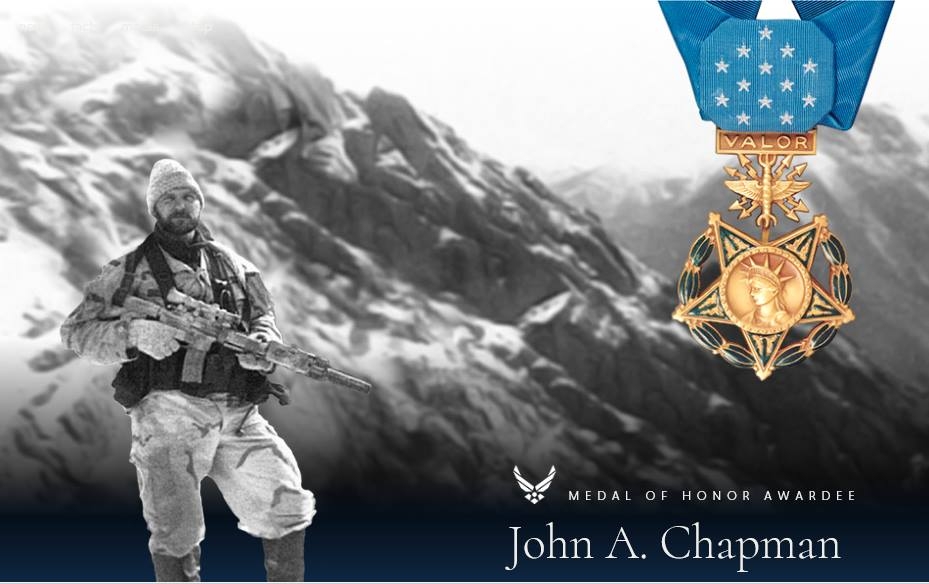
    The President of the United States of America takes pride in presenting the Medal of Honor (Posthumously) to (then) Technical Sergeant John A. Chapman, United States Air Force, for conspicuous gallantry and intrepidity at the risk of life above and beyond the call of duty.

    Technical Sergeant Chapman distinguished himself by extraordinary heroism as an Air Force Special Tactics Combat Controller of the 24th Special Tactics Squadron, attached to a Navy Sea, Air, and Land (SEAL) Team conducting reconnaissance operations in Takur Ghar, Afghanistan, on 4 March 2002.

    During insertion, the team’s helicopter was ambushed causing a teammate to fall into an entrenched group of enemy combatants below.

    Sergeant Chapman and the team voluntarily reinserted onto the snow-capped mountain, into the heart of a known enemy stronghold to rescue one of their own.

    Without regard for his own safety, Sergeant Chapman immediately engaged, moving in the direction of the closest enemy position despite coming under heavy fire from multiple directions.

    He fearlessly charged an enemy bunker, up a steep incline in thigh-deep snow and into hostile fire, directly engaging the enemy.

    Upon reaching the bunker, Sergeant Chapman assaulted and cleared the position, killing all enemy occupants.

    With complete disregard for his own life, Sergeant Chapman deliberately moved from cover only 12 meters from the enemy, and exposed himself once again to attack a second bunker, from which an emplaced machine gun was firing on his team.

    During this assault from an exposed position directly in the line of intense fire, Sergeant Chapman was struck and injured by enemy fire.

    Despite severe, mortal wounds, he continued to fight relentlessly, sustaining a violent engagement with multiple enemy personnel before making the ultimate sacrifice.

    By his heroic actions and extraordinary valor, sacrificing his life for the lives of his teammates, Technical Sergeant Chapman upheld the highest traditions of military service and reflected great credit upon himself and the United States Air Force.

    #medalofhonor #moh #neverforgotten #honor #courage #bravery #airforce #cct #combatcontroller #firstthere

    Air Force Special Operations Command
    Air Force Special Tactics
    via: USAF Special Warfare Recruiting · This Sunday’s Hero Story… The President of the United States of America takes pride in presenting the Medal of Honor (Posthumously) to (then) Technical Sergeant John A. Chapman, United States Air Force, for conspicuous gallantry and intrepidity at the risk of life above and beyond the call of duty. Technical Sergeant Chapman distinguished himself by extraordinary heroism as an Air Force Special Tactics Combat Controller of the 24th Special Tactics Squadron, attached to a Navy Sea, Air, and Land (SEAL) Team conducting reconnaissance operations in Takur Ghar, Afghanistan, on 4 March 2002. During insertion, the team’s helicopter was ambushed causing a teammate to fall into an entrenched group of enemy combatants below. Sergeant Chapman and the team voluntarily reinserted onto the snow-capped mountain, into the heart of a known enemy stronghold to rescue one of their own. Without regard for his own safety, Sergeant Chapman immediately engaged, moving in the direction of the closest enemy position despite coming under heavy fire from multiple directions. He fearlessly charged an enemy bunker, up a steep incline in thigh-deep snow and into hostile fire, directly engaging the enemy. Upon reaching the bunker, Sergeant Chapman assaulted and cleared the position, killing all enemy occupants. With complete disregard for his own life, Sergeant Chapman deliberately moved from cover only 12 meters from the enemy, and exposed himself once again to attack a second bunker, from which an emplaced machine gun was firing on his team. During this assault from an exposed position directly in the line of intense fire, Sergeant Chapman was struck and injured by enemy fire. Despite severe, mortal wounds, he continued to fight relentlessly, sustaining a violent engagement with multiple enemy personnel before making the ultimate sacrifice. By his heroic actions and extraordinary valor, sacrificing his life for the lives of his teammates, Technical Sergeant Chapman upheld the highest traditions of military service and reflected great credit upon himself and the United States Air Force. #medalofhonor #moh #neverforgotten #honor #courage #bravery #airforce #cct #combatcontroller #firstthere Air Force Special Operations Command Air Force Special Tactics
    Like
    1
    0 Comments 0 Shares 99463 Views

  • via: USAF Special Warfare Recruiting
    ·
    This Sunday’s Hero Story…

    The President of the United States of America awarded the Air Force Cross to Captain Barry F. Crawford, Jr., United States Air Force, for extraordinary heroism in military operations against an armed enemy of the United States as Special Tactics Officer of the 21st Special Tactics Squadron, in action near Laghman Province, Afghanistan, on 4 May 2010.

    On that date, while attached to Army Special Forces Operational Detachment Alpha and their Afghan partner force, Captain Crawford conducted a helicopter assault into Hendor Village. Upon landing, Captain Crawford received reports that multiple groups of armed enemy were maneuvering into prepared fighting positions in the high ground around the village. As the assault force initiated clearance operations, they began to receive a high volume of accurate machine gun and sniper fire from an enemy force well over 100 fighters. As the assault force was attacked, Captain Crawford took decisive action to save the lives of three wounded Afghan soldiers and evacuate two Afghan soldiers killed in action. Recognizing that the wounded Afghan soldiers would die without evacuation to definitive care, Captain Crawford took decisive action and ran out into the open in an effort to guide the helicopter to the landing zone. Once the pilot had eyes on his position, Captain Crawford remained exposed, despite having one of his radio antennas shot off mere inches from his face, while he vectored in the aircraft. Acting without hesitation, Captain Crawford then bounded across open terrain, engaged enemy positions with his assault rifle and called in AH-64 strafe attacks to defeat the ambush allowing the aid-and-litter teams to move toward the casualties. While the casualties were being moved the team's exposed position once again came under attack from two enemy trucks that had moved into the area and were threatening the medical evacuation landing zone. As one of the aid-and-litter teams was pinned down by enemy fire, and the medical evacuation helicopter took direct hits from small arms fire, it departed with only four casualties leaving one wounded Afghan soldier on the ground. Captain Crawford developed, coordinated, and executed a plan to suppress the enemy, enabling the helicopter to return to the hot landing zone to retrieve the last casualty. While Captain Crawford's element exfiltrated the village, the assault force conducted a two-kilometer movement over steep terrain with little to no cover. During this movement the ground force commander and Captain Crawford's element were ambushed and pinned down in the open from multiple enemy fighting positions, some as close as 150 meters away. Without regard for his own life, Captain Crawford moved alone across open terrain in the kill zone to locate and engage enemy positions with his assault rifle while directing AH-64 30-mm. strafe attacks. Continuing to move the team further over 1.5 kilometers of steep terrain with minimal cover, Captain Crawford again engaged the enemy with his assault rifle while integrating AH-64s and F-15E's in a coordinated air-to-ground attack plan that included strafing runs along with 500 and 2,0000-pound bomb and Hellfire missile strikes. Throughout the course of the ten-hour firefight, Captain Crawford braved effective enemy fire and consciously placed himself at grave risk on four occasions while controlling over 33 aircraft and more than 40 air strikes on a well-trained and well-prepared enemy force. His selfless actions and expert airpower employment neutralized a numerically superior enemy force and enabled friendly elements to exfiltrate the area without massive casualties. Through his extraordinary heroism, superb airmanship, and aggressiveness in the face of the enemy, Captain Crawford has reflected great credit upon himself and the United States Air Force.
    via: USAF Special Warfare Recruiting · This Sunday’s Hero Story… The President of the United States of America awarded the Air Force Cross to Captain Barry F. Crawford, Jr., United States Air Force, for extraordinary heroism in military operations against an armed enemy of the United States as Special Tactics Officer of the 21st Special Tactics Squadron, in action near Laghman Province, Afghanistan, on 4 May 2010. On that date, while attached to Army Special Forces Operational Detachment Alpha and their Afghan partner force, Captain Crawford conducted a helicopter assault into Hendor Village. Upon landing, Captain Crawford received reports that multiple groups of armed enemy were maneuvering into prepared fighting positions in the high ground around the village. As the assault force initiated clearance operations, they began to receive a high volume of accurate machine gun and sniper fire from an enemy force well over 100 fighters. As the assault force was attacked, Captain Crawford took decisive action to save the lives of three wounded Afghan soldiers and evacuate two Afghan soldiers killed in action. Recognizing that the wounded Afghan soldiers would die without evacuation to definitive care, Captain Crawford took decisive action and ran out into the open in an effort to guide the helicopter to the landing zone. Once the pilot had eyes on his position, Captain Crawford remained exposed, despite having one of his radio antennas shot off mere inches from his face, while he vectored in the aircraft. Acting without hesitation, Captain Crawford then bounded across open terrain, engaged enemy positions with his assault rifle and called in AH-64 strafe attacks to defeat the ambush allowing the aid-and-litter teams to move toward the casualties. While the casualties were being moved the team's exposed position once again came under attack from two enemy trucks that had moved into the area and were threatening the medical evacuation landing zone. As one of the aid-and-litter teams was pinned down by enemy fire, and the medical evacuation helicopter took direct hits from small arms fire, it departed with only four casualties leaving one wounded Afghan soldier on the ground. Captain Crawford developed, coordinated, and executed a plan to suppress the enemy, enabling the helicopter to return to the hot landing zone to retrieve the last casualty. While Captain Crawford's element exfiltrated the village, the assault force conducted a two-kilometer movement over steep terrain with little to no cover. During this movement the ground force commander and Captain Crawford's element were ambushed and pinned down in the open from multiple enemy fighting positions, some as close as 150 meters away. Without regard for his own life, Captain Crawford moved alone across open terrain in the kill zone to locate and engage enemy positions with his assault rifle while directing AH-64 30-mm. strafe attacks. Continuing to move the team further over 1.5 kilometers of steep terrain with minimal cover, Captain Crawford again engaged the enemy with his assault rifle while integrating AH-64s and F-15E's in a coordinated air-to-ground attack plan that included strafing runs along with 500 and 2,0000-pound bomb and Hellfire missile strikes. Throughout the course of the ten-hour firefight, Captain Crawford braved effective enemy fire and consciously placed himself at grave risk on four occasions while controlling over 33 aircraft and more than 40 air strikes on a well-trained and well-prepared enemy force. His selfless actions and expert airpower employment neutralized a numerically superior enemy force and enabled friendly elements to exfiltrate the area without massive casualties. Through his extraordinary heroism, superb airmanship, and aggressiveness in the face of the enemy, Captain Crawford has reflected great credit upon himself and the United States Air Force.
    Salute
    2
    0 Comments 0 Shares 54342 Views

  • via: USAF Special Warfare Recruiting
    ·
    This Sunday’s Hero Story…

    The President of the United States of America takes pride in presenting the Medal of Honor (Posthumously) to (then) Technical Sergeant John A. Chapman, United States Air Force, for conspicuous gallantry and intrepidity at the risk of life above and beyond the call of duty. Technical Sergeant Chapman distinguished himself by extraordinary heroism as an Air Force Special Tactics Combat Controller of the 24th Special Tactics Squadron, attached to a Navy Sea, Air, and Land (SEAL) Team conducting reconnaissance operations in Takur Ghar, Afghanistan, on 4 March 2002. During insertion, the team’s helicopter was ambushed causing a teammate to fall into an entrenched group of enemy combatants below. Sergeant Chapman and the team voluntarily reinserted onto the snow-capped mountain, into the heart of a known enemy stronghold to rescue one of their own. Without regard for his own safety, Sergeant Chapman immediately engaged, moving in the direction of the closest enemy position despite coming under heavy fire from multiple directions. He fearlessly charged an enemy bunker, up a steep incline in thigh-deep snow and into hostile fire, directly engaging the enemy. Upon reaching the bunker, Sergeant Chapman assaulted and cleared the position, killing all enemy occupants. With complete disregard for his own life, Sergeant Chapman deliberately moved from cover only 12 meters from the enemy, and exposed himself once again to attack a second bunker, from which an emplaced machine gun was firing on his team. During this assault from an exposed position directly in the line of intense fire, Sergeant Chapman was struck and injured by enemy fire. Despite severe, mortal wounds, he continued to fight relentlessly, sustaining a violent engagement with multiple enemy personnel before making the ultimate sacrifice. By his heroic actions and extraordinary valor, sacrificing his life for the lives of his teammates, Technical Sergeant Chapman upheld the highest traditions of military service and reflected great credit upon himself and the United States Air Force.

    #medalofhonor #moh #neverforgotten #honor #courage #bravery #airforce #cct #combatcontroller #firstthere

    Air Force Special Operations Command
    Air Force Special Tactics
    via: USAF Special Warfare Recruiting · This Sunday’s Hero Story… The President of the United States of America takes pride in presenting the Medal of Honor (Posthumously) to (then) Technical Sergeant John A. Chapman, United States Air Force, for conspicuous gallantry and intrepidity at the risk of life above and beyond the call of duty. Technical Sergeant Chapman distinguished himself by extraordinary heroism as an Air Force Special Tactics Combat Controller of the 24th Special Tactics Squadron, attached to a Navy Sea, Air, and Land (SEAL) Team conducting reconnaissance operations in Takur Ghar, Afghanistan, on 4 March 2002. During insertion, the team’s helicopter was ambushed causing a teammate to fall into an entrenched group of enemy combatants below. Sergeant Chapman and the team voluntarily reinserted onto the snow-capped mountain, into the heart of a known enemy stronghold to rescue one of their own. Without regard for his own safety, Sergeant Chapman immediately engaged, moving in the direction of the closest enemy position despite coming under heavy fire from multiple directions. He fearlessly charged an enemy bunker, up a steep incline in thigh-deep snow and into hostile fire, directly engaging the enemy. Upon reaching the bunker, Sergeant Chapman assaulted and cleared the position, killing all enemy occupants. With complete disregard for his own life, Sergeant Chapman deliberately moved from cover only 12 meters from the enemy, and exposed himself once again to attack a second bunker, from which an emplaced machine gun was firing on his team. During this assault from an exposed position directly in the line of intense fire, Sergeant Chapman was struck and injured by enemy fire. Despite severe, mortal wounds, he continued to fight relentlessly, sustaining a violent engagement with multiple enemy personnel before making the ultimate sacrifice. By his heroic actions and extraordinary valor, sacrificing his life for the lives of his teammates, Technical Sergeant Chapman upheld the highest traditions of military service and reflected great credit upon himself and the United States Air Force. #medalofhonor #moh #neverforgotten #honor #courage #bravery #airforce #cct #combatcontroller #firstthere Air Force Special Operations Command Air Force Special Tactics
    Like
    Salute
    2
    0 Comments 0 Shares 99234 Views
  • - AFSOC Combat Controller TSgt.John Chapman's family receives his Medal of Honor posthumously today -

    This is the FIRST Medal of Honor for a Special Tactics Airman -- & the 1st Airman since the Vietnam War.

    SUMMARY OF ACTION: BATTLE AT TAKUR GHAR

    Sergeant Chapman enlisted in the Air Force on Sept. 27, 1985, as an information systems operator, but felt called to be part of Air Force special operations. In 1989, he cross-trained to become an Air Force combat controller.

    According to friends and family, Sergeant Chapman had a tendency to make the difficult look effortless, and consistently sought new challenges. Dating back to his high school days, he made the varsity soccer squad as a freshman. Also an avid muscle-car enthusiast, he rebuilt and maintained an old Pontiac GTO.

    Combat control would prove to be another instance of “making it look easy.”

    Combat control training is more than two years long and amongst the most rigorous in the U.S. military. Only about one in ten Airmen who start the program graduate.

    From months of rigorous physical fitness training to multiple joint schools – including military SCUBA, Army static-line and freefall, air traffic control, and combat control schools – Sergeant Chapman is remembered as someone who could do anything put in front of him.

    “One remembers two types of students – the sharp ones and the really dull ones – and Chapman was in the sharp category,” said Ron Childress, a former Combat Control School instructor. Combat Control School is one of the most difficult points of a combat controller’s training program, from completing arduous tasks without sleeping for days, to running miles with weighted rucksacks and a gas mask.

    “During one of his first days at Combat Control School, I noticed a slight smirk on his face like [the training] was too simple for him…and it was,” said Childress.

    Following Combat Control School, Sergeant Chapman served with the 1721st Combat Control Squadron at Pope Air Force Base, North Carolina, where he met his wife, Valerie, in 1992. They had two daughters, who were the center of Sergeant Chapman’s world even when he was away from home – which was common in the combat control career field.

    “He would come home from a long trip and immediately have on his father hat – feeding, bathing, reading and getting his girls ready for bed,” said Chief Master Sgt. Michael West, who served with Sergeant Chapman through Combat Control School, a three-year tour in Okinawa, Japan, and at Pope Air Force Base. “They were his life and he was proud of them…to the Air Force he was a great hero…what I saw was a great father.”

    The Battle of Takur Ghar

    In conjunction with Operation Anaconda in March 2002, small reconnaissance teams were tasked to establish observation posts in strategic locations in Afghanistan, and when able, direct U.S. air power to destroy enemy targets. The mountain of Takur Ghar was an ideal spot for such an observation post, with excellent visibility to key locations. For Sergeant Chapman and his joint special operations teammates, the mission on the night of March 3 was to establish a reconnaissance position on Takur Ghar and report al Qaeda movement in the Sahi-Kowt area.

    “This was very high profile, no-fail job, and we picked John,” said retired Air Force Col. Ken Rodriguez, Sergeant Chapman’s commander at the time. “In a very high-caliber career field, with the highest quality of men – even then – John stood out as our guy.”

    During the initial insertion onto Afghanistan’s Takur Ghar mountaintop on March 4, the MH-47 “Chinook” helicopter carrying Sergeant Chapman and the joint special operations reconnaissance team was ambushed. A rocket propelled grenade struck the helicopter and bullets ripped through the fuselage. The blast ripped through the left side of the Chinook, throwing Navy Petty Officer 1st Class Neil Roberts off the ramp of the helicopter onto the enemy-infested mountaintop below.

    The severely damaged aircraft was unable to return for Petty Officer Roberts, and performed a controlled crash landing a few miles from the mountaintop. Thus began the chain of events that led to unparalleled acts of valor by numerous joint special operations forces, the deaths of seven U.S. servicemen and now, 16 years later, posthumous award of the Medal of Honor to Sergeant Chapman.

    Alone, against the elements and separated from his team with enemy personnel closing in, Petty Officer Roberts was in desperate need of support. The remaining joint special operations team members, fully aware of his precarious situation, immediately began planning a daring rescue attempt that included returning to the top of Takur Ghar where they had just taken heavy enemy fire.

    As the team returned to Petty Officer Roberts’ last-known position, now on a second MH-47, the entrenched enemy forces immediately engaged the approaching helicopter with heavy fire. Miraculously, the helicopter, although heavily damaged, was able to successfully offload the remaining special operations team members and return to base. Sergeant Chapman, upon exiting the helicopter, immediately charged uphill through the snow toward enemy positions while under heavy fire from three directions.

    Once on the ground, the team assessed the situation and moved quickly to the high ground. The most prominent cover and concealment on the hilltop were a large rock and tree. As they approached the tree, Sergeant Chapman received fire from two enemy personnel in a fortified position. He returned fire, charged the enemy position and took out the enemy combatants within.

    Almost immediately, the team began taking machine gun fire from another fortified enemy position only 12 meters away. Sergeant Chapman deliberately moved into the open to engage the new enemy position. As he heroically engaged the enemy, he was struck by a burst of gunfire and became critically injured.

    Sergeant Chapman regained his faculties and continued to fight relentlessly despite his severe wounds. He sustained a violent engagement with multiple enemy fighters, for over an hour through the arrival of the quick reaction force, before paying the ultimate sacrifice. In performance of these remarkably heroic actions, Sergeant Chapman is credited with saving the lives of his teammates.

    The upgrade to MOH

    “John was always selfless – it didn’t just emerge on Takur Ghar – he had always been selfless and highly competent, and thank God for all those qualities,” said Col. Rodriguez. “He could have hunkered down in the bunker and waited for the (Quick Reaction Force) and (Combat Search and Rescue) team to come in, but he assessed the situation and selflessly gave his life for them.”

    Sergeant Chapman was originally awarded the Air Force Cross for his actions; however, following a review of Air Force Cross and Silver Star recipients directed by then-Secretary of Defense Ash Carter, the Secretary of the Air Force recommended Sergeant Chapman’s Air Force Cross be upgraded to the Medal of Honor.

    In accordance with Air Force policy whereby Medal of Honor recipients are automatically promoted one grade on the first day of the month following the award, Sergeant Chapman will be posthumously promoted to the rank of master sergeant on Sept. 1, 2018.

    Although Sergeant Chapman will be awarded the Medal of Honor, family and friends have expressed his humility and how he would react today, if he were here.

    “If John were to find out he received the Medal of Honor, he would be very humbled and honored,” said Chief Master Sergeant West. “He was just doing his job, and that’s what he would say at this moment.”

    His widow, Valerie Nessel, has always known her husband was capable of such greatness, but asserts that John wouldn’t be anxious to be in the spotlight.

    “[John] would want to recognize the other men that lost their lives,” said Valerie. “Even though he did something he was awarded the Medal of Honor for, he would not want the other guys to be forgotten – that they were part of the team together.”

    “I think he would say that his Medal of Honor was not just for him, but for all of the guys who were lost,” she added.

    In total, seven service members lost their lives during the Battle of Takur Ghar:

    Petty Officer 1st Class Neil Roberts – U.S. Navy SEAL
    Technical Sergeant John Chapman – U.S. Air Force combat control
    Senior Airman Jason Cunningham – U.S. Air Force pararescue
    Corporal Matthew Commons – U.S. Army Ranger
    Sergeant Bradley Crose – U.S. Army Ranger
    Specialist Marc Anderson – U.S. Army Ranger
    Sergeant Philip Svitak – U.S. Army 160th Special Operations Aviation Regiment

    “John would have, so I’ll say it for him. Every American who set foot on that mountaintop acted with great courage and selflessness, and deserve all of our praise and admiration for the sacrifices they made,” said Col. Rodriguez.
    - AFSOC Combat Controller TSgt.John Chapman's family receives his Medal of Honor posthumously today - This is the FIRST Medal of Honor for a Special Tactics Airman -- & the 1st Airman since the Vietnam War. SUMMARY OF ACTION: BATTLE AT TAKUR GHAR Sergeant Chapman enlisted in the Air Force on Sept. 27, 1985, as an information systems operator, but felt called to be part of Air Force special operations. In 1989, he cross-trained to become an Air Force combat controller. According to friends and family, Sergeant Chapman had a tendency to make the difficult look effortless, and consistently sought new challenges. Dating back to his high school days, he made the varsity soccer squad as a freshman. Also an avid muscle-car enthusiast, he rebuilt and maintained an old Pontiac GTO. Combat control would prove to be another instance of “making it look easy.” Combat control training is more than two years long and amongst the most rigorous in the U.S. military. Only about one in ten Airmen who start the program graduate. From months of rigorous physical fitness training to multiple joint schools – including military SCUBA, Army static-line and freefall, air traffic control, and combat control schools – Sergeant Chapman is remembered as someone who could do anything put in front of him. “One remembers two types of students – the sharp ones and the really dull ones – and Chapman was in the sharp category,” said Ron Childress, a former Combat Control School instructor. Combat Control School is one of the most difficult points of a combat controller’s training program, from completing arduous tasks without sleeping for days, to running miles with weighted rucksacks and a gas mask. “During one of his first days at Combat Control School, I noticed a slight smirk on his face like [the training] was too simple for him…and it was,” said Childress. Following Combat Control School, Sergeant Chapman served with the 1721st Combat Control Squadron at Pope Air Force Base, North Carolina, where he met his wife, Valerie, in 1992. They had two daughters, who were the center of Sergeant Chapman’s world even when he was away from home – which was common in the combat control career field. “He would come home from a long trip and immediately have on his father hat – feeding, bathing, reading and getting his girls ready for bed,” said Chief Master Sgt. Michael West, who served with Sergeant Chapman through Combat Control School, a three-year tour in Okinawa, Japan, and at Pope Air Force Base. “They were his life and he was proud of them…to the Air Force he was a great hero…what I saw was a great father.” The Battle of Takur Ghar In conjunction with Operation Anaconda in March 2002, small reconnaissance teams were tasked to establish observation posts in strategic locations in Afghanistan, and when able, direct U.S. air power to destroy enemy targets. The mountain of Takur Ghar was an ideal spot for such an observation post, with excellent visibility to key locations. For Sergeant Chapman and his joint special operations teammates, the mission on the night of March 3 was to establish a reconnaissance position on Takur Ghar and report al Qaeda movement in the Sahi-Kowt area. “This was very high profile, no-fail job, and we picked John,” said retired Air Force Col. Ken Rodriguez, Sergeant Chapman’s commander at the time. “In a very high-caliber career field, with the highest quality of men – even then – John stood out as our guy.” During the initial insertion onto Afghanistan’s Takur Ghar mountaintop on March 4, the MH-47 “Chinook” helicopter carrying Sergeant Chapman and the joint special operations reconnaissance team was ambushed. A rocket propelled grenade struck the helicopter and bullets ripped through the fuselage. The blast ripped through the left side of the Chinook, throwing Navy Petty Officer 1st Class Neil Roberts off the ramp of the helicopter onto the enemy-infested mountaintop below. The severely damaged aircraft was unable to return for Petty Officer Roberts, and performed a controlled crash landing a few miles from the mountaintop. Thus began the chain of events that led to unparalleled acts of valor by numerous joint special operations forces, the deaths of seven U.S. servicemen and now, 16 years later, posthumous award of the Medal of Honor to Sergeant Chapman. Alone, against the elements and separated from his team with enemy personnel closing in, Petty Officer Roberts was in desperate need of support. The remaining joint special operations team members, fully aware of his precarious situation, immediately began planning a daring rescue attempt that included returning to the top of Takur Ghar where they had just taken heavy enemy fire. As the team returned to Petty Officer Roberts’ last-known position, now on a second MH-47, the entrenched enemy forces immediately engaged the approaching helicopter with heavy fire. Miraculously, the helicopter, although heavily damaged, was able to successfully offload the remaining special operations team members and return to base. Sergeant Chapman, upon exiting the helicopter, immediately charged uphill through the snow toward enemy positions while under heavy fire from three directions. Once on the ground, the team assessed the situation and moved quickly to the high ground. The most prominent cover and concealment on the hilltop were a large rock and tree. As they approached the tree, Sergeant Chapman received fire from two enemy personnel in a fortified position. He returned fire, charged the enemy position and took out the enemy combatants within. Almost immediately, the team began taking machine gun fire from another fortified enemy position only 12 meters away. Sergeant Chapman deliberately moved into the open to engage the new enemy position. As he heroically engaged the enemy, he was struck by a burst of gunfire and became critically injured. Sergeant Chapman regained his faculties and continued to fight relentlessly despite his severe wounds. He sustained a violent engagement with multiple enemy fighters, for over an hour through the arrival of the quick reaction force, before paying the ultimate sacrifice. In performance of these remarkably heroic actions, Sergeant Chapman is credited with saving the lives of his teammates. The upgrade to MOH “John was always selfless – it didn’t just emerge on Takur Ghar – he had always been selfless and highly competent, and thank God for all those qualities,” said Col. Rodriguez. “He could have hunkered down in the bunker and waited for the (Quick Reaction Force) and (Combat Search and Rescue) team to come in, but he assessed the situation and selflessly gave his life for them.” Sergeant Chapman was originally awarded the Air Force Cross for his actions; however, following a review of Air Force Cross and Silver Star recipients directed by then-Secretary of Defense Ash Carter, the Secretary of the Air Force recommended Sergeant Chapman’s Air Force Cross be upgraded to the Medal of Honor. In accordance with Air Force policy whereby Medal of Honor recipients are automatically promoted one grade on the first day of the month following the award, Sergeant Chapman will be posthumously promoted to the rank of master sergeant on Sept. 1, 2018. Although Sergeant Chapman will be awarded the Medal of Honor, family and friends have expressed his humility and how he would react today, if he were here. “If John were to find out he received the Medal of Honor, he would be very humbled and honored,” said Chief Master Sergeant West. “He was just doing his job, and that’s what he would say at this moment.” His widow, Valerie Nessel, has always known her husband was capable of such greatness, but asserts that John wouldn’t be anxious to be in the spotlight. “[John] would want to recognize the other men that lost their lives,” said Valerie. “Even though he did something he was awarded the Medal of Honor for, he would not want the other guys to be forgotten – that they were part of the team together.” “I think he would say that his Medal of Honor was not just for him, but for all of the guys who were lost,” she added. In total, seven service members lost their lives during the Battle of Takur Ghar: Petty Officer 1st Class Neil Roberts – U.S. Navy SEAL Technical Sergeant John Chapman – U.S. Air Force combat control Senior Airman Jason Cunningham – U.S. Air Force pararescue Corporal Matthew Commons – U.S. Army Ranger Sergeant Bradley Crose – U.S. Army Ranger Specialist Marc Anderson – U.S. Army Ranger Sergeant Philip Svitak – U.S. Army 160th Special Operations Aviation Regiment “John would have, so I’ll say it for him. Every American who set foot on that mountaintop acted with great courage and selflessness, and deserve all of our praise and admiration for the sacrifices they made,” said Col. Rodriguez.
    Salute
    1
    0 Comments 0 Shares 123836 Views
  • The Enduring Solitude Of Combat Vets:

    Retired Army Special Forces Sgt. Maj. Alan Farrell is one of the more interesting people in this country nowadays, a decorated veteran of the Vietnam War who teaches French at VMI, reviews films and writes poetry. Just your typical sergeant major/brigadier general with a Ph.D. in French and a fistful of other degrees.

    This is a speech that he gave to Vets at the Harvard Business School last Veterans' Day. I know it is long but well worth the read:
    --------
    "Ladies and Gentlemens:

    Kurt Vonnegut -- Corporal Vonnegut -- famously told an assembly like this one that his wife had begged him to "bring light into their tunnels" that night. "Can't do that," said Vonnegut, since, according to him, the audience would at once sense his duplicity, his mendacity, his insincerity... and have yet another reason for despair. I'll not likely have much light to bring into any tunnels this night, either.

    The remarks I'm about to make to you I've made before... in essence at least. I dare to make them again because other Veterans seem to approve. I speak mostly to Veterans. I don't have much to say to them, the others, civilians, real people. These remarks, I offer you for the reaction I got from one of them, though, a prison shrink. I speak in prisons a lot. Because some of our buddies wind up in there. Because their service was a Golden Moment in a life gone sour. Because... because no one else will.

    In the event, I've just got done saying what I'm about to say to you, when the prison psychologist sidles up to me to announce quietly: "You've got it." The "it," of course, is Post Stress Traumatic Traumatic Post Stress Disorder Stress... Post. Can never seem to get the malady nor the abbreviation straight. He's worried about me... that I'm wandering around loose... that I'm talking to his cons. So worried, but so sincere, that I let him make me an appointment at the V.A. for "diagnosis." Sincerity is a rare pearl.

    So I sulk in the stuffy anteroom of the V.A. shrink's office for the requisite two hours (maybe you have), finally get admitted. He's a nice guy. Asks me about my war, scans my 201 File, and, after what I take to be clinical scrutiny, announces without preamble: "You've got it." He can snag me, he says, 30 percent disability. Reimbursement, he says, from Uncle Sam, now till the end of my days. Oh, and by the way, he says, there's a cure. I'm not so sure that I want a cure for 30 percent every month. This inspires him to explain. He takes out a piece of paper and a Magic Marker™. Now: Anybody who takes out a frickin' Magic Marker™ to explain something to you thinks you're a bonehead and by that very gesture says so to God and everybody.

    Anyhow. He draws two big circles on a sheet of paper, then twelve small circles. Apples and grapes, you might say. In fact, he does say. The "grapes," he asserts, stand for the range of emotional response open to a healthy civilian, a normal person: titillation, for instance, then amusement, then pleasure, then joy, then delight and so on across the spectrum through mild distress on through angst -- whatever that is -- to black depression. The apples? That's what you got, traumatized veteran: Ecstasy and Despair. But we can fix that for you. We can make you normal.

    So here's my question: Why on earth would anybody want to be normal?

    And here's what triggered that curious episode:

    The words of the prophet Jeremiah:

    My bowels. My bowels. I am pained at my very heart; my heart maketh a noise in me... [T]hou hast heard, O my soul, the sound of the trumpet, the alarm of war. Destruction upon destruction is cried; for the whole land is spoilt and my curtains... How long shall I see the standard and hear the sound of the trumpet?

    I dunno about Jeremiah's bowels... or his curtains, but I've seen the standard and heard the sound of the trumpet. Again. Civilians mooing about that "Thin Red Line of 'eroes" between them and the Darkness. Again. ‘Course it's not red any more. Used to be olive drab. Then treetop camouflage. Then woodland. Then chocolate chip. Now pixelated, random computer-generated. Multi-cam next, is it? Progress. The kids are in the soup. Again. Me? I can't see the front sights of me piece any more. And if I can still lug my rucksack five miles, I need these days to be defibrillated when I get there. Nope. I got something like six Honorable Discharges from Pharaoh's Army. Your Mom's gonna be wearing Kevlar before I do. Nope. This one's on the kids, I'm afraid, the next generation.

    I can't help them. Not those who make the sacrifice in the desert nor those in the cesspool cities of a land that if two troopers from the One Oh One or two Lance Corporals could find on a map a few years ago, I'll be surprised. Nobody can help... except by trying to build a society Back Here that deserves such a sacrifice.

    We gonna win the war? I dunno. They tell me I lost mine. I know I didn't start it. Soldiers don't start wars. Civilians do. And civilians say when they're over. I'm just satisfied right now that these kids, for better or worse, did their duty as God gave them the light to see it. But I want them back. And I worry not about the fight, but about the after: after the war, after the victory, after... God forbid... the defeat, if it come to that. It's after that things get tricky. After that a Soldier needs the real grit and wit. And after that a Soldier needs to believe. Anybody can believe before. During? A Soldier has company in the fight, in Kandahar or Kabul, Basra or Baghdad. It's enough to believe in the others during. But after... and I can tell you this having come home from a war: After ...a Soldier is alone. A batch of them, maybe... but still alone.

    Years ago, maybe... when I was still in the Army, my A Team got the mission to support an Air Force escape and evasion exercise. Throw a bunch of downed pilots into the wilderness, let local guerrillas (us) feed them into a clandestine escape net and spirit them out by train just like in The Great Escape to... Baltimore, of all places. So we set up an elaborate underground network: farmhouses, caves, barns, pickup trucks, loads of hay where a guy can hide, fifty-five gallon drums to smuggle the evadees through checkpoints in. We've even cozened the Norfolk and Western Railroad out of a boxcar.

    Sooooo... come midnight, with our escapees safely stowed in that car, we wait for a special train to make a detour, back onto the siding, hook it up, and freight the pilots off to Maree-land. Pretty realistic, seems to us.

    Now, for safety's sake the Railroad requires a Line Administrator on site to supervise any special stop. Sure enough, just before midnight two suit-and-ties show up toting a red lantern. Civilians. We sniff at them disdainfully. One of them wigwags to the train. With a clank she couples the boxcar and chugs out into the night. The other guy -- frumpy Babbit from the front office -- shuffles off down the track and out onto a trestle bridge over the gorge. He stands there with his hands behind his back, peering up at the cloud-strewn summertime sky, a thousand bucks worth of Burberry overcoat riffling in the night breeze. I edge over respectfully behind him. Wait. He notices me after a while, looks back. "You know," he says, "Was on a night like this 40 years ago that I jumped into Normandy."

    Who'da thought?

    Who'da thought? Then I thought... back to right after my return from Vietnam. I'm working nights at a convenience store just down the road from this very spot. Lousy job. Whores, bums, burnouts, lowlifes. That's your clientele after midnight in a convenience store. One particular guy I remember drifts in every morning about 0400. Night work. Janitor, maybe. Not much to distinguish him from the rest of the early morning crowd of shadows shuffling around the place. Fingers and teeth yellowed from cigarette smoke. A weathered, leathered face that just dissolves into the colorless crowd of nobodies.

    Never says a word. Buys his margarine and macaroni and Miller's. Plunks down his cash. Hooks a grubby hand around his bag and threads his way out of the place and down the street. Lost in another world. Like the rest of the derelicts. One night, he's fumbling for his keys, drops them on the floor, sets his wallet on the counter -- brown leather, I still remember -- and the wallet flops open. Pinned to the inside of it, worn shiny and smooth, with its gold star gleaming out of the center: combat jump badge from that great World War II... Normandy maybe, just like the suit-and-tie.

    Who'da thought?

    Two guys scarred Out There. Not sure just where or how even. You can lose your life without dying. But the guy who made it to the top and the guy shambling along the bottom are what James Joyce calls in another context "secret messengers." Citizens among the rest, who look like the rest, talk like the rest, act like the rest... but who know prodigious secrets, wherever they wash up and whatever use they make of them. Who know somber despair but inexplicable laughter, the ache of duty but distrust of inaction. Who know risk and exaltation... and that awful drop though empty air we call failure... and solitude! They know solitude.

    Because solitude is what waits for the one who shall have borne the battle. Out There in it together... back here alone.

    Alone to make way in a scrappy, greedy, civilian world "filching lucre and gulping warm beer," as Conrad had it. Alone to learn the skills a self-absorbed, hustling, modern society values. Alone to unlearn the deadly skills of the former -- and bloody -- business. Alone to find a companion -- maybe -- and alone -- maybe -- even with that companion over a lifetime... for who can make someone else who hasn't seen it understand horror, blackness, filth Incommunicado. Voiceless. Alone.

    My Railroad president wandered off by himself to face his memories; my Store 24 regular was clearly a man alone with his.

    For my two guys, it was the after the battle that they endured, and far longer than the moment of terror in the battle. Did my Railroad exec learn in the dark of war to elbow other men aside, to view all other men as the enemy, to "fight" his way up the corporate ladder just as he fought his way out of the bocages of Normandy? Did he find he could never get close to a wife or children again and turn his energy, perhaps his anger toward some other and solitary goal Did the Store/24 guy never get out of his parachute harness and shiver in an endless night patrolled by demons he couldn't get shut of? Did he haul out that tattered wallet and shove his jump badge under the nose of those he'd done wrong to, disappointed, embarrassed? Did he find fewer and fewer citizens Back Here who even knew what it was? Did he keep it because he knew what it was? From what I've seen -- from a distance, of course -- of success, I'd say it's not necessarily sweeter than failure -- which I have seen close up.

    Well, that's what I said that woke up the prison shrink.
    And I say again to you that silence is the reward we reserve for you and your buddies, for my Cadets. Silence is the sound of Honor, which speaks no word and lays no tread. And Nothing is the glory of the one who's done Right. And Alone is the society of those who do it the Hard Way, alone even when they have comrades like themselves in the fight. I've gotta hope as a teacher that my Cadets, as a citizen that you and your buddies will have the inner resources, the stuff of inner life, the values in short, to abide the brute loneliness of after, to find the courage to continue the march, to do Right, to live with what they've done, you've done in our name, to endure that dark hour of frustration, humiliation, failure maybe... or victory, for one or the other is surely waiting Back Here. Unless you opt for those grapes...

    My two guys started at the same place and wound up at the far ends of the spectrum. As we measure their distance from that starting point, they seem to return to it: the one guy in the darkness drawn back to a Golden Moment in his life from a lofty vantage point; t'other guy lugging through God knows what gauntlet of shame and frustration that symbol of his Golden Moment. Today we celebrate your Golden Moment. While a whole generation went ganging after its own indulgence, vanity, appetite, you clung to a foolish commitment, to foolish old traditions; as Soldiers, Sailors, Pilots, Marines you honored pointless ritual, suffered the endless, sluggish monotony of duty, raised that flag not just once, or again, or -- as has become fashionable now -- in time of peril, but every single morning. You stuck it out. You may have had -- as we like to say -- the camaraderie of brothers or sisters to buck each other up or the dubious support (as we like to say... and say more than do, by the way) of the folks back home, us... but in the end you persevered alone. Just as alone you made that long walk from Out There with a duffle bag fulla pixelated, random computer-generated dirty laundry -- along with your bruised dreams, your ecstasy and your despair -- Back Here at tour's end.

    And you will be alone, for all the good intentions and solicitude of them, the other, the civilians. Alone. But...together. Your generation, whom us dumbo civilians couldn't keep out of war, will bear the burden of a soldier's return... alone. And a fresh duty: to complete the lives of your buddies who didn't make it back, to confect for them a living monument to their memory.

    Your comfort, such as it is, will come from the knowledge that others of that tiny fraction of the population that fought for us are alone but grappling with the same dilemmas -- often small and immediate, often undignified or humiliating, now and then immense and overwhelming -- by your persistence courting the risk, by your obstinacy clinging to that Hard Way. Some of you will be stronger than others, but even the strong ones will have their darker moments. Where we can join each other if not relieve each other, we secret messengers, is right here in places like this and on occasions like this -- one lousy day of the year, your day, my day, our day, -- in the company of each other and of the flag we served. Not much cheer in that kerugma. But there's the by-God glory.

    "I know..." says the prophet Isaiah:

    ... I know that thou art obstinate, and thy neck is an iron sinew, and thy brow brass...I have shewed thee new things, even hidden things. Behold, I have refined thee, but not with silver; I have [refined] thee...in the furnace of affliction...

    Well, all right, then. Why on earth would anybody want to be normal? Thanks for Listening and Lord love the lot of youse."
    The Enduring Solitude Of Combat Vets: Retired Army Special Forces Sgt. Maj. Alan Farrell is one of the more interesting people in this country nowadays, a decorated veteran of the Vietnam War who teaches French at VMI, reviews films and writes poetry. Just your typical sergeant major/brigadier general with a Ph.D. in French and a fistful of other degrees. This is a speech that he gave to Vets at the Harvard Business School last Veterans' Day. I know it is long but well worth the read: -------- "Ladies and Gentlemens: Kurt Vonnegut -- Corporal Vonnegut -- famously told an assembly like this one that his wife had begged him to "bring light into their tunnels" that night. "Can't do that," said Vonnegut, since, according to him, the audience would at once sense his duplicity, his mendacity, his insincerity... and have yet another reason for despair. I'll not likely have much light to bring into any tunnels this night, either. The remarks I'm about to make to you I've made before... in essence at least. I dare to make them again because other Veterans seem to approve. I speak mostly to Veterans. I don't have much to say to them, the others, civilians, real people. These remarks, I offer you for the reaction I got from one of them, though, a prison shrink. I speak in prisons a lot. Because some of our buddies wind up in there. Because their service was a Golden Moment in a life gone sour. Because... because no one else will. In the event, I've just got done saying what I'm about to say to you, when the prison psychologist sidles up to me to announce quietly: "You've got it." The "it," of course, is Post Stress Traumatic Traumatic Post Stress Disorder Stress... Post. Can never seem to get the malady nor the abbreviation straight. He's worried about me... that I'm wandering around loose... that I'm talking to his cons. So worried, but so sincere, that I let him make me an appointment at the V.A. for "diagnosis." Sincerity is a rare pearl. So I sulk in the stuffy anteroom of the V.A. shrink's office for the requisite two hours (maybe you have), finally get admitted. He's a nice guy. Asks me about my war, scans my 201 File, and, after what I take to be clinical scrutiny, announces without preamble: "You've got it." He can snag me, he says, 30 percent disability. Reimbursement, he says, from Uncle Sam, now till the end of my days. Oh, and by the way, he says, there's a cure. I'm not so sure that I want a cure for 30 percent every month. This inspires him to explain. He takes out a piece of paper and a Magic Marker™. Now: Anybody who takes out a frickin' Magic Marker™ to explain something to you thinks you're a bonehead and by that very gesture says so to God and everybody. Anyhow. He draws two big circles on a sheet of paper, then twelve small circles. Apples and grapes, you might say. In fact, he does say. The "grapes," he asserts, stand for the range of emotional response open to a healthy civilian, a normal person: titillation, for instance, then amusement, then pleasure, then joy, then delight and so on across the spectrum through mild distress on through angst -- whatever that is -- to black depression. The apples? That's what you got, traumatized veteran: Ecstasy and Despair. But we can fix that for you. We can make you normal. So here's my question: Why on earth would anybody want to be normal? And here's what triggered that curious episode: The words of the prophet Jeremiah: My bowels. My bowels. I am pained at my very heart; my heart maketh a noise in me... [T]hou hast heard, O my soul, the sound of the trumpet, the alarm of war. Destruction upon destruction is cried; for the whole land is spoilt and my curtains... How long shall I see the standard and hear the sound of the trumpet? I dunno about Jeremiah's bowels... or his curtains, but I've seen the standard and heard the sound of the trumpet. Again. Civilians mooing about that "Thin Red Line of 'eroes" between them and the Darkness. Again. ‘Course it's not red any more. Used to be olive drab. Then treetop camouflage. Then woodland. Then chocolate chip. Now pixelated, random computer-generated. Multi-cam next, is it? Progress. The kids are in the soup. Again. Me? I can't see the front sights of me piece any more. And if I can still lug my rucksack five miles, I need these days to be defibrillated when I get there. Nope. I got something like six Honorable Discharges from Pharaoh's Army. Your Mom's gonna be wearing Kevlar before I do. Nope. This one's on the kids, I'm afraid, the next generation. I can't help them. Not those who make the sacrifice in the desert nor those in the cesspool cities of a land that if two troopers from the One Oh One or two Lance Corporals could find on a map a few years ago, I'll be surprised. Nobody can help... except by trying to build a society Back Here that deserves such a sacrifice. We gonna win the war? I dunno. They tell me I lost mine. I know I didn't start it. Soldiers don't start wars. Civilians do. And civilians say when they're over. I'm just satisfied right now that these kids, for better or worse, did their duty as God gave them the light to see it. But I want them back. And I worry not about the fight, but about the after: after the war, after the victory, after... God forbid... the defeat, if it come to that. It's after that things get tricky. After that a Soldier needs the real grit and wit. And after that a Soldier needs to believe. Anybody can believe before. During? A Soldier has company in the fight, in Kandahar or Kabul, Basra or Baghdad. It's enough to believe in the others during. But after... and I can tell you this having come home from a war: After ...a Soldier is alone. A batch of them, maybe... but still alone. Years ago, maybe... when I was still in the Army, my A Team got the mission to support an Air Force escape and evasion exercise. Throw a bunch of downed pilots into the wilderness, let local guerrillas (us) feed them into a clandestine escape net and spirit them out by train just like in The Great Escape to... Baltimore, of all places. So we set up an elaborate underground network: farmhouses, caves, barns, pickup trucks, loads of hay where a guy can hide, fifty-five gallon drums to smuggle the evadees through checkpoints in. We've even cozened the Norfolk and Western Railroad out of a boxcar. Sooooo... come midnight, with our escapees safely stowed in that car, we wait for a special train to make a detour, back onto the siding, hook it up, and freight the pilots off to Maree-land. Pretty realistic, seems to us. Now, for safety's sake the Railroad requires a Line Administrator on site to supervise any special stop. Sure enough, just before midnight two suit-and-ties show up toting a red lantern. Civilians. We sniff at them disdainfully. One of them wigwags to the train. With a clank she couples the boxcar and chugs out into the night. The other guy -- frumpy Babbit from the front office -- shuffles off down the track and out onto a trestle bridge over the gorge. He stands there with his hands behind his back, peering up at the cloud-strewn summertime sky, a thousand bucks worth of Burberry overcoat riffling in the night breeze. I edge over respectfully behind him. Wait. He notices me after a while, looks back. "You know," he says, "Was on a night like this 40 years ago that I jumped into Normandy." Who'da thought? Who'da thought? Then I thought... back to right after my return from Vietnam. I'm working nights at a convenience store just down the road from this very spot. Lousy job. Whores, bums, burnouts, lowlifes. That's your clientele after midnight in a convenience store. One particular guy I remember drifts in every morning about 0400. Night work. Janitor, maybe. Not much to distinguish him from the rest of the early morning crowd of shadows shuffling around the place. Fingers and teeth yellowed from cigarette smoke. A weathered, leathered face that just dissolves into the colorless crowd of nobodies. Never says a word. Buys his margarine and macaroni and Miller's. Plunks down his cash. Hooks a grubby hand around his bag and threads his way out of the place and down the street. Lost in another world. Like the rest of the derelicts. One night, he's fumbling for his keys, drops them on the floor, sets his wallet on the counter -- brown leather, I still remember -- and the wallet flops open. Pinned to the inside of it, worn shiny and smooth, with its gold star gleaming out of the center: combat jump badge from that great World War II... Normandy maybe, just like the suit-and-tie. Who'da thought? Two guys scarred Out There. Not sure just where or how even. You can lose your life without dying. But the guy who made it to the top and the guy shambling along the bottom are what James Joyce calls in another context "secret messengers." Citizens among the rest, who look like the rest, talk like the rest, act like the rest... but who know prodigious secrets, wherever they wash up and whatever use they make of them. Who know somber despair but inexplicable laughter, the ache of duty but distrust of inaction. Who know risk and exaltation... and that awful drop though empty air we call failure... and solitude! They know solitude. Because solitude is what waits for the one who shall have borne the battle. Out There in it together... back here alone. Alone to make way in a scrappy, greedy, civilian world "filching lucre and gulping warm beer," as Conrad had it. Alone to learn the skills a self-absorbed, hustling, modern society values. Alone to unlearn the deadly skills of the former -- and bloody -- business. Alone to find a companion -- maybe -- and alone -- maybe -- even with that companion over a lifetime... for who can make someone else who hasn't seen it understand horror, blackness, filth Incommunicado. Voiceless. Alone. My Railroad president wandered off by himself to face his memories; my Store 24 regular was clearly a man alone with his. For my two guys, it was the after the battle that they endured, and far longer than the moment of terror in the battle. Did my Railroad exec learn in the dark of war to elbow other men aside, to view all other men as the enemy, to "fight" his way up the corporate ladder just as he fought his way out of the bocages of Normandy? Did he find he could never get close to a wife or children again and turn his energy, perhaps his anger toward some other and solitary goal Did the Store/24 guy never get out of his parachute harness and shiver in an endless night patrolled by demons he couldn't get shut of? Did he haul out that tattered wallet and shove his jump badge under the nose of those he'd done wrong to, disappointed, embarrassed? Did he find fewer and fewer citizens Back Here who even knew what it was? Did he keep it because he knew what it was? From what I've seen -- from a distance, of course -- of success, I'd say it's not necessarily sweeter than failure -- which I have seen close up. Well, that's what I said that woke up the prison shrink. And I say again to you that silence is the reward we reserve for you and your buddies, for my Cadets. Silence is the sound of Honor, which speaks no word and lays no tread. And Nothing is the glory of the one who's done Right. And Alone is the society of those who do it the Hard Way, alone even when they have comrades like themselves in the fight. I've gotta hope as a teacher that my Cadets, as a citizen that you and your buddies will have the inner resources, the stuff of inner life, the values in short, to abide the brute loneliness of after, to find the courage to continue the march, to do Right, to live with what they've done, you've done in our name, to endure that dark hour of frustration, humiliation, failure maybe... or victory, for one or the other is surely waiting Back Here. Unless you opt for those grapes... My two guys started at the same place and wound up at the far ends of the spectrum. As we measure their distance from that starting point, they seem to return to it: the one guy in the darkness drawn back to a Golden Moment in his life from a lofty vantage point; t'other guy lugging through God knows what gauntlet of shame and frustration that symbol of his Golden Moment. Today we celebrate your Golden Moment. While a whole generation went ganging after its own indulgence, vanity, appetite, you clung to a foolish commitment, to foolish old traditions; as Soldiers, Sailors, Pilots, Marines you honored pointless ritual, suffered the endless, sluggish monotony of duty, raised that flag not just once, or again, or -- as has become fashionable now -- in time of peril, but every single morning. You stuck it out. You may have had -- as we like to say -- the camaraderie of brothers or sisters to buck each other up or the dubious support (as we like to say... and say more than do, by the way) of the folks back home, us... but in the end you persevered alone. Just as alone you made that long walk from Out There with a duffle bag fulla pixelated, random computer-generated dirty laundry -- along with your bruised dreams, your ecstasy and your despair -- Back Here at tour's end. And you will be alone, for all the good intentions and solicitude of them, the other, the civilians. Alone. But...together. Your generation, whom us dumbo civilians couldn't keep out of war, will bear the burden of a soldier's return... alone. And a fresh duty: to complete the lives of your buddies who didn't make it back, to confect for them a living monument to their memory. Your comfort, such as it is, will come from the knowledge that others of that tiny fraction of the population that fought for us are alone but grappling with the same dilemmas -- often small and immediate, often undignified or humiliating, now and then immense and overwhelming -- by your persistence courting the risk, by your obstinacy clinging to that Hard Way. Some of you will be stronger than others, but even the strong ones will have their darker moments. Where we can join each other if not relieve each other, we secret messengers, is right here in places like this and on occasions like this -- one lousy day of the year, your day, my day, our day, -- in the company of each other and of the flag we served. Not much cheer in that kerugma. But there's the by-God glory. "I know..." says the prophet Isaiah: ... I know that thou art obstinate, and thy neck is an iron sinew, and thy brow brass...I have shewed thee new things, even hidden things. Behold, I have refined thee, but not with silver; I have [refined] thee...in the furnace of affliction... Well, all right, then. Why on earth would anybody want to be normal? Thanks for Listening and Lord love the lot of youse."
    Like
    Salute
    2
    1 Comments 0 Shares 83166 Views
  • Triple Canopy - Airborne, Ranger and Special Forces
    ·
    First day, Desert Storm, 1991, February 25:

    Seventy miles to the east, eight Special Forces soldiers from ODA 525 landed near the small village of Swayjghazi. CWO “Bulldog” Balwanz had his team dig two hide sites, 300 yards west Highway 7. This team had the same problem as Sims’ Team. They did not think that villagers would be wandering around their position, located near a drainage ditch. However as soon as the sun came up shepherds led their goats near the Special Forces team, while women and children gathered firewood. Just like Sims’ Team, children discovered the hide site. Balwanz knew that they could not shoot children, so after they were discovered the Team moved 400 yards away and into a muddy ditch. The children returned with a young man, who spotted the Americans. “As-Salaam Aleykum” Balwanz called to him, but the young man turned and hurried back to the village.

    Thirty villagers returned, armed with rifles. As they fanned out across the field four trucks arrived, along with a bus and a Land Rover. The vehicles unloaded 150 Iraqi soldiers. Balwanz called XVIII Corps headquarters and told them that he needed immediate extraction and air support. Balwanz ordered his men to pile all their rucksacks and equipment outside the ditch, and then primed it with a block of C-4 plastic explosive. The Americans only kept their weapons, ammo, and a single satellite radio. The C-4 exploded just as a group of Iraqis reached the pile.

    Bullets tore through the dirt around them, as the Americans returned fire with M16s and M203 grenade launchers. The Iraqis resorted to human wave attacks, but they never quite understood the accuracy of American soldiers.

    In just the first ten minutes of the fight Balwanz and his men killed about forty Iraqi soldiers. The fighting continued, with no end in sight. Though the field was littered with Iraqi bodies, the men did not see any rescue in their future. Balwanz saw his men wave farewell to each other across the sides of the ditch.

    Just as the Iraqis were close enough to rush the Team, several F-16s arrived and dropped cluster bombs on the highway. Balwanz used his survival radio to direct bombs to within 200 yards of his position. A group of Iraqis charged down the ditch, trying to stay clear of the F-16s, but Balwanz and one of his sergeants stopped their attack.

    Balwanz moved his men 300 yards away in all the chaos, without the Iraqis being aware of it. After an hour and a half two rescue helicopters were able to land right on top of the team, and rescue Balwanz and his men.

    With 150 Iraqis dead in the field, it probably seemed to the Iraqis that they had been rescued from the demons that had been unleashed upon their small village.

    HOOAH!
    Triple Canopy - Airborne, Ranger and Special Forces · First day, Desert Storm, 1991, February 25: Seventy miles to the east, eight Special Forces soldiers from ODA 525 landed near the small village of Swayjghazi. CWO “Bulldog” Balwanz had his team dig two hide sites, 300 yards west Highway 7. This team had the same problem as Sims’ Team. They did not think that villagers would be wandering around their position, located near a drainage ditch. However as soon as the sun came up shepherds led their goats near the Special Forces team, while women and children gathered firewood. Just like Sims’ Team, children discovered the hide site. Balwanz knew that they could not shoot children, so after they were discovered the Team moved 400 yards away and into a muddy ditch. The children returned with a young man, who spotted the Americans. “As-Salaam Aleykum” Balwanz called to him, but the young man turned and hurried back to the village. Thirty villagers returned, armed with rifles. As they fanned out across the field four trucks arrived, along with a bus and a Land Rover. The vehicles unloaded 150 Iraqi soldiers. Balwanz called XVIII Corps headquarters and told them that he needed immediate extraction and air support. Balwanz ordered his men to pile all their rucksacks and equipment outside the ditch, and then primed it with a block of C-4 plastic explosive. The Americans only kept their weapons, ammo, and a single satellite radio. The C-4 exploded just as a group of Iraqis reached the pile. Bullets tore through the dirt around them, as the Americans returned fire with M16s and M203 grenade launchers. The Iraqis resorted to human wave attacks, but they never quite understood the accuracy of American soldiers. In just the first ten minutes of the fight Balwanz and his men killed about forty Iraqi soldiers. The fighting continued, with no end in sight. Though the field was littered with Iraqi bodies, the men did not see any rescue in their future. Balwanz saw his men wave farewell to each other across the sides of the ditch. Just as the Iraqis were close enough to rush the Team, several F-16s arrived and dropped cluster bombs on the highway. Balwanz used his survival radio to direct bombs to within 200 yards of his position. A group of Iraqis charged down the ditch, trying to stay clear of the F-16s, but Balwanz and one of his sergeants stopped their attack. Balwanz moved his men 300 yards away in all the chaos, without the Iraqis being aware of it. After an hour and a half two rescue helicopters were able to land right on top of the team, and rescue Balwanz and his men. With 150 Iraqis dead in the field, it probably seemed to the Iraqis that they had been rescued from the demons that had been unleashed upon their small village. HOOAH!
    Love
    1
    1 Comments 0 Shares 39760 Views
  • via: The Giant Killer
    ·
    Pictured are the eight U.S. Marines of the suicide mission "Doom Patrol" to recover the body of a dead Marine, Charlie Company, 7th Marine in Quảng Nam Province, 1968.

    In February 1968, eight Marines volunteered for a suicide mission. After 32 US casualties were incurred during the first 30 hours of Operation Pursuit. The operation was initiated in mid-February 1968 by the 1st Marine Division to search for enemy rocket caches in the mountains west of Da Nang.

    Operation Pursuit began at 11 a.m. on Feb. 14 as Charlie Company crossed the western end of Hill 10 while Delta Company departed from Hill 41, about 2 miles to the southeast. Accompanying them were 1st Division combat correspondent Sgt. Robert Bayer and photographer Cpl. R.J. Del Vecchio.

    The two companies linked up on the approach to Hills 270 and 310. The dense jungle growth at the base of Hill 270 channeled the Marines into a single-file column during the slow, exhausting climb that forced the men to hack out a trail with machetes. By 6:30 p.m., Delta Company had secured Objective 1, the saddle between Hills 270 and 310. Charlie Company had secured Objective 2, the top of Hill 270.

    Pfc. Michael J. Kelly, a member of the point squad who had been with the company for only two months, was hit by an enemy bullet that struck a grenade on his cartridge belt. The detonation killed Kelly, severing a leg in the process.

    Lt. Col. Bill Davis ordered Charlie and Delta companies of the 1st Battalion, 7th Marine Regiment, to get off Hills 270 and 310 and return to their base camps in the flatlands to the east.

    A little later the morning of Feb. 16, the acting commander of Charlie Company, 1st Lt. Dana F. MacCormack, whose men were descending from Hill 270, radioed Davis: “Here come the NVA, Colonel! I’ve got one more KIA that the last helo did not have room for. We are having a hell of a time carrying this body, and the bones are cutting up the body bag.”

    Davis, on Hill 310 with the battalion command group, told MacCormack to get Charlie Company off the mountain immediately to avoid any more casualties. And that meant leaving the body behind.

    Thousands of North Vietnamese Army troops had trekked down the Ho Chi Minh Trail in eastern Laos and moved through South Vietnam’s A Shau Valley before making their way to high ground, including Hills 270 and 310, overlooking an area known as Happy Valley and the Marine positions to the east.

    In early afternoon, out of food and water and low on ammunition, the weary, battle-shocked Marines of Charlie Company arrived at Hill 10 and were met by the actual company commander, Capt. Karl Ripplemeyer, who had been on leave and just returned. Delta Company, meanwhile, had reached its base camp on Hill 41.

    Davis radioed the regimental commander, Col. Ross R. Miner, and told him that the Marines were back at the command posts, but added that a dead Marine had to be left behind. A few hours later, Miner told Davis that a B-52 bombing mission was scheduled to strike Hills 270 and 310 and ordered him to send a team to recover Kelly’s body before the bombing started. Davis, however, did not want to risk any more lives in those mountains before the bombing runs were completed and argued against an immediate recovery mission, but Miner wouldn’t rescind his order.

    Davis discussed Miner’s order with Ripplemeyer, as well as the battalion operations officer and the officer who coordinated air support for the battalion. Davis decided to use Charlie Company volunteers for the recovery since they knew the location of Kelly’s body.

    “It was 100% a suicide mission,” Whittier, the 2nd Platoon lieutenant, would write to his wife on Feb. 17. “This is a point I can’t too heavily emphasize.”

    “Suicide mission” was an unintentionally appropriate term, given Charlie Company’s longstanding nickname: “Suicide Charley.” The unit had earned its nickname during the October 1942 Japanese assault on Guadalcanal, when 1st Battalion was led by Lt. Col. Lewis B. “Chesty” Puller, who later became the Corps’ most decorated Marine and finished his career as a lieutenant general. During that battle, Charlie Company held its line against a far larger Japanese force despite suffering heavy losses. The day after the fight, a white flag of parachute cloth with a picture of a skull and crossbones rose over the company’s position. Emblazoned on the flag was “Suicide Charley.”

    The patrol to recover Kelly’s body had only a few hours to prepare for its departure. A runner was sent to Charlie Company seeking the volunteers, including an experienced squad leader. John D. McCreless, then a 20-year-old sergeant, recalled: “When the decision came down to use a squad of volunteers, I got crazy and raised my hand and said I’d lead it.”

    Lance Cpl. Stephen B. McCashin responded similarly: “When I heard they were asking for volunteers, I said anyone who would go back into those mountains again would have to be crazy. I thought it was a suicide mission, but since I’m on my second tour here, I must be crazy, so I decided to go.”

    Pfc. Joseph A. Hamrick signed up because, he said, “I was the only one of the volunteers who knew exactly where the body was, so even though I had only been in the ‘Nam’ for a month and had never walked point, I figured I could go right to it.”

    The other Marines on the eight-man patrol were Pfc. Thomas M. Adamson, Lance Cpl. Tyree Albert Chamberlain, Pfc. Alfred P. Granados, Cpl. Billy R. Ranes and Pfc. Pedro A. Rodriguez. Someone—no one can remember exactly who—dubbed the volunteers the “Doom Patrol.”

    Granados, the radio operator, remembers their preparations. “Our equipment was light for a short recon patrol—no helmets, flak jackets or cartridge belts, and all but one of the men of the Doom Patrol asked to trade their M16s for the more reliable M14, and permission was granted,” he said. “We were to make no enemy contact, travel by stealth in the dark, get the body and return. If we ran into a superior enemy force, we were to abort, split up and get back any way we could.”

    Before the men departed, a senior staff sergeant told McCreless: “None of you will probably return alive, but to increase your chances, if things get hairy you can just bring back the leg.” The eight Marines weren’t totally on their own for the mission. The battalion air officer had arranged for continuous air support for the patrol.

    At 2 a.m. on Feb. 17, McCreless’ squad left Hill 10. A little more than an hour later, near the abandoned village of Phuoc Ninh —military maps distinguished villages with the same name by numbering them—the Marines spotted NVA soldiers moving toward their position. Chamberlain opened fire and killed one of them, but the patrol was now compromised. McCreless faced a difficult decision: abort the mission or stay the course. He spoke to the battalion command center and was told to proceed. No one wanted an empty casket sent to Kelly’s family, and the men on the mission knew the odds when they volunteered.

    On the move again toward the base of Hill 270, the Marines observed another enemy patrol, and McCreless stopped for an hour near another abandoned village, Phuoc Ninh, a precautionary pause in the dark to make sure there was no other NVA activity in the area before continuing their journey.

    By sunrise, around 5 a.m., the patrol had cleared the open rice paddy areas and started into the dense jungle on the side of the mountain—with a long march still ahead, which meant they would have to conduct their “stealth” mission in broad daylight. Three hours later, the men were in a flat area above the bomb crater where Kelly’s body lay, covered with a poncho. There they waited while pilots in O1-Bird Dog propeller-driven planes called in airstrikes.

    One of the pilots radioed McCreless to tell him that napalm drops by F-4 Phantom II fighter-bombers would land just forward of the bomb crater. He instructed the patrol members to take cover, take three deep breaths, exhale and hold their next breath. The napalm struck about a 100 yards in front of the patrol.
    Granados still remembers the intense heat and dust being sucked past his face into the inferno. The shock waves from the blast seemed to raise him off the ground.

    After the napalm flames diminished, Granados saw NVA soldiers emerging from bunkers and spider holes.
    McCreless, worried that the enemy troops were about to move against his seriously outnumbered men, yelled: “Get the leg, and let’s get the hell out!”

    Moments later, Ranes and Adamson dashed to the crater. They grabbed the severed leg and quickly strapped it to a backpack that Chamberlain carried. The eight Marines then ran back down the trail, amid the still-smoldering napalm and the enemy fire tearing into trees and brush around them. A final strafing run by F-4 Phantoms silenced the firing.

    After reaching the flatlands, the patrol came upon Charlie Company’s 1st Platoon, sent to assist the squad if any of the men had been wounded or killed. The platoon escorted McCreless’ squad to base camp, and by 2 p.m. all the Marines were back on Hill 10.

    Amid great rejoicing, Davis summoned the men to his quarters and handed them cigars and cold beer to celebrate their incredible accomplishment. (He wasn’t aware at that time that the full body had not been recovered.) As recounted in his autobiography Tet Marine, Davis told the Doom Patrol that he had been a fan of Suicide Charley since the Chosin Reservoir battle during the Korean War. “I’ve been proud of them during all these years, because they did great things at the Reservoir,” he said. “But never did they do anything greater than YOU did, as volunteers, last night and today.”

    McCreless said: “The only reason I can think of why we were able to pull it off is that the NVA just couldn’t believe that we were stupid enough to go in there and do what we did. They must have thought we were bait for some kind of trap.”

    After the celebration, Davis typed a letter to the commander of the 7th Marine Regiment:

    “Dear Colonel Miner, I’ve never been prouder to be a Marine than at this moment! This magnificent squad [from Suicide Charley] went on what appeared to be a suicide mission. I wish you could have heard this young Marine [Pfc. Joseph Hamrick] describe why he volunteered. He just couldn’t imagine that an empty casket would go to a Marine’s parents. He knew they had to do the job, and while he was scared all the way out, and all the way back, he knew that they just had to succeed. I’ve just lived through an experience that I’ll always hold dear to me. Semper Fi.”

    Within 10 hours of the patrol’s return, the B-52s from Andersen Air Force Base on Guam devastated the high ground on Hills 270 and 310. But the NVA would return to Hill 310, and many more Marines were wounded or killed there the following month during Operation Worth and in August during Operation Mameluke Thrust.

    On March 8, Whittier and McCreless were wounded. Later that day, at the Navy hospital in Da Nang, Whittier died from his wounds. A few days later, McCreless was medevaced to Japan for additional surgery. During fighting on May 30, Doom Patrol volunteer Rodriguez was killed.

    Men from E Company, 2nd Battalion, 7th Marines, found Kelly’s body on March 25 during Operation Worth. A medevac helicopter picked up the remains and took them to the mortuary in Da Nang. A funeral with a casket containing Kelly’s leg was held in his hometown of Findlay, Ohio, in March 1968. A second funeral, with the rest of his remains, was held in April 1968.

    Story by Jack Wells
    — Jack Wells served in Vietnam during 1968-69 as an artillery forward observer with Alpha and Bravo companies, 1st Battalion, 7th Marine Regiment, 1st Marine Division, and later as executive officer of H Battery, 3rd Battalion, 11th Marine Regiment, 1st Marine Division.

    SALUTE!
    via: The Giant Killer · Pictured are the eight U.S. Marines of the suicide mission "Doom Patrol" to recover the body of a dead Marine, Charlie Company, 7th Marine in Quảng Nam Province, 1968. In February 1968, eight Marines volunteered for a suicide mission. After 32 US casualties were incurred during the first 30 hours of Operation Pursuit. The operation was initiated in mid-February 1968 by the 1st Marine Division to search for enemy rocket caches in the mountains west of Da Nang. Operation Pursuit began at 11 a.m. on Feb. 14 as Charlie Company crossed the western end of Hill 10 while Delta Company departed from Hill 41, about 2 miles to the southeast. Accompanying them were 1st Division combat correspondent Sgt. Robert Bayer and photographer Cpl. R.J. Del Vecchio. The two companies linked up on the approach to Hills 270 and 310. The dense jungle growth at the base of Hill 270 channeled the Marines into a single-file column during the slow, exhausting climb that forced the men to hack out a trail with machetes. By 6:30 p.m., Delta Company had secured Objective 1, the saddle between Hills 270 and 310. Charlie Company had secured Objective 2, the top of Hill 270. Pfc. Michael J. Kelly, a member of the point squad who had been with the company for only two months, was hit by an enemy bullet that struck a grenade on his cartridge belt. The detonation killed Kelly, severing a leg in the process. Lt. Col. Bill Davis ordered Charlie and Delta companies of the 1st Battalion, 7th Marine Regiment, to get off Hills 270 and 310 and return to their base camps in the flatlands to the east. A little later the morning of Feb. 16, the acting commander of Charlie Company, 1st Lt. Dana F. MacCormack, whose men were descending from Hill 270, radioed Davis: “Here come the NVA, Colonel! I’ve got one more KIA that the last helo did not have room for. We are having a hell of a time carrying this body, and the bones are cutting up the body bag.” Davis, on Hill 310 with the battalion command group, told MacCormack to get Charlie Company off the mountain immediately to avoid any more casualties. And that meant leaving the body behind. Thousands of North Vietnamese Army troops had trekked down the Ho Chi Minh Trail in eastern Laos and moved through South Vietnam’s A Shau Valley before making their way to high ground, including Hills 270 and 310, overlooking an area known as Happy Valley and the Marine positions to the east. In early afternoon, out of food and water and low on ammunition, the weary, battle-shocked Marines of Charlie Company arrived at Hill 10 and were met by the actual company commander, Capt. Karl Ripplemeyer, who had been on leave and just returned. Delta Company, meanwhile, had reached its base camp on Hill 41. Davis radioed the regimental commander, Col. Ross R. Miner, and told him that the Marines were back at the command posts, but added that a dead Marine had to be left behind. A few hours later, Miner told Davis that a B-52 bombing mission was scheduled to strike Hills 270 and 310 and ordered him to send a team to recover Kelly’s body before the bombing started. Davis, however, did not want to risk any more lives in those mountains before the bombing runs were completed and argued against an immediate recovery mission, but Miner wouldn’t rescind his order. Davis discussed Miner’s order with Ripplemeyer, as well as the battalion operations officer and the officer who coordinated air support for the battalion. Davis decided to use Charlie Company volunteers for the recovery since they knew the location of Kelly’s body. “It was 100% a suicide mission,” Whittier, the 2nd Platoon lieutenant, would write to his wife on Feb. 17. “This is a point I can’t too heavily emphasize.” “Suicide mission” was an unintentionally appropriate term, given Charlie Company’s longstanding nickname: “Suicide Charley.” The unit had earned its nickname during the October 1942 Japanese assault on Guadalcanal, when 1st Battalion was led by Lt. Col. Lewis B. “Chesty” Puller, who later became the Corps’ most decorated Marine and finished his career as a lieutenant general. During that battle, Charlie Company held its line against a far larger Japanese force despite suffering heavy losses. The day after the fight, a white flag of parachute cloth with a picture of a skull and crossbones rose over the company’s position. Emblazoned on the flag was “Suicide Charley.” The patrol to recover Kelly’s body had only a few hours to prepare for its departure. A runner was sent to Charlie Company seeking the volunteers, including an experienced squad leader. John D. McCreless, then a 20-year-old sergeant, recalled: “When the decision came down to use a squad of volunteers, I got crazy and raised my hand and said I’d lead it.” Lance Cpl. Stephen B. McCashin responded similarly: “When I heard they were asking for volunteers, I said anyone who would go back into those mountains again would have to be crazy. I thought it was a suicide mission, but since I’m on my second tour here, I must be crazy, so I decided to go.” Pfc. Joseph A. Hamrick signed up because, he said, “I was the only one of the volunteers who knew exactly where the body was, so even though I had only been in the ‘Nam’ for a month and had never walked point, I figured I could go right to it.” The other Marines on the eight-man patrol were Pfc. Thomas M. Adamson, Lance Cpl. Tyree Albert Chamberlain, Pfc. Alfred P. Granados, Cpl. Billy R. Ranes and Pfc. Pedro A. Rodriguez. Someone—no one can remember exactly who—dubbed the volunteers the “Doom Patrol.” Granados, the radio operator, remembers their preparations. “Our equipment was light for a short recon patrol—no helmets, flak jackets or cartridge belts, and all but one of the men of the Doom Patrol asked to trade their M16s for the more reliable M14, and permission was granted,” he said. “We were to make no enemy contact, travel by stealth in the dark, get the body and return. If we ran into a superior enemy force, we were to abort, split up and get back any way we could.” Before the men departed, a senior staff sergeant told McCreless: “None of you will probably return alive, but to increase your chances, if things get hairy you can just bring back the leg.” The eight Marines weren’t totally on their own for the mission. The battalion air officer had arranged for continuous air support for the patrol. At 2 a.m. on Feb. 17, McCreless’ squad left Hill 10. A little more than an hour later, near the abandoned village of Phuoc Ninh —military maps distinguished villages with the same name by numbering them—the Marines spotted NVA soldiers moving toward their position. Chamberlain opened fire and killed one of them, but the patrol was now compromised. McCreless faced a difficult decision: abort the mission or stay the course. He spoke to the battalion command center and was told to proceed. No one wanted an empty casket sent to Kelly’s family, and the men on the mission knew the odds when they volunteered. On the move again toward the base of Hill 270, the Marines observed another enemy patrol, and McCreless stopped for an hour near another abandoned village, Phuoc Ninh, a precautionary pause in the dark to make sure there was no other NVA activity in the area before continuing their journey. By sunrise, around 5 a.m., the patrol had cleared the open rice paddy areas and started into the dense jungle on the side of the mountain—with a long march still ahead, which meant they would have to conduct their “stealth” mission in broad daylight. Three hours later, the men were in a flat area above the bomb crater where Kelly’s body lay, covered with a poncho. There they waited while pilots in O1-Bird Dog propeller-driven planes called in airstrikes. One of the pilots radioed McCreless to tell him that napalm drops by F-4 Phantom II fighter-bombers would land just forward of the bomb crater. He instructed the patrol members to take cover, take three deep breaths, exhale and hold their next breath. The napalm struck about a 100 yards in front of the patrol. Granados still remembers the intense heat and dust being sucked past his face into the inferno. The shock waves from the blast seemed to raise him off the ground. After the napalm flames diminished, Granados saw NVA soldiers emerging from bunkers and spider holes. McCreless, worried that the enemy troops were about to move against his seriously outnumbered men, yelled: “Get the leg, and let’s get the hell out!” Moments later, Ranes and Adamson dashed to the crater. They grabbed the severed leg and quickly strapped it to a backpack that Chamberlain carried. The eight Marines then ran back down the trail, amid the still-smoldering napalm and the enemy fire tearing into trees and brush around them. A final strafing run by F-4 Phantoms silenced the firing. After reaching the flatlands, the patrol came upon Charlie Company’s 1st Platoon, sent to assist the squad if any of the men had been wounded or killed. The platoon escorted McCreless’ squad to base camp, and by 2 p.m. all the Marines were back on Hill 10. Amid great rejoicing, Davis summoned the men to his quarters and handed them cigars and cold beer to celebrate their incredible accomplishment. (He wasn’t aware at that time that the full body had not been recovered.) As recounted in his autobiography Tet Marine, Davis told the Doom Patrol that he had been a fan of Suicide Charley since the Chosin Reservoir battle during the Korean War. “I’ve been proud of them during all these years, because they did great things at the Reservoir,” he said. “But never did they do anything greater than YOU did, as volunteers, last night and today.” McCreless said: “The only reason I can think of why we were able to pull it off is that the NVA just couldn’t believe that we were stupid enough to go in there and do what we did. They must have thought we were bait for some kind of trap.” After the celebration, Davis typed a letter to the commander of the 7th Marine Regiment: “Dear Colonel Miner, I’ve never been prouder to be a Marine than at this moment! This magnificent squad [from Suicide Charley] went on what appeared to be a suicide mission. I wish you could have heard this young Marine [Pfc. Joseph Hamrick] describe why he volunteered. He just couldn’t imagine that an empty casket would go to a Marine’s parents. He knew they had to do the job, and while he was scared all the way out, and all the way back, he knew that they just had to succeed. I’ve just lived through an experience that I’ll always hold dear to me. Semper Fi.” Within 10 hours of the patrol’s return, the B-52s from Andersen Air Force Base on Guam devastated the high ground on Hills 270 and 310. But the NVA would return to Hill 310, and many more Marines were wounded or killed there the following month during Operation Worth and in August during Operation Mameluke Thrust. On March 8, Whittier and McCreless were wounded. Later that day, at the Navy hospital in Da Nang, Whittier died from his wounds. A few days later, McCreless was medevaced to Japan for additional surgery. During fighting on May 30, Doom Patrol volunteer Rodriguez was killed. Men from E Company, 2nd Battalion, 7th Marines, found Kelly’s body on March 25 during Operation Worth. A medevac helicopter picked up the remains and took them to the mortuary in Da Nang. A funeral with a casket containing Kelly’s leg was held in his hometown of Findlay, Ohio, in March 1968. A second funeral, with the rest of his remains, was held in April 1968. Story by Jack Wells — Jack Wells served in Vietnam during 1968-69 as an artillery forward observer with Alpha and Bravo companies, 1st Battalion, 7th Marine Regiment, 1st Marine Division, and later as executive officer of H Battery, 3rd Battalion, 11th Marine Regiment, 1st Marine Division. SALUTE!
    Salute
    1
    0 Comments 0 Shares 76115 Views
  • The Enduring Solitude Of Combat Vets:

    Retired Army Special Forces Sgt. Maj. Alan Farrell is one of the more interesting people in this country nowadays, a decorated veteran of the Vietnam War who teaches French at VMI, reviews films and writes poetry. Just your typical sergeant major/brigadier general with a Ph.D. in French and a fistful of other degrees.
    This is a speech that he gave to Vets at the Harvard Business School last Veterans' Day. I know it is long but well worth the read:
    --------
    "Ladies and Gentlemens:
    Kurt Vonnegut -- Corporal Vonnegut -- famously told an assembly like this one that his wife had begged him to "bring light into their tunnels" that night. "Can't do that," said Vonnegut, since, according to him, the audience would at once sense his duplicity, his mendacity, his insincerity... and have yet another reason for despair. I'll not likely have much light to bring into any tunnels this night, either.

    The remarks I'm about to make to you I've made before... in essence at least. I dare to make them again because other Veterans seem to approve. I speak mostly to Veterans. I don't have much to say to them, the others, civilians, real people. These remarks, I offer you for the reaction I got from one of them, though, a prison shrink. I speak in prisons a lot. Because some of our buddies wind up in there. Because their service was a Golden Moment in a life gone sour. Because... because no one else will.

    In the event, I've just got done saying what I'm about to say to you, when the prison psychologist sidles up to me to announce quietly: "You've got it." The "it," of course, is Post Stress Traumatic Traumatic Post Stress Disorder Stress... Post. Can never seem to get the malady nor the abbreviation straight. He's worried about me... that I'm wandering around loose... that I'm talking to his cons. So worried, but so sincere, that I let him make me an appointment at the V.A. for "diagnosis." Sincerity is a rare pearl.

    So I sulk in the stuffy anteroom of the V.A. shrink's office for the requisite two hours (maybe you have), finally get admitted. He's a nice guy. Asks me about my war, scans my 201 File, and, after what I take to be clinical scrutiny, announces without preamble: "You've got it." He can snag me, he says, 30 percent disability. Reimbursement, he says, from Uncle Sam, now till the end of my days. Oh, and by the way, he says, there's a cure. I'm not so sure that I want a cure for 30 percent every month. This inspires him to explain. He takes out a piece of paper and a Magic Marker™. Now: Anybody who takes out a frickin' Magic Marker™ to explain something to you thinks you're a bonehead and by that very gesture says so to God and everybody.

    Anyhow. He draws two big circles on a sheet of paper, then twelve small circles. Apples and grapes, you might say. In fact, he does say. The "grapes," he asserts, stand for the range of emotional response open to a healthy civilian, a normal person: titillation, for instance, then amusement, then pleasure, then joy, then delight and so on across the spectrum through mild distress on through angst -- whatever that is -- to black depression. The apples? That's what you got, traumatized veteran: Ecstasy and Despair. But we can fix that for you. We can make you normal.

    So here's my question: Why on earth would anybody want to be normal?

    And here's what triggered that curious episode:
    The words of the prophet Jeremiah:

    "My bowels. My bowels. I am pained at my very heart; my heart maketh a noise in me... [T]hou hast heard, O my soul, the sound of the trumpet, the alarm of war. Destruction upon destruction is cried; for the whole land is spoilt and my curtains... How long shall I see the standard and hear the sound of the trumpet?"

    I dunno about Jeremiah's bowels... or his curtains, but I've seen the standard and heard the sound of the trumpet.

    Again. Civilians mooing about that "Thin Red Line of 'eroes" between them and the Darkness.

    Again. ‘Course it's not red any more. Used to be olive drab. Then treetop camouflage. Then woodland. Then chocolate chip. Now pixelated, random computer-generated. Multi-cam next, is it? Progress. The kids are in the soup.

    Again. Me? I can't see the front sights of me piece any more. And if I can still lug my rucksack five miles, I need these days to be defibrillated when I get there. Nope. I got something like six Honorable Discharges from Pharaoh's Army. Your Mom's gonna be wearing Kevlar before I do. Nope. This one's on the kids, I'm afraid, the next generation.

    I can't help them. Not those who make the sacrifice in the desert nor those in the cesspool cities of a land that if two troopers from the One Oh One or two Lance Corporals could find on a map a few years ago, I'll be surprised. Nobody can help... except by trying to build a society Back Here that deserves such a sacrifice.

    We gonna win the war? I dunno. They tell me I lost mine. I know I didn't start it. Soldiers don't start wars. Civilians do. And civilians say when they're over. I'm just satisfied right now that these kids, for better or worse, did their duty as God gave them the light to see it. But I want them back. And I worry not about the fight, but about the after: after the war, after the victory, after... God forbid... the defeat, if it come to that. It's after that things get tricky. After that a Soldier needs the real grit and wit. And after that a Soldier needs to believe.

    Anybody can believe before. During? A Soldier has company in the fight, in Kandahar or Kabul, Basra or Baghdad. It's enough to believe in the others during. But after... and I can tell you this having come home from a war: After ...a Soldier is alone. A batch of them, maybe... but still alone.

    Years ago, maybe... when I was still in the Army, my A Team got the mission to support an Air Force escape and evasion exercise. Throw a bunch of downed pilots into the wilderness, let local guerrillas (us) feed them into a clandestine escape net and spirit them out by train just like in The Great Escape to... Baltimore, of all places. So we set up an elaborate underground network: farmhouses, caves, barns, pickup trucks, loads of hay where a guy can hide, fifty-five gallon drums to smuggle the evadees through checkpoints in. We've even cozened the Norfolk and Western Railroad out of a boxcar.

    Sooooo... come midnight, with our escapees safely stowed in that car, we wait for a special train to make a detour, back onto the siding, hook it up, and freight the pilots off to Maree-land. Pretty realistic, seems to us.

    Now, for safety's sake the Railroad requires a Line Administrator on site to supervise any special stop. Sure enough, just before midnight two suit-and-ties show up toting a red lantern. Civilians. We sniff at them disdainfully. One of them wigwags to the train. With a clank she couples the boxcar and chugs out into the night. The other guy -- frumpy Babbit from the front office -- shuffles off down the track and out onto a trestle bridge over the gorge. He stands there with his hands behind his back, peering up at the cloud-strewn summertime sky, a thousand bucks worth of Burberry overcoat riffling in the night breeze. I edge over respectfully behind him. Wait. He notices me after a while, looks back. "You know," he says, "Was on a night like this 40 years ago that I jumped into Normandy."

    Who'da thought?

    Who'da thought? Then I thought... back to right after my return from Vietnam. I'm working nights at a convenience store just down the road from this very spot. Lousy job. Whores, bums, burnouts, lowlifes. That's your clientele after midnight in a convenience store. One particular guy I remember drifts in every morning about 0400. Night work. Janitor, maybe. Not much to distinguish him from the rest of the early morning crowd of shadows shuffling around the place. Fingers and teeth yellowed from cigarette smoke. A weathered, leathered face that just dissolves into the colorless crowd of nobodies.

    Never says a word. Buys his margarine and macaroni and Miller's. Plunks down his cash. Hooks a grubby hand around his bag and threads his way out of the place and down the street. Lost in another world. Like the rest of the derelicts. One night, he's fumbling for his keys, drops them on the floor, sets his wallet on the counter -- brown leather, I still remember -- and the wallet flops open. Pinned to the inside of it, worn shiny and smooth, with its gold star gleaming out of the center: combat jump badge from that great World War II... Normandy maybe, just like the suit-and-tie.

    Who'da thought?

    Two guys scarred Out There. Not sure just where or how even. You can lose your life without dying. But the guy who made it to the top and the guy shambling along the bottom are what James Joyce calls in another context "secret messengers." Citizens among the rest, who look like the rest, talk like the rest, act like the rest... but who know prodigious secrets, wherever they wash up and whatever use they make of them. Who know somber despair but inexplicable laughter, the ache of duty but distrust of inaction. Who know risk and exaltation... and that awful drop though empty air we call failure... and solitude!

    They know solitude.
    Because solitude is what waits for the one who shall have borne the battle. Out There in it together... back here alone.

    Alone to make way in a scrappy, greedy, civilian world "filching lucre and gulping warm beer," as Conrad had it. Alone to learn the skills a self-absorbed, hustling, modern society values. Alone to unlearn the deadly skills of the former -- and bloody -- business. Alone to find a companion -- maybe -- and alone -- maybe -- even with that companion over a lifetime... for who can make someone else who hasn't seen it understand horror, blackness, filth Incommunicado. Voiceless. Alone.

    My Railroad president wandered off by himself to face his memories; my Store 24 regular was clearly a man alone with his.

    For my two guys, it was the after the battle that they endured, and far longer than the moment of terror in the battle. Did my Railroad exec learn in the dark of war to elbow other men aside, to view all other men as the enemy, to "fight" his way up the corporate ladder just as he fought his way out of the bocages of Normandy?

    Did he find he could never get close to a wife or children again and turn his energy, perhaps his anger toward some other and solitary goal Did the Store/24 guy never get out of his parachute harness and shiver in an endless night patrolled by demons he couldn't get shut of? Did he haul out that tattered wallet and shove his jump badge under the nose of those he'd done wrong to, disappointed, embarrassed? Did he find fewer and fewer citizens Back Here who even knew what it was? Did he keep it because he knew what it was? From what I've seen -- from a distance, of course -- of success, I'd say it's not necessarily sweeter than failure -- which I have seen close up.

    Well, that's what I said that woke up the prison shrink.

    And I say again to you that silence is the reward we reserve for you and your buddies, for my Cadets. Silence is the sound of Honor, which speaks no word and lays no tread. And Nothing is the glory of the one who's done Right. And Alone is the society of those who do it the Hard Way, alone even when they have comrades like themselves in the fight. I've gotta hope as a teacher that my Cadets, as a citizen that you and your buddies will have the inner resources, the stuff of inner life, the values in short, to abide the brute loneliness of after, to find the courage to continue the march, to do Right, to live with what they've done, you've done in our name, to endure that dark hour of frustration, humiliation, failure maybe... or victory, for one or the other is surely waiting Back Here. Unless you opt for those grapes...

    My two guys started at the same place and wound up at the far ends of the spectrum. As we measure their distance from that starting point, they seem to return to it: the one guy in the darkness drawn back to a Golden Moment in his life from a lofty vantage point; t'other guy lugging through God knows what gauntlet of shame and frustration that symbol of his Golden Moment. Today we celebrate your Golden Moment. While a whole generation went ganging after its own indulgence, vanity, appetite, you clung to a foolish commitment, to foolish old traditions; as Soldiers, Sailors, Pilots, Marines you honored pointless ritual, suffered the endless, sluggish monotony of duty, raised that flag not just once, or again, or -- as has become fashionable now -- in time of peril, but every single morning. You stuck it out. You may have had -- as we like to say -- the camaraderie of brothers or sisters to buck each other up or the dubious support (as we like to say... and say more than do, by the way) of the folks back home, us... but in the end you persevered alone. Just as alone you made that long walk from Out There with a duffle bag fulla pixelated, random computer-generated dirty laundry -- along with your bruised dreams, your ecstasy and your despair -- Back Here at tour's end.

    And you will be alone, for all the good intentions and solicitude of them, the other, the civilians. Alone. But...together. Your generation, whom us dumbo civilians couldn't keep out of war, will bear the burden of a soldier's return... alone. And a fresh duty: to complete the lives of your buddies who didn't make it back, to confect for them a living monument to their memory.

    Your comfort, such as it is, will come from the knowledge that others of that tiny fraction of the population that fought for us are alone but grappling with the same dilemmas -- often small and immediate, often undignified or humiliating, now and then immense and overwhelming -- by your persistence courting the risk, by your obstinacy clinging to that Hard Way. Some of you will be stronger than others, but even the strong ones will have their darker moments. Where we can join each other if not relieve each other, we secret messengers, is right here in places like this and on occasions like this -- one lousy day of the year, your day, my day, our day, -- in the company of each other and of the flag we served. Not much cheer in that kerugma.

    But there's the by-God glory.

    "I know..." says the prophet Isaiah:
    ... I know that thou art obstinate, and thy neck is an iron sinew, and thy brow brass...I have shewed thee new things, even hidden things. Behold, I have refined thee, but not with silver; I have [refined] thee...in the furnace of affliction...

    Well, all right, then.

    Why on earth would anybody want to be normal?

    Thanks for Listening and Lord love the lot of youse."

    The Enduring Solitude Of Combat Vets: Retired Army Special Forces Sgt. Maj. Alan Farrell is one of the more interesting people in this country nowadays, a decorated veteran of the Vietnam War who teaches French at VMI, reviews films and writes poetry. Just your typical sergeant major/brigadier general with a Ph.D. in French and a fistful of other degrees. This is a speech that he gave to Vets at the Harvard Business School last Veterans' Day. I know it is long but well worth the read: -------- "Ladies and Gentlemens: Kurt Vonnegut -- Corporal Vonnegut -- famously told an assembly like this one that his wife had begged him to "bring light into their tunnels" that night. "Can't do that," said Vonnegut, since, according to him, the audience would at once sense his duplicity, his mendacity, his insincerity... and have yet another reason for despair. I'll not likely have much light to bring into any tunnels this night, either. The remarks I'm about to make to you I've made before... in essence at least. I dare to make them again because other Veterans seem to approve. I speak mostly to Veterans. I don't have much to say to them, the others, civilians, real people. These remarks, I offer you for the reaction I got from one of them, though, a prison shrink. I speak in prisons a lot. Because some of our buddies wind up in there. Because their service was a Golden Moment in a life gone sour. Because... because no one else will. In the event, I've just got done saying what I'm about to say to you, when the prison psychologist sidles up to me to announce quietly: "You've got it." The "it," of course, is Post Stress Traumatic Traumatic Post Stress Disorder Stress... Post. Can never seem to get the malady nor the abbreviation straight. He's worried about me... that I'm wandering around loose... that I'm talking to his cons. So worried, but so sincere, that I let him make me an appointment at the V.A. for "diagnosis." Sincerity is a rare pearl. So I sulk in the stuffy anteroom of the V.A. shrink's office for the requisite two hours (maybe you have), finally get admitted. He's a nice guy. Asks me about my war, scans my 201 File, and, after what I take to be clinical scrutiny, announces without preamble: "You've got it." He can snag me, he says, 30 percent disability. Reimbursement, he says, from Uncle Sam, now till the end of my days. Oh, and by the way, he says, there's a cure. I'm not so sure that I want a cure for 30 percent every month. This inspires him to explain. He takes out a piece of paper and a Magic Marker™. Now: Anybody who takes out a frickin' Magic Marker™ to explain something to you thinks you're a bonehead and by that very gesture says so to God and everybody. Anyhow. He draws two big circles on a sheet of paper, then twelve small circles. Apples and grapes, you might say. In fact, he does say. The "grapes," he asserts, stand for the range of emotional response open to a healthy civilian, a normal person: titillation, for instance, then amusement, then pleasure, then joy, then delight and so on across the spectrum through mild distress on through angst -- whatever that is -- to black depression. The apples? That's what you got, traumatized veteran: Ecstasy and Despair. But we can fix that for you. We can make you normal. So here's my question: Why on earth would anybody want to be normal? And here's what triggered that curious episode: The words of the prophet Jeremiah: "My bowels. My bowels. I am pained at my very heart; my heart maketh a noise in me... [T]hou hast heard, O my soul, the sound of the trumpet, the alarm of war. Destruction upon destruction is cried; for the whole land is spoilt and my curtains... How long shall I see the standard and hear the sound of the trumpet?" I dunno about Jeremiah's bowels... or his curtains, but I've seen the standard and heard the sound of the trumpet. Again. Civilians mooing about that "Thin Red Line of 'eroes" between them and the Darkness. Again. ‘Course it's not red any more. Used to be olive drab. Then treetop camouflage. Then woodland. Then chocolate chip. Now pixelated, random computer-generated. Multi-cam next, is it? Progress. The kids are in the soup. Again. Me? I can't see the front sights of me piece any more. And if I can still lug my rucksack five miles, I need these days to be defibrillated when I get there. Nope. I got something like six Honorable Discharges from Pharaoh's Army. Your Mom's gonna be wearing Kevlar before I do. Nope. This one's on the kids, I'm afraid, the next generation. I can't help them. Not those who make the sacrifice in the desert nor those in the cesspool cities of a land that if two troopers from the One Oh One or two Lance Corporals could find on a map a few years ago, I'll be surprised. Nobody can help... except by trying to build a society Back Here that deserves such a sacrifice. We gonna win the war? I dunno. They tell me I lost mine. I know I didn't start it. Soldiers don't start wars. Civilians do. And civilians say when they're over. I'm just satisfied right now that these kids, for better or worse, did their duty as God gave them the light to see it. But I want them back. And I worry not about the fight, but about the after: after the war, after the victory, after... God forbid... the defeat, if it come to that. It's after that things get tricky. After that a Soldier needs the real grit and wit. And after that a Soldier needs to believe. Anybody can believe before. During? A Soldier has company in the fight, in Kandahar or Kabul, Basra or Baghdad. It's enough to believe in the others during. But after... and I can tell you this having come home from a war: After ...a Soldier is alone. A batch of them, maybe... but still alone. Years ago, maybe... when I was still in the Army, my A Team got the mission to support an Air Force escape and evasion exercise. Throw a bunch of downed pilots into the wilderness, let local guerrillas (us) feed them into a clandestine escape net and spirit them out by train just like in The Great Escape to... Baltimore, of all places. So we set up an elaborate underground network: farmhouses, caves, barns, pickup trucks, loads of hay where a guy can hide, fifty-five gallon drums to smuggle the evadees through checkpoints in. We've even cozened the Norfolk and Western Railroad out of a boxcar. Sooooo... come midnight, with our escapees safely stowed in that car, we wait for a special train to make a detour, back onto the siding, hook it up, and freight the pilots off to Maree-land. Pretty realistic, seems to us. Now, for safety's sake the Railroad requires a Line Administrator on site to supervise any special stop. Sure enough, just before midnight two suit-and-ties show up toting a red lantern. Civilians. We sniff at them disdainfully. One of them wigwags to the train. With a clank she couples the boxcar and chugs out into the night. The other guy -- frumpy Babbit from the front office -- shuffles off down the track and out onto a trestle bridge over the gorge. He stands there with his hands behind his back, peering up at the cloud-strewn summertime sky, a thousand bucks worth of Burberry overcoat riffling in the night breeze. I edge over respectfully behind him. Wait. He notices me after a while, looks back. "You know," he says, "Was on a night like this 40 years ago that I jumped into Normandy." Who'da thought? Who'da thought? Then I thought... back to right after my return from Vietnam. I'm working nights at a convenience store just down the road from this very spot. Lousy job. Whores, bums, burnouts, lowlifes. That's your clientele after midnight in a convenience store. One particular guy I remember drifts in every morning about 0400. Night work. Janitor, maybe. Not much to distinguish him from the rest of the early morning crowd of shadows shuffling around the place. Fingers and teeth yellowed from cigarette smoke. A weathered, leathered face that just dissolves into the colorless crowd of nobodies. Never says a word. Buys his margarine and macaroni and Miller's. Plunks down his cash. Hooks a grubby hand around his bag and threads his way out of the place and down the street. Lost in another world. Like the rest of the derelicts. One night, he's fumbling for his keys, drops them on the floor, sets his wallet on the counter -- brown leather, I still remember -- and the wallet flops open. Pinned to the inside of it, worn shiny and smooth, with its gold star gleaming out of the center: combat jump badge from that great World War II... Normandy maybe, just like the suit-and-tie. Who'da thought? Two guys scarred Out There. Not sure just where or how even. You can lose your life without dying. But the guy who made it to the top and the guy shambling along the bottom are what James Joyce calls in another context "secret messengers." Citizens among the rest, who look like the rest, talk like the rest, act like the rest... but who know prodigious secrets, wherever they wash up and whatever use they make of them. Who know somber despair but inexplicable laughter, the ache of duty but distrust of inaction. Who know risk and exaltation... and that awful drop though empty air we call failure... and solitude! They know solitude. Because solitude is what waits for the one who shall have borne the battle. Out There in it together... back here alone. Alone to make way in a scrappy, greedy, civilian world "filching lucre and gulping warm beer," as Conrad had it. Alone to learn the skills a self-absorbed, hustling, modern society values. Alone to unlearn the deadly skills of the former -- and bloody -- business. Alone to find a companion -- maybe -- and alone -- maybe -- even with that companion over a lifetime... for who can make someone else who hasn't seen it understand horror, blackness, filth Incommunicado. Voiceless. Alone. My Railroad president wandered off by himself to face his memories; my Store 24 regular was clearly a man alone with his. For my two guys, it was the after the battle that they endured, and far longer than the moment of terror in the battle. Did my Railroad exec learn in the dark of war to elbow other men aside, to view all other men as the enemy, to "fight" his way up the corporate ladder just as he fought his way out of the bocages of Normandy? Did he find he could never get close to a wife or children again and turn his energy, perhaps his anger toward some other and solitary goal Did the Store/24 guy never get out of his parachute harness and shiver in an endless night patrolled by demons he couldn't get shut of? Did he haul out that tattered wallet and shove his jump badge under the nose of those he'd done wrong to, disappointed, embarrassed? Did he find fewer and fewer citizens Back Here who even knew what it was? Did he keep it because he knew what it was? From what I've seen -- from a distance, of course -- of success, I'd say it's not necessarily sweeter than failure -- which I have seen close up. Well, that's what I said that woke up the prison shrink. And I say again to you that silence is the reward we reserve for you and your buddies, for my Cadets. Silence is the sound of Honor, which speaks no word and lays no tread. And Nothing is the glory of the one who's done Right. And Alone is the society of those who do it the Hard Way, alone even when they have comrades like themselves in the fight. I've gotta hope as a teacher that my Cadets, as a citizen that you and your buddies will have the inner resources, the stuff of inner life, the values in short, to abide the brute loneliness of after, to find the courage to continue the march, to do Right, to live with what they've done, you've done in our name, to endure that dark hour of frustration, humiliation, failure maybe... or victory, for one or the other is surely waiting Back Here. Unless you opt for those grapes... My two guys started at the same place and wound up at the far ends of the spectrum. As we measure their distance from that starting point, they seem to return to it: the one guy in the darkness drawn back to a Golden Moment in his life from a lofty vantage point; t'other guy lugging through God knows what gauntlet of shame and frustration that symbol of his Golden Moment. Today we celebrate your Golden Moment. While a whole generation went ganging after its own indulgence, vanity, appetite, you clung to a foolish commitment, to foolish old traditions; as Soldiers, Sailors, Pilots, Marines you honored pointless ritual, suffered the endless, sluggish monotony of duty, raised that flag not just once, or again, or -- as has become fashionable now -- in time of peril, but every single morning. You stuck it out. You may have had -- as we like to say -- the camaraderie of brothers or sisters to buck each other up or the dubious support (as we like to say... and say more than do, by the way) of the folks back home, us... but in the end you persevered alone. Just as alone you made that long walk from Out There with a duffle bag fulla pixelated, random computer-generated dirty laundry -- along with your bruised dreams, your ecstasy and your despair -- Back Here at tour's end. And you will be alone, for all the good intentions and solicitude of them, the other, the civilians. Alone. But...together. Your generation, whom us dumbo civilians couldn't keep out of war, will bear the burden of a soldier's return... alone. And a fresh duty: to complete the lives of your buddies who didn't make it back, to confect for them a living monument to their memory. Your comfort, such as it is, will come from the knowledge that others of that tiny fraction of the population that fought for us are alone but grappling with the same dilemmas -- often small and immediate, often undignified or humiliating, now and then immense and overwhelming -- by your persistence courting the risk, by your obstinacy clinging to that Hard Way. Some of you will be stronger than others, but even the strong ones will have their darker moments. Where we can join each other if not relieve each other, we secret messengers, is right here in places like this and on occasions like this -- one lousy day of the year, your day, my day, our day, -- in the company of each other and of the flag we served. Not much cheer in that kerugma. But there's the by-God glory. "I know..." says the prophet Isaiah: ... I know that thou art obstinate, and thy neck is an iron sinew, and thy brow brass...I have shewed thee new things, even hidden things. Behold, I have refined thee, but not with silver; I have [refined] thee...in the furnace of affliction... Well, all right, then. Why on earth would anybody want to be normal? Thanks for Listening and Lord love the lot of youse."
    0 Comments 0 Shares 80523 Views
  • It isn’t for everyone, nor should it be ,but…….Are you struck in a place you don’t know how you got into?? Does your anxiety, depression, or even guilt from not being who you feel you were meant to be define the course of your day?? Do you struggle with substances or manic behavior?? You aren’t alone!! Nor will you ever be, but the phone won’t just ring. You have to pick it up and make a call. https://vetsolutions.org/healing-grants/
    It isn’t for everyone, nor should it be ,but…….Are you struck in a place you don’t know how you got into?? Does your anxiety, depression, or even guilt from not being who you feel you were meant to be define the course of your day?? Do you struggle with substances or manic behavior?? You aren’t alone!! Nor will you ever be, but the phone won’t just ring. You have to pick it up and make a call. https://vetsolutions.org/healing-grants/
    VETSOLUTIONS.ORG
    Healing Grants | VETS
    Since 2019, VETS has provided grants for hundreds of U.S. Special Operations Forces (SOF) veterans to receive psychedelic-assisted therapy treatment …
    Like
    2
    0 Comments 2 Shares 13064 Views
  • The incredible story of POW Navy Pilot Dieter Dengler and his escape from a prison camp in Laos.

    Dieter Dengler (May 22, 1938 – February 7, 2001) was a German-born United States Navy aviator during the Vietnam War and, following six months of imprisonment and torture, became the first captured U.S. airman to escape enemy captivity during the war. Of seven prisoners of war who escaped together from a Pathet Lao prison camp in Laos, Dengler was one of two survivors (the other was Thailand citizen Phisit Intharathat). Dengler was rescued after 23 days on the run.

    Dieter Dengler was born and raised in the small town of Wildberg, in the Black Forest region of the German state of Baden-Württemberg. He grew up not knowing his father, who had been drafted into the German army in 1939 and was killed during World War II on the Eastern Front during the winter of 1943/44. Dengler became very close to his mother and brothers. Dengler's maternal grandfather, Hermann Schnuerle, claimed he refused to vote for Adolf Hitler in the 1934 elections. Subsequently he was paraded around town with a placard around his neck, was spat upon, and was then sent to labor in a rock mine for a year. Dengler credited his grandfather's resolve as a major inspiration during his time in Laos. His grandfather's steadfastness despite the great risks was one reason Dengler refused a North Vietnamese demand that he sign a document condemning American aggression in Southeast Asia.

    Dieter grew up in extreme poverty but always found ways to help his family survive. Dieter and his brothers would go into bombed-out buildings, tear off wallpaper, and bring it to their mother to boil for the nutrients in the wheat-based wallpaper paste. When members of the small group of Moroccans who lived in the area would slaughter sheep for their meals, Dieter would sneak over to their lodgings to take the scraps and leftovers they would not eat and his mother would make dinner from them. He also built a bicycle by scavenging from dumps. Dieter was apprenticed to a blacksmith at the age of 14. The blacksmith and the other boys, who worked six days a week building giant clocks and clock faces to repair German cathedrals, regularly beat him. Later in life Dieter thanked his former master "for his disciplined training and for helping Dieter become more capable, self-reliant and yes, 'tough enough to survive'".

    After seeing an advertisement in an American magazine, expressing a need for pilots, he decided to go to the United States. Although a family friend agreed to sponsor him, he lacked money for passage and came up with a plan to independently salvage brass and other metals to sell.

    In 1956, when he turned 18 and upon completion of his apprenticeship, Dengler hitchhiked to Hamburg and spent two weeks surviving on the streets before the ship set sail for New York City. While on the ship he saved fruit and sandwiches for the coming days and when going through customs the agent was astonished when the food tumbled out of his shirt. He lived on the streets of Manhattan for just over a week and eventually found his way to an Air Force recruiter. He was assured that piloting aircraft was what the Air Force was all about so he enlisted in June 1957 and went to basic training at Lackland AFB in San Antonio, Texas. After basic training, Dengler spent two years peeling potatoes and then transferred to a motor pool as a mechanic. His qualifications as a machinist led to an assignment as a gunsmith. He passed the test for aviation cadets but was told that only college graduates were selected to be pilots and his enlistment expired before he was selected for pilot training.

    After his discharge Dengler joined his brother working in a bakery shop near San Francisco and enrolled in San Francisco City College, then transferred to the College of San Mateo, where he studied aeronautics. Upon completion of two years of college he applied for the US Navy aviation cadet program and was accepted.
    Dengler would do whatever it took to become a pilot. In his inaugural flight at primary flight training, for example, the instructor told Dengler that if he became airsick and vomited in the cockpit that he would receive a "down" on his record. Students were only allowed three downs then they would wash out of flight training. The instructor took the plane through spins and loops causing Dengler to become dizzy and disoriented. Knowing he was about to vomit and not wanting to receive a "down", Dengler took off his boot, threw up into it and put it back on. At the end of the flight the instructor checked the cockpit and could smell the vomit, but couldn't find any evidence of it. He didn't get a "down".

    After his completion of flight training Dengler went to the Naval Air Station Corpus Christi, Texas for training as an attack pilot in the Douglas AD Skyraider. He joined VA-145 while the squadron was on shore duty at Naval Air Station Alameda, California. In 1965 the squadron joined the carrier USS Ranger. In December the carrier set sail for the coast of Vietnam. He was stationed initially at Dixie Station, off South Vietnam then moved north to Yankee Station for operations against North Vietnam.

    On February 1, 1966, the day after the carrier began flying missions from Yankee Station, Lieutenant, Junior Grade Dengler launched from the Ranger with three other aircraft on an interdiction mission against a truck convoy that had been reported in North Vietnam. Thunderstorms forced the pilots to divert to their secondary target, a road intersection located west of the Mu Gia Pass in Laos. At the time, U.S. air operations in Laos were classified "secret". Visibility was poor due to smoke from burning fields, and upon rolling in on the target, Dengler and the remainder of his flight lost sight of one another. Visibility was poor, and as Dengler rolled his Skyraider in on the target after flying for two-and-a-half hours into enemy territory, he was hit by anti-aircraft fire.

    "There was a large explosion on my right side," he remembered when interviewed shortly before his death in 2001.

    It was like lightning striking. The right wing was gone. The airplane seemed to cartwheel through the sky in slow motion. There were more explosions—boom, boom, boom—and I was still able to guide the plane into a clearing in Laos.
    He said: "Many times, people have asked me if I was afraid. Just before dying, there is no more fear. I felt I was floating."

    When his squadron mates realized that he had been downed, they remained confident that he would be rescued. Immediately after he was shot down, Dengler smashed his survival radio and hid most of his other survival equipment to keep Vietnamese or Lao search parties from finding it. The day after being shot down Dengler was apprehended by Pathet Lao troops, the Laotian equivalent of the Viet Cong.

    He was marched through the jungle, was tied on the ground to four stakes spreadeagled in order to stop him escaping at night. In the morning his face would be swollen from mosquito bites and he was unable to see.

    After an early escape attempt he was recaptured while drinking from a spring. According to Dengler he was tortured in retaliation:

    I had escaped from them, [and] they wanted to get even. He was hung upside down by his ankles with a nest of biting ants over his face until he lost consciousness, suspended in a freezing well at night so that if he fell asleep he might drown. On other occasions he was dragged through villages by a water buffalo, to the amusement of his guards, as they goaded the animal with a whip. He was asked by Pathet Lao officials to sign a document condemning the United States, but he refused and as a result he was tortured as tiny wedges of bamboo were inserted under his fingernails and into incisions on his body which grew and festered.

    "They were always thinking of something new to do to me." Dengler recalled. "One guy made a rope tourniquet around my upper arm. He inserted a piece of wood, and twisted and twisted until my nerves cut against the bone. The hand was completely unusable for six months."

    After some weeks Dengler was handed over to the Vietnamese. As they marched him through a village, a man slipped Dengler's engagement ring from his finger. Dengler complained to his guards. They found the culprit, summarily chopped off his finger with a machete and handed the ring back to Dengler.

    "I realized right there and then that you don't fool around with the Viet Cong", he said.
    Dengler had trained in escaping and survival at the Navy SERE survival school, where he had twice escaped from the mock-POW camp run by SERE instructors and Marine guards and was planning a third escape when the training ended. He had also set a record as the only student to gain weight (three pounds) during the SERE course; his childhood experiences had made him unafraid of eating whatever he could find and he had feasted on food the course instructors had thrown in the garbage.

    Dengler was eventually brought to a prison camp near the village of Par Kung where he met other POWs. The other six prisoners were:
    Phisit Intharathat (Thai)
    Prasit Promsuwan (Thai)
    Prasit Thanee (Thai)
    Y.C. To (Chinese)
    Eugene DeBruin (American)
    Duane W. Martin (American)

    Except for Martin, an Air Force helicopter pilot who had been shot down in North Vietnam nearly a year before, the other prisoners were civilians employed by Air America, a civilian airline owned by the Central Intelligence Agency. The civilians had been held by the Pathet Lao for over two and a half years when Dengler joined them.

    "I had hoped to see other pilots. What I saw horrified me. The first one who came out was carrying his intestines around in his hands. One had no teeth - plagued by awful infections, he had begged the others to knock them out with a rock and a rusty nail in order to release pus from his gums". "They had been there for two and a half years," said Dengler. "I looked at them and it was just awful. I realized that was how I would look in six months. I had to escape."

    The day he arrived in the camp, Dengler advised the other prisoners that he intended to escape and invited them to join him. They advised that he wait until the monsoon season when there would be plenty of water.

    Shortly after Dengler arrived, the prisoners were moved to a new camp ten miles away at Hoi Het. After the move, a strong debate ensued among the prisoners with Dengler, Martin and Prasit arguing for escape which the other prisoners, particularly Phisit initially opposed.

    As food began to run out, tension between the men grew: they were given just a single handful of rice to share while the guards would stalk deer, pulling the grass out of the animal's stomach for the prisoners to eat while they shared the meat. The prisoners' only "treats" were snakes they occasionally caught from the communal latrine or the rats that lived under their hut which they could spear with sharpened bamboo. At night the men were handcuffed together and shackled to wooden foot blocks. They suffered chronic dysentery and were made to lie in their excrement until morning.

    After several months, one of the Thai prisoners overheard the guards talking about shooting them in the jungle and making it look like an escape attempt. They too, were starving and wanted to return to their villages. With that revelation, everyone agreed and a date to escape was set. Their plan was to take over the camp and signal a C-130 Hercules flare-ship that made nightly visits to the area. Dengler loosened logs under the hut that allowed the prisoners to squeeze through. The plan was for him to go out when the guards were eating and seize their weapons and pass them to Phisit Intharathat and Promsuwan while Martin and DeBruin procured others from other locations.

    "I planned to capture the guards at lunchtime, when they put down their rifles to get their food. There were two minutes and twenty seconds in the day when I could strike." In that time Dengler had to release all the men from their handcuffs.

    Escape
    On June 29, 1966 while the guards were eating, the group slipped out of their hand-cuffs and foot restraints and grabbed the guards' unattended weapons which included M1 rifles, Chinese automatic rifles, an American carbine and at least one sub-machine gun as well as an early version of the AK47 automatic rifle, which Dengler used during the escape from the POW camp. Dengler went out first followed by Martin. He went to the guard hut and seized an M1 for himself and passed the American carbine to Martin. The guards realized the prisoners had escaped and five of them rushed toward Dengler, who shot at least three with the AK47. Phisit killed another guard as he reached for his rifle. Two others ran off, presumably to get help, although at least one had been wounded. The seven prisoners split into three groups. DeBruin was originally supposed to go with Dengler and Martin but decided to go with To, who was recovering from a fever and unable to keep up. They intended to get over the nearest ridge and wait for rescue. Dengler and Martin went off by themselves with the intention of heading for the Mekong River to escape to Thailand, but they never got more than a few miles from the camp from which they had escaped.

    "Seven of us escaped," said Dengler. "I was the only one who came out alive."
    With the exception of Phisit, who was recaptured and later rescued by Laotian troops, none of the other prisoners were ever seen again. DeBruin was reportedly captured and placed in another camp, then disappeared in 1968.

    Rescue
    Escape proved to be hazardous. Soon, the two men's feet were white, mangled stumps from trekking through the dense jungle. They found the sole of an old tennis shoe, which they wore alternately, strapping it onto a foot with rattan for a few moments' respite. In this way they were able to make their way to a fast-flowing river.

    "It was the highway to freedom," said Dengler, "We knew it would flow into the Mekong River, which would take us over the border into Thailand and to safety."

    The men built a raft and floated downstream on ferocious rapids, tying themselves to trees at night to stop themselves being washed away in the torrential water. By morning they would be covered in mud and hundreds of leeches. When they thought they were on their way to the Mekong, they discovered that they had gone around in a circle. They had spotted several villages but had not been detected. They set up camp in an abandoned village where they found shelter from the nearly incessant rain. They had brought rice with them and found other food, but were still on the verge of starvation. Their intent had been to signal a C-130 but at first lacked the energy to build a fire using primitive methods of rubbing bamboo together. Dengler finally managed to locate carbine cartridges that Martin had thrown away and used their powder to enhance the tinder and got a fire going. That night they lit torches and waved them in the shape of an S and O when a C-130 came over. The airplane circled and dropped a couple of flares and they were overjoyed, believing they had been spotted. They woke up the next morning to find the landscape covered by fog and drizzle, but when it lifted, no rescue force appeared.

    Martin, who was weak from starvation and was suffering from malaria, wanted to approach a nearby Akha village to steal some food. Dengler knew it was not a good idea, but refused to let his friend go near the village alone. They saw a little boy playing with a dog and the child ran into the village calling out "American!" Within seconds a villager appeared and they knelt down on the trail in supplication, but the man swung his machete and struck Martin in the leg. With the next swipe, Martin's head came off. Dengler jumped to his feet and rushed toward the villager, who turned and ran into the village to get help.

    I reached for the rubber sole from his foot, grabbed it and ran. From that moment on, all my motions became mechanical. I couldn't care less if I lived or died.

    Dengler recalls, it was a wild animal who gave him the mental strength to continue.
    "I was followed by this beautiful bear. He became like my pet dog and was the only friend I had."
    These were his darkest hours. Little more than a walking skeleton after weeks on the run, he floated in and out of a hallucinatory state.

    "I was just crawling along," he said. "Then I had a vision: these enormous doors opened up. Lots of horses came galloping out. They were not driven by death, but by angels. Death didn't want me."

    Dengler managed to evade the searchers who went out after him and escaped back into the jungle. He returned to the abandoned village where the two had been spending their time and where he and Martin had signaled the C-130. That night when a C-130 flare-ship came, Dengler set fire to the huts and burned the village down. The C-130 crew spotted the fires and dropped flares, but even though the crew reported their sighting when they returned to Udorn Royal Thai Air Force Base, the fires were not recognized by intelligence as having been a signal from a survivor.

    Deatrick has long marvelled at the fact that had he stuck to his original flight schedule on the morning of July 20, 1966, Dieter would not have been at the river to be sighted at that earlier hour. "If God put me on the earth for one reason," Deatrick says, "it was to find Dieter over there in the jungle." As it was, Deatrick describes it as "a million-in-one chance."
    -Excerpt from Dengler biography regarding the role of pilot Eugene Deatrick

    When a rescue force again failed to materialize, Dengler decided to find one of the parachutes from a flare for use as a possible signal. He found one on a bush and placed it in his rucksack. On July 20, 1966, after 23 days in the jungle, Dengler managed to signal an Air Force pilot with the parachute. A 2-ship flight of Air Force Skyraiders from the 1st Air Commando Squadron happened to fly up the river where Dengler was. Eugene Peyton Deatrick, the pilot of the lead plane and the squadron commander, spotted a flash of white while making a turn at the river's bend and came back and spotted a man waving something white. Deatrick and his wingman contacted rescue forces, but were told to ignore the sighting, as no airmen were known to be down in the area. Deatrick persisted and eventually managed to convince the command and control center to dispatch a rescue force. Fearing that Dengler might be a Viet Cong soldier, the helicopter crew restrained him when he was brought aboard.

    According to the documentary Little Dieter Needs to Fly Dengler said one of the flight crew who was holding him down pulled out a half eaten snake from underneath Dengler's clothing and was so surprised he nearly fell out of the helicopter. Dengler was stripped of his clothes to ensure he was not armed or in possession of a hand grenade. When questioned, Dengler told Air Force pararescue specialist Michael Leonard that he was a Navy Lieutenant JG who had escaped from a North Vietnamese prisoner of war camp two months earlier. Deatrick radioed the rescue helicopter crew to see if they could identify the person they had just hoisted up from the jungle. They reported that they had a man who claimed to be a downed Navy pilot who flew a Douglas A-1H Skyraider.

    It wasn't until after he reached the hospital at Da Nang that Dengler's identity was confirmed. A conflict between the Air Force and the Navy developed over who should control his debriefing and recovery. In an apparent attempt to prevent the Air Force from embarrassing them in some way, the Navy sent a team of SEALs into the hospital to steal Dengler. He was brought out of the hospital in a covered gurney and rushed to the air field, where he was placed aboard a Navy carrier delivery transport Grumman C-2A from VR-21 and flown to the Ranger where a welcoming party had been prepared. At night, however, he was tormented by awful terrors, and had to be tied to his bed. In the end, his friends put him to sleep in a cockpit, surrounded by pillows. "It was the only place I felt safe," he said.

    Dengler's deprivation from malnutrition and parasites caused the Navy doctors to order that he be airlifted to the United States.

    Later life and death
    Dengler recovered physically, but never put his ordeal behind him. As Werner Herzog described it in his documentary about Dengler, "Men are often haunted by things that happen to them in life, especially in war Their lives seem to be normal, but they are not."

    He remained in the navy for a year, was promoted to Lieutenant, and was trained to fly jets. When his military obligation was satisfied, he resigned from the Navy and applied for a position as an airline pilot with Trans World Airlines (TWA). He continued flying and survived four subsequent crashes as a civilian test pilot.

    In 1977, during a time when he was furloughed from TWA, Dengler returned to Laos and was greeted as a celebrity by the Pathet Lao. He was taken to the camp from which he had escaped and was surprised to discover that at one point he and Martin had been within a mile and a half of it.

    His fascination with airplanes and aviation continued for the remainder of his life. He continued flying almost up until his death. He took an early-retirement as a pilot for TWA sometime prior to 1985, but continued flying his meticulously restored Cessna 195, putting it on static display at numerous California air shows.

    In 2000, Dengler was inducted into the Gathering of Eagles program and told the story of his escape to groups of young military officers. Dengler was diagnosed with amyotrophic lateral sclerosis, an incurable neurological disorder; on February 7, 2001, he rolled his wheelchair from his house down to the driveway of a fire station and shot himself. He was buried at Arlington National Cemetery. A Navy honor guard was present at the burial as well as a fly-over by Navy F-14 Tomcats.
    The incredible story of POW Navy Pilot Dieter Dengler and his escape from a prison camp in Laos. Dieter Dengler (May 22, 1938 – February 7, 2001) was a German-born United States Navy aviator during the Vietnam War and, following six months of imprisonment and torture, became the first captured U.S. airman to escape enemy captivity during the war. Of seven prisoners of war who escaped together from a Pathet Lao prison camp in Laos, Dengler was one of two survivors (the other was Thailand citizen Phisit Intharathat). Dengler was rescued after 23 days on the run. Dieter Dengler was born and raised in the small town of Wildberg, in the Black Forest region of the German state of Baden-Württemberg. He grew up not knowing his father, who had been drafted into the German army in 1939 and was killed during World War II on the Eastern Front during the winter of 1943/44. Dengler became very close to his mother and brothers. Dengler's maternal grandfather, Hermann Schnuerle, claimed he refused to vote for Adolf Hitler in the 1934 elections. Subsequently he was paraded around town with a placard around his neck, was spat upon, and was then sent to labor in a rock mine for a year. Dengler credited his grandfather's resolve as a major inspiration during his time in Laos. His grandfather's steadfastness despite the great risks was one reason Dengler refused a North Vietnamese demand that he sign a document condemning American aggression in Southeast Asia. Dieter grew up in extreme poverty but always found ways to help his family survive. Dieter and his brothers would go into bombed-out buildings, tear off wallpaper, and bring it to their mother to boil for the nutrients in the wheat-based wallpaper paste. When members of the small group of Moroccans who lived in the area would slaughter sheep for their meals, Dieter would sneak over to their lodgings to take the scraps and leftovers they would not eat and his mother would make dinner from them. He also built a bicycle by scavenging from dumps. Dieter was apprenticed to a blacksmith at the age of 14. The blacksmith and the other boys, who worked six days a week building giant clocks and clock faces to repair German cathedrals, regularly beat him. Later in life Dieter thanked his former master "for his disciplined training and for helping Dieter become more capable, self-reliant and yes, 'tough enough to survive'". After seeing an advertisement in an American magazine, expressing a need for pilots, he decided to go to the United States. Although a family friend agreed to sponsor him, he lacked money for passage and came up with a plan to independently salvage brass and other metals to sell. In 1956, when he turned 18 and upon completion of his apprenticeship, Dengler hitchhiked to Hamburg and spent two weeks surviving on the streets before the ship set sail for New York City. While on the ship he saved fruit and sandwiches for the coming days and when going through customs the agent was astonished when the food tumbled out of his shirt. He lived on the streets of Manhattan for just over a week and eventually found his way to an Air Force recruiter. He was assured that piloting aircraft was what the Air Force was all about so he enlisted in June 1957 and went to basic training at Lackland AFB in San Antonio, Texas. After basic training, Dengler spent two years peeling potatoes and then transferred to a motor pool as a mechanic. His qualifications as a machinist led to an assignment as a gunsmith. He passed the test for aviation cadets but was told that only college graduates were selected to be pilots and his enlistment expired before he was selected for pilot training. After his discharge Dengler joined his brother working in a bakery shop near San Francisco and enrolled in San Francisco City College, then transferred to the College of San Mateo, where he studied aeronautics. Upon completion of two years of college he applied for the US Navy aviation cadet program and was accepted. Dengler would do whatever it took to become a pilot. In his inaugural flight at primary flight training, for example, the instructor told Dengler that if he became airsick and vomited in the cockpit that he would receive a "down" on his record. Students were only allowed three downs then they would wash out of flight training. The instructor took the plane through spins and loops causing Dengler to become dizzy and disoriented. Knowing he was about to vomit and not wanting to receive a "down", Dengler took off his boot, threw up into it and put it back on. At the end of the flight the instructor checked the cockpit and could smell the vomit, but couldn't find any evidence of it. He didn't get a "down". After his completion of flight training Dengler went to the Naval Air Station Corpus Christi, Texas for training as an attack pilot in the Douglas AD Skyraider. He joined VA-145 while the squadron was on shore duty at Naval Air Station Alameda, California. In 1965 the squadron joined the carrier USS Ranger. In December the carrier set sail for the coast of Vietnam. He was stationed initially at Dixie Station, off South Vietnam then moved north to Yankee Station for operations against North Vietnam. On February 1, 1966, the day after the carrier began flying missions from Yankee Station, Lieutenant, Junior Grade Dengler launched from the Ranger with three other aircraft on an interdiction mission against a truck convoy that had been reported in North Vietnam. Thunderstorms forced the pilots to divert to their secondary target, a road intersection located west of the Mu Gia Pass in Laos. At the time, U.S. air operations in Laos were classified "secret". Visibility was poor due to smoke from burning fields, and upon rolling in on the target, Dengler and the remainder of his flight lost sight of one another. Visibility was poor, and as Dengler rolled his Skyraider in on the target after flying for two-and-a-half hours into enemy territory, he was hit by anti-aircraft fire. "There was a large explosion on my right side," he remembered when interviewed shortly before his death in 2001. It was like lightning striking. The right wing was gone. The airplane seemed to cartwheel through the sky in slow motion. There were more explosions—boom, boom, boom—and I was still able to guide the plane into a clearing in Laos. He said: "Many times, people have asked me if I was afraid. Just before dying, there is no more fear. I felt I was floating." When his squadron mates realized that he had been downed, they remained confident that he would be rescued. Immediately after he was shot down, Dengler smashed his survival radio and hid most of his other survival equipment to keep Vietnamese or Lao search parties from finding it. The day after being shot down Dengler was apprehended by Pathet Lao troops, the Laotian equivalent of the Viet Cong. He was marched through the jungle, was tied on the ground to four stakes spreadeagled in order to stop him escaping at night. In the morning his face would be swollen from mosquito bites and he was unable to see. After an early escape attempt he was recaptured while drinking from a spring. According to Dengler he was tortured in retaliation: I had escaped from them, [and] they wanted to get even. He was hung upside down by his ankles with a nest of biting ants over his face until he lost consciousness, suspended in a freezing well at night so that if he fell asleep he might drown. On other occasions he was dragged through villages by a water buffalo, to the amusement of his guards, as they goaded the animal with a whip. He was asked by Pathet Lao officials to sign a document condemning the United States, but he refused and as a result he was tortured as tiny wedges of bamboo were inserted under his fingernails and into incisions on his body which grew and festered. "They were always thinking of something new to do to me." Dengler recalled. "One guy made a rope tourniquet around my upper arm. He inserted a piece of wood, and twisted and twisted until my nerves cut against the bone. The hand was completely unusable for six months." After some weeks Dengler was handed over to the Vietnamese. As they marched him through a village, a man slipped Dengler's engagement ring from his finger. Dengler complained to his guards. They found the culprit, summarily chopped off his finger with a machete and handed the ring back to Dengler. "I realized right there and then that you don't fool around with the Viet Cong", he said. Dengler had trained in escaping and survival at the Navy SERE survival school, where he had twice escaped from the mock-POW camp run by SERE instructors and Marine guards and was planning a third escape when the training ended. He had also set a record as the only student to gain weight (three pounds) during the SERE course; his childhood experiences had made him unafraid of eating whatever he could find and he had feasted on food the course instructors had thrown in the garbage. Dengler was eventually brought to a prison camp near the village of Par Kung where he met other POWs. The other six prisoners were: Phisit Intharathat (Thai) Prasit Promsuwan (Thai) Prasit Thanee (Thai) Y.C. To (Chinese) Eugene DeBruin (American) Duane W. Martin (American) Except for Martin, an Air Force helicopter pilot who had been shot down in North Vietnam nearly a year before, the other prisoners were civilians employed by Air America, a civilian airline owned by the Central Intelligence Agency. The civilians had been held by the Pathet Lao for over two and a half years when Dengler joined them. "I had hoped to see other pilots. What I saw horrified me. The first one who came out was carrying his intestines around in his hands. One had no teeth - plagued by awful infections, he had begged the others to knock them out with a rock and a rusty nail in order to release pus from his gums". "They had been there for two and a half years," said Dengler. "I looked at them and it was just awful. I realized that was how I would look in six months. I had to escape." The day he arrived in the camp, Dengler advised the other prisoners that he intended to escape and invited them to join him. They advised that he wait until the monsoon season when there would be plenty of water. Shortly after Dengler arrived, the prisoners were moved to a new camp ten miles away at Hoi Het. After the move, a strong debate ensued among the prisoners with Dengler, Martin and Prasit arguing for escape which the other prisoners, particularly Phisit initially opposed. As food began to run out, tension between the men grew: they were given just a single handful of rice to share while the guards would stalk deer, pulling the grass out of the animal's stomach for the prisoners to eat while they shared the meat. The prisoners' only "treats" were snakes they occasionally caught from the communal latrine or the rats that lived under their hut which they could spear with sharpened bamboo. At night the men were handcuffed together and shackled to wooden foot blocks. They suffered chronic dysentery and were made to lie in their excrement until morning. After several months, one of the Thai prisoners overheard the guards talking about shooting them in the jungle and making it look like an escape attempt. They too, were starving and wanted to return to their villages. With that revelation, everyone agreed and a date to escape was set. Their plan was to take over the camp and signal a C-130 Hercules flare-ship that made nightly visits to the area. Dengler loosened logs under the hut that allowed the prisoners to squeeze through. The plan was for him to go out when the guards were eating and seize their weapons and pass them to Phisit Intharathat and Promsuwan while Martin and DeBruin procured others from other locations. "I planned to capture the guards at lunchtime, when they put down their rifles to get their food. There were two minutes and twenty seconds in the day when I could strike." In that time Dengler had to release all the men from their handcuffs. Escape On June 29, 1966 while the guards were eating, the group slipped out of their hand-cuffs and foot restraints and grabbed the guards' unattended weapons which included M1 rifles, Chinese automatic rifles, an American carbine and at least one sub-machine gun as well as an early version of the AK47 automatic rifle, which Dengler used during the escape from the POW camp. Dengler went out first followed by Martin. He went to the guard hut and seized an M1 for himself and passed the American carbine to Martin. The guards realized the prisoners had escaped and five of them rushed toward Dengler, who shot at least three with the AK47. Phisit killed another guard as he reached for his rifle. Two others ran off, presumably to get help, although at least one had been wounded. The seven prisoners split into three groups. DeBruin was originally supposed to go with Dengler and Martin but decided to go with To, who was recovering from a fever and unable to keep up. They intended to get over the nearest ridge and wait for rescue. Dengler and Martin went off by themselves with the intention of heading for the Mekong River to escape to Thailand, but they never got more than a few miles from the camp from which they had escaped. "Seven of us escaped," said Dengler. "I was the only one who came out alive." With the exception of Phisit, who was recaptured and later rescued by Laotian troops, none of the other prisoners were ever seen again. DeBruin was reportedly captured and placed in another camp, then disappeared in 1968. Rescue Escape proved to be hazardous. Soon, the two men's feet were white, mangled stumps from trekking through the dense jungle. They found the sole of an old tennis shoe, which they wore alternately, strapping it onto a foot with rattan for a few moments' respite. In this way they were able to make their way to a fast-flowing river. "It was the highway to freedom," said Dengler, "We knew it would flow into the Mekong River, which would take us over the border into Thailand and to safety." The men built a raft and floated downstream on ferocious rapids, tying themselves to trees at night to stop themselves being washed away in the torrential water. By morning they would be covered in mud and hundreds of leeches. When they thought they were on their way to the Mekong, they discovered that they had gone around in a circle. They had spotted several villages but had not been detected. They set up camp in an abandoned village where they found shelter from the nearly incessant rain. They had brought rice with them and found other food, but were still on the verge of starvation. Their intent had been to signal a C-130 but at first lacked the energy to build a fire using primitive methods of rubbing bamboo together. Dengler finally managed to locate carbine cartridges that Martin had thrown away and used their powder to enhance the tinder and got a fire going. That night they lit torches and waved them in the shape of an S and O when a C-130 came over. The airplane circled and dropped a couple of flares and they were overjoyed, believing they had been spotted. They woke up the next morning to find the landscape covered by fog and drizzle, but when it lifted, no rescue force appeared. Martin, who was weak from starvation and was suffering from malaria, wanted to approach a nearby Akha village to steal some food. Dengler knew it was not a good idea, but refused to let his friend go near the village alone. They saw a little boy playing with a dog and the child ran into the village calling out "American!" Within seconds a villager appeared and they knelt down on the trail in supplication, but the man swung his machete and struck Martin in the leg. With the next swipe, Martin's head came off. Dengler jumped to his feet and rushed toward the villager, who turned and ran into the village to get help. I reached for the rubber sole from his foot, grabbed it and ran. From that moment on, all my motions became mechanical. I couldn't care less if I lived or died. Dengler recalls, it was a wild animal who gave him the mental strength to continue. "I was followed by this beautiful bear. He became like my pet dog and was the only friend I had." These were his darkest hours. Little more than a walking skeleton after weeks on the run, he floated in and out of a hallucinatory state. "I was just crawling along," he said. "Then I had a vision: these enormous doors opened up. Lots of horses came galloping out. They were not driven by death, but by angels. Death didn't want me." Dengler managed to evade the searchers who went out after him and escaped back into the jungle. He returned to the abandoned village where the two had been spending their time and where he and Martin had signaled the C-130. That night when a C-130 flare-ship came, Dengler set fire to the huts and burned the village down. The C-130 crew spotted the fires and dropped flares, but even though the crew reported their sighting when they returned to Udorn Royal Thai Air Force Base, the fires were not recognized by intelligence as having been a signal from a survivor. Deatrick has long marvelled at the fact that had he stuck to his original flight schedule on the morning of July 20, 1966, Dieter would not have been at the river to be sighted at that earlier hour. "If God put me on the earth for one reason," Deatrick says, "it was to find Dieter over there in the jungle." As it was, Deatrick describes it as "a million-in-one chance." -Excerpt from Dengler biography regarding the role of pilot Eugene Deatrick When a rescue force again failed to materialize, Dengler decided to find one of the parachutes from a flare for use as a possible signal. He found one on a bush and placed it in his rucksack. On July 20, 1966, after 23 days in the jungle, Dengler managed to signal an Air Force pilot with the parachute. A 2-ship flight of Air Force Skyraiders from the 1st Air Commando Squadron happened to fly up the river where Dengler was. Eugene Peyton Deatrick, the pilot of the lead plane and the squadron commander, spotted a flash of white while making a turn at the river's bend and came back and spotted a man waving something white. Deatrick and his wingman contacted rescue forces, but were told to ignore the sighting, as no airmen were known to be down in the area. Deatrick persisted and eventually managed to convince the command and control center to dispatch a rescue force. Fearing that Dengler might be a Viet Cong soldier, the helicopter crew restrained him when he was brought aboard. According to the documentary Little Dieter Needs to Fly Dengler said one of the flight crew who was holding him down pulled out a half eaten snake from underneath Dengler's clothing and was so surprised he nearly fell out of the helicopter. Dengler was stripped of his clothes to ensure he was not armed or in possession of a hand grenade. When questioned, Dengler told Air Force pararescue specialist Michael Leonard that he was a Navy Lieutenant JG who had escaped from a North Vietnamese prisoner of war camp two months earlier. Deatrick radioed the rescue helicopter crew to see if they could identify the person they had just hoisted up from the jungle. They reported that they had a man who claimed to be a downed Navy pilot who flew a Douglas A-1H Skyraider. It wasn't until after he reached the hospital at Da Nang that Dengler's identity was confirmed. A conflict between the Air Force and the Navy developed over who should control his debriefing and recovery. In an apparent attempt to prevent the Air Force from embarrassing them in some way, the Navy sent a team of SEALs into the hospital to steal Dengler. He was brought out of the hospital in a covered gurney and rushed to the air field, where he was placed aboard a Navy carrier delivery transport Grumman C-2A from VR-21 and flown to the Ranger where a welcoming party had been prepared. At night, however, he was tormented by awful terrors, and had to be tied to his bed. In the end, his friends put him to sleep in a cockpit, surrounded by pillows. "It was the only place I felt safe," he said. Dengler's deprivation from malnutrition and parasites caused the Navy doctors to order that he be airlifted to the United States. Later life and death Dengler recovered physically, but never put his ordeal behind him. As Werner Herzog described it in his documentary about Dengler, "Men are often haunted by things that happen to them in life, especially in war Their lives seem to be normal, but they are not." He remained in the navy for a year, was promoted to Lieutenant, and was trained to fly jets. When his military obligation was satisfied, he resigned from the Navy and applied for a position as an airline pilot with Trans World Airlines (TWA). He continued flying and survived four subsequent crashes as a civilian test pilot. In 1977, during a time when he was furloughed from TWA, Dengler returned to Laos and was greeted as a celebrity by the Pathet Lao. He was taken to the camp from which he had escaped and was surprised to discover that at one point he and Martin had been within a mile and a half of it. His fascination with airplanes and aviation continued for the remainder of his life. He continued flying almost up until his death. He took an early-retirement as a pilot for TWA sometime prior to 1985, but continued flying his meticulously restored Cessna 195, putting it on static display at numerous California air shows. In 2000, Dengler was inducted into the Gathering of Eagles program and told the story of his escape to groups of young military officers. Dengler was diagnosed with amyotrophic lateral sclerosis, an incurable neurological disorder; on February 7, 2001, he rolled his wheelchair from his house down to the driveway of a fire station and shot himself. He was buried at Arlington National Cemetery. A Navy honor guard was present at the burial as well as a fly-over by Navy F-14 Tomcats.
    Like
    1
    0 Comments 0 Shares 105505 Views
  • AM General LLC

    39 years ago, the first production truck rolled off the line in Mishawaka, Indiana.

    Fast forward to today, the HUMVEE platform's unmatched reliability and ruggedness are still what Warfighters around the world rely on to stay mobile in the most challenging environments.
    AM General LLC 39 years ago, the first production truck rolled off the line in Mishawaka, Indiana. Fast forward to today, the HUMVEE platform's unmatched reliability and ruggedness are still what Warfighters around the world rely on to stay mobile in the most challenging environments.
    Salute
    1
    0 Comments 0 Shares 5736 Views
  • The Foundation for Exceptional Warriors - The FEW
    - 4 Jan, 2022

    He was the first.
    On this day in U.S. Army SF history, 04-January, 2002:
    US Army Special Forces Staff Sgt. Ross Chapman was killed by enemy fire near Khost, Afghanistan. He became the first US military service member to be Killed In Action by enemy fire after 9/11.

    Chapman's military career spanned 13 years and included combat service in Haiti, Panama and the Persian Gulf War. In 1989, he parachuted into Panama during the invasion of that country. He also served in Operation Desert Storm and later attended the U.S. Army Special Forces School at Fort Bragg, North Carolina. Assigned to the 1st Special Forces Group following the 11 September attacks, Chapman was directing troop movements from the back of a flatbed truck when he was shot. He did not die instantly from the attack, which also saw a CIA Paramilitary Operations Officer from Special Activities Division wounded.

    Rest Easy, Brother - We Remember...
    DOL

    #exceptionalwarriors #TheFEW #purpleheart #SOF #Valor #Heroes #warfighter #America #armyranger #navySEAL #MARSOC #JSOC #SOCOM #greenberet #ranger #PJ #jtac #deltaforce #OGA
    The Foundation for Exceptional Warriors - The FEW - 4 Jan, 2022 He was the first. On this day in U.S. Army SF history, 04-January, 2002: US Army Special Forces Staff Sgt. Ross Chapman was killed by enemy fire near Khost, Afghanistan. He became the first US military service member to be Killed In Action by enemy fire after 9/11. Chapman's military career spanned 13 years and included combat service in Haiti, Panama and the Persian Gulf War. In 1989, he parachuted into Panama during the invasion of that country. He also served in Operation Desert Storm and later attended the U.S. Army Special Forces School at Fort Bragg, North Carolina. Assigned to the 1st Special Forces Group following the 11 September attacks, Chapman was directing troop movements from the back of a flatbed truck when he was shot. He did not die instantly from the attack, which also saw a CIA Paramilitary Operations Officer from Special Activities Division wounded. Rest Easy, Brother - We Remember... DOL #exceptionalwarriors #TheFEW #purpleheart #SOF #Valor #Heroes #warfighter #America #armyranger #navySEAL #MARSOC #JSOC #SOCOM #greenberet #ranger #PJ #jtac #deltaforce #OGA
    2 Comments 0 Shares 99025 Views
  • Lông Trắng, aka "White Feather Sniper"

    After the Vietnam War
    After returning to active duty, Hathcock helped establish the Marine Corps Scout Sniper School, at the Marine base in Quantico, Virginia. Due to his extreme injuries suffered in Vietnam, he was in nearly constant pain, but he continued to dedicate himself to teaching snipers.

    In 1975, Hathcock's health began to deteriorate, and he was diagnosed with multiple sclerosis. He stayed in the Corps, but his health continued to decline, and was forced to retire just 55 days short of the 20 years that would have made him eligible for full retirement pay. Being medically retired, he received 100% disability. He would have received only 50% of his final pay grade had he retired after 20 years. He fell into a state of depression when he was forced out of the Marines, because he felt as if the service had kicked him out. During this depression, his wife Jo nearly left him, but decided to stay. Hathcock eventually picked up the hobby of shark fishing, which helped him overcome his depression.

    Hathcock provided sniper instruction to police departments and select military units, such as SEAL Team Six.

    Civilian life
    Hathcock once said that he survived in his work because of an ability to "get in the bubble", to put himself into a state of "utter, complete, absolute concentration", first with his equipment, then his environment, in which every breeze and every leaf meant something, and finally on his quarry. After the war, a friend showed Hathcock a passage written by Ernest Hemingway: "Certainly there is no hunting like the hunting of man, and those who have hunted armed men long enough and like it, never really care for anything else thereafter." He copied Hemingway's words on a piece of paper. "He got that right", Hathcock said. "It was the hunt, not the killing." Hathcock said in a book written about his career as a sniper: "I like shooting, and I love hunting. But I never did enjoy killing anybody. It's my job. If I don't get those bastards, then they're gonna kill a lot of these kids dressed up like Marines. That's the way I look at it."

    Hathcock's son, Carlos Hathcock III, later enlisted in the Marine Corps; he retired from the Marine Corps as a Gunnery Sergeant after following in his father's footsteps as a shooter, and became a member of the Board of Governors of the Marine Corps Distinguished Shooters Association.

    Carlos Hathcock died on February 23, 1999, in Virginia Beach, Virginia, from multiple sclerosis.

    Hathcock was awarded a Silver Star in 1996 not for his sniping, but for his act in 1969 of saving the lives of seven fellow Marines after the amphibious tractor (AMTRAC) on which they were riding struck a landmine. Hathcock was knocked unconscious, but awoke in time to race back through the flames to rescue his injured comrades.
    Lông Trắng, aka "White Feather Sniper" After the Vietnam War After returning to active duty, Hathcock helped establish the Marine Corps Scout Sniper School, at the Marine base in Quantico, Virginia. Due to his extreme injuries suffered in Vietnam, he was in nearly constant pain, but he continued to dedicate himself to teaching snipers. In 1975, Hathcock's health began to deteriorate, and he was diagnosed with multiple sclerosis. He stayed in the Corps, but his health continued to decline, and was forced to retire just 55 days short of the 20 years that would have made him eligible for full retirement pay. Being medically retired, he received 100% disability. He would have received only 50% of his final pay grade had he retired after 20 years. He fell into a state of depression when he was forced out of the Marines, because he felt as if the service had kicked him out. During this depression, his wife Jo nearly left him, but decided to stay. Hathcock eventually picked up the hobby of shark fishing, which helped him overcome his depression. Hathcock provided sniper instruction to police departments and select military units, such as SEAL Team Six. Civilian life Hathcock once said that he survived in his work because of an ability to "get in the bubble", to put himself into a state of "utter, complete, absolute concentration", first with his equipment, then his environment, in which every breeze and every leaf meant something, and finally on his quarry. After the war, a friend showed Hathcock a passage written by Ernest Hemingway: "Certainly there is no hunting like the hunting of man, and those who have hunted armed men long enough and like it, never really care for anything else thereafter." He copied Hemingway's words on a piece of paper. "He got that right", Hathcock said. "It was the hunt, not the killing." Hathcock said in a book written about his career as a sniper: "I like shooting, and I love hunting. But I never did enjoy killing anybody. It's my job. If I don't get those bastards, then they're gonna kill a lot of these kids dressed up like Marines. That's the way I look at it." Hathcock's son, Carlos Hathcock III, later enlisted in the Marine Corps; he retired from the Marine Corps as a Gunnery Sergeant after following in his father's footsteps as a shooter, and became a member of the Board of Governors of the Marine Corps Distinguished Shooters Association. Carlos Hathcock died on February 23, 1999, in Virginia Beach, Virginia, from multiple sclerosis. Hathcock was awarded a Silver Star in 1996 not for his sniping, but for his act in 1969 of saving the lives of seven fellow Marines after the amphibious tractor (AMTRAC) on which they were riding struck a landmine. Hathcock was knocked unconscious, but awoke in time to race back through the flames to rescue his injured comrades.
    Like
    1
    1 Comments 0 Shares 22346 Views
  • Army Emergency Relief | Dec. 12, 2023

    Soldiers and Army Families impacted by the tornado that struck in the Clarksville, Tennessee, area are encouraged to contact Fort Campbell’s Army Emergency Relief office for financial assistance. AER officers are located at 5662 Screaming Eagle Blvd. and can be reached at (270) 798-5518.

    Financial hardships faced by those affected by natural disasters can be devastating. As the U.S. Army’s official nonprofit, AER provides grants, loans or a combination of both to cover costs for basic essential needs like temporary lodging, food and fuel.

    Those eligible for AER disaster assistance are:

    Soldiers on active duty and their eligible Family members
    Soldiers retired from active duty because of longevity and their eligible Family members
    Retired Army Reserve and National Guard Soldiers receiving retired pay and their Family members
    Medically retired Soldiers and their dependents, including both those placed on the Permanent Disability Retired List (PDRL) or Temporary Disability Retirement List (TDRL)
    Surviving spouses and children of Soldiers who died while on active duty (including those on Title 10 Orders) or in an eligible retired status
    Members of the Reserve Component of the Army (National Guard and Army Reserve under Title 10 U.S.C) on continuous Active Duty for more than 30 consecutive days and their eligible Family members
    Title 10, Title 32 and TPU Army National Guard and Army Reserve Soldiers NOT mobilized, or are mobilized for LESS THAN 30 consecutive days and those activated in support of tornado relief efforts.
    Assistance may be provided up to $600 as a grant for all those listed above. For active duty Soldiers, commanders should be the individuals who validate need by signing AER Form 101 prior to Soldiers requesting assistance. Any amount above $600 may be considered as a loan, grant or a combination.
    Army Emergency Relief | Dec. 12, 2023 Soldiers and Army Families impacted by the tornado that struck in the Clarksville, Tennessee, area are encouraged to contact Fort Campbell’s Army Emergency Relief office for financial assistance. AER officers are located at 5662 Screaming Eagle Blvd. and can be reached at (270) 798-5518. Financial hardships faced by those affected by natural disasters can be devastating. As the U.S. Army’s official nonprofit, AER provides grants, loans or a combination of both to cover costs for basic essential needs like temporary lodging, food and fuel. Those eligible for AER disaster assistance are: Soldiers on active duty and their eligible Family members Soldiers retired from active duty because of longevity and their eligible Family members Retired Army Reserve and National Guard Soldiers receiving retired pay and their Family members Medically retired Soldiers and their dependents, including both those placed on the Permanent Disability Retired List (PDRL) or Temporary Disability Retirement List (TDRL) Surviving spouses and children of Soldiers who died while on active duty (including those on Title 10 Orders) or in an eligible retired status Members of the Reserve Component of the Army (National Guard and Army Reserve under Title 10 U.S.C) on continuous Active Duty for more than 30 consecutive days and their eligible Family members Title 10, Title 32 and TPU Army National Guard and Army Reserve Soldiers NOT mobilized, or are mobilized for LESS THAN 30 consecutive days and those activated in support of tornado relief efforts. Assistance may be provided up to $600 as a grant for all those listed above. For active duty Soldiers, commanders should be the individuals who validate need by signing AER Form 101 prior to Soldiers requesting assistance. Any amount above $600 may be considered as a loan, grant or a combination.
    0 Comments 0 Shares 14928 Views
  • https://www.bing.com/videos/riverview/relatedvideo?&q=american+truck+simulator&&mid=F50E51DA9768A7F396B0F50E51DA9768A7F396B0&&FORM=VRDGAR
    https://www.bing.com/videos/riverview/relatedvideo?&q=american+truck+simulator&&mid=F50E51DA9768A7F396B0F50E51DA9768A7F396B0&&FORM=VRDGAR
    0 Comments 0 Shares 5352 Views
G-D3M06PHS7Z